
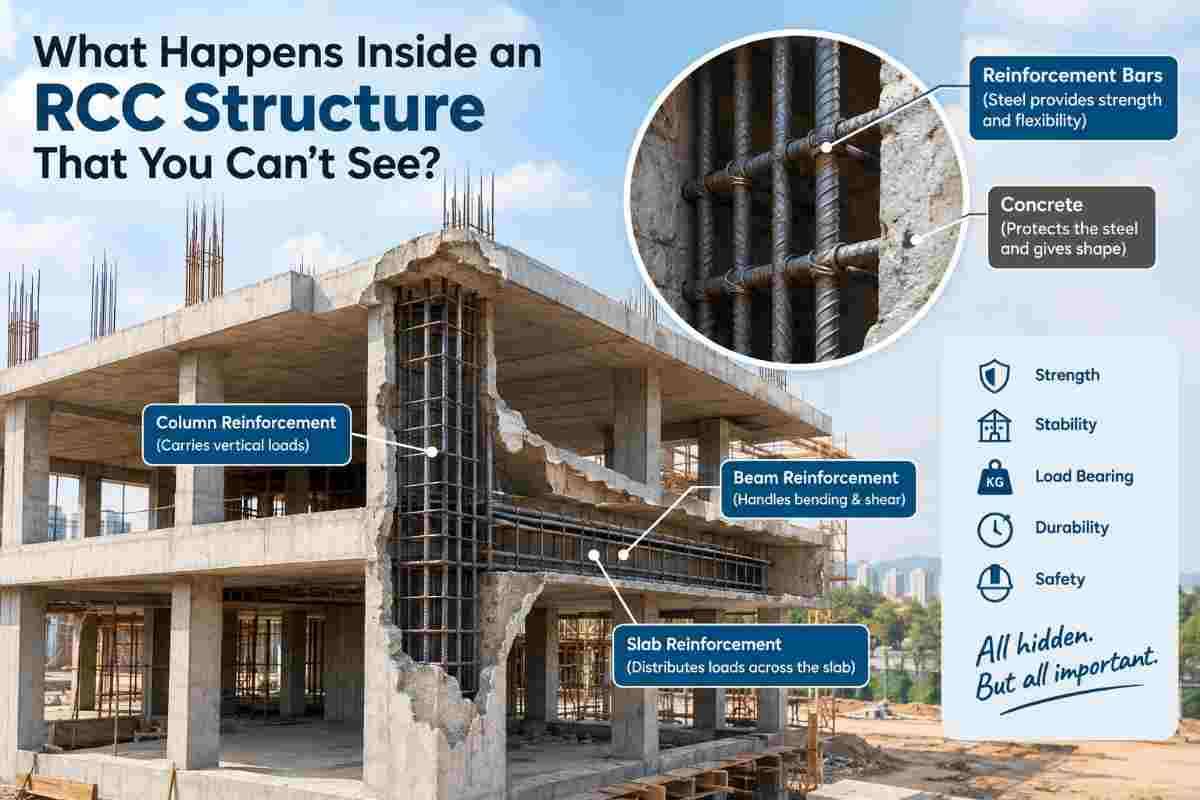
Walk into any building in India, whether an apartment block, a flyover, a hospital or a factory, and you are almost certainly surrounded by reinforced cement concrete (RCC). It looks solid, silent and unchanging. But that grey surface hides a surprisingly active world. Inside every beam, column and slab, chemical reactions continue for years. Steel bars fight a slow battle against moisture, tiny cracks open and close with the seasons, and pipes, conduits and cables sit exactly where someone placed them decades ago.
Most of this is invisible, and what you can't see is what causes the most expensive surprises: a drill bit striking a rebar, a slab cut through a stressed cable, or a "healthy" column that turns out to be honeycombed at the core. In this guide from Core Cutting India (https://corecuttingindia.com/), we open up an RCC structure, figuratively speaking, to show what really goes on inside, why it matters, and how professionals investigate it safely.
RCC Basics: Two Materials, One Partnership
To understand the hidden life of RCC, start with why it exists. Concrete is excellent in compression but weak in tension, with a tensile strength of roughly a tenth of its compressive strength. Steel is superb in tension. Place steel bars where tension develops, such as the bottom of a beam at mid-span or the top of a slab over its supports, and you get a composite material that carries both.
This partnership works because of three quiet conditions:
- Bond. Ribbed TMT bars grip the surrounding concrete so the two deform together.
- Compatible thermal movement. Steel and concrete expand and contract by nearly the same amount, around 10–12 millionths per degree Celsius, so temperature swings don't tear them apart.
- Chemical protection. Concrete's high alkalinity wraps the steel in a protective film that prevents rust.
Nearly everything hidden inside an RCC structure comes down to one question: are these three conditions still holding? When one fails, deterioration begins, usually silently.
Curing and Hydration: The Chemistry That Never Fully Stops
Concrete doesn't "dry" into strength. It cures. When cement meets water, a reaction called hydration produces calcium silicate hydrate, the gel that binds sand and aggregate into stone-like mass. This reaction releases heat, which in thick pours can cause thermal cracking before the structure has carried a single load.
Strength builds gradually. Concrete reaches roughly 65–70% of its design strength in 7 days and its characteristic strength at 28 days, and it keeps gaining slowly for months if moisture is available. That last condition is where many sites go wrong.
If curing is poor, the surface dries too early and hydration stops in the outer zone. The result is a porous skin, and that skin is the "cover" meant to protect the steel. Excess water in the mix causes a similar problem. When surplus water evaporates, it leaves a network of capillary pores that become highways for moisture, oxygen, chlorides and carbon dioxide. A high water-cement ratio in the first week can shape the structure's durability for the next fifty years.
The Steel Cage Inside: Rebar, Spacing and Cover
Behind the plaster is a cage of main bars, stirrups, ties and distribution steel, tied together and positioned before pouring. Its geometry decides how the member behaves under load, and several things can go wrong that no one will see once the formwork is removed.
Cover. IS 456 specifies minimum nominal cover ranging from 20 mm for mild exposure up to 75 mm for extreme exposure. On real sites, cover blocks get crushed, shifted or forgotten, and bars sag toward the formwork during pouring. Where cover is thin, the steel is only a few millimetres from the outside air. That's where trouble starts first.
Congestion. At beam-column junctions, bars can be packed so tightly that concrete struggles to flow between them, leaving voids around the steel.
Displacement. Bars pushed out of position by workers walking on top mats no longer sit where the structural designer intended, which reduces their effectiveness.
None of this shows on the finished surface. A wall can look perfect while its bars sit an inch off the drawing.
Carbonation: The Silent Threat to Steel
Fresh concrete has a pH of about 12.5 to 13.5. In that alkaline environment, steel develops a thin, stable oxide film that protects it. This is the "chemical protection" described earlier.
Over time, carbon dioxide from the air seeps into concrete's pores and reacts with calcium hydroxide to form calcium carbonate. This process, called carbonation, gradually lowers the pH of the concrete to around 9 or below. The carbonation front advances inward at a rate that depends on concrete quality, humidity and cover, typically a few millimetres per decade in good concrete and much faster in porous, poorly cured concrete.
Nothing visible happens while this front moves. The concrete stays hard and looks unchanged. But once the front reaches the steel, the protective film breaks down and the bar is exposed to corrosion. Engineers check carbonation depth by spraying phenolphthalein on a freshly broken concrete surface or core: alkaline concrete turns pink, and carbonated concrete stays colourless.
Corrosion: When Rust Breaks Concrete From Within
Once protection fails, steel meets oxygen and moisture and begins to rust. The critical fact is that rust occupies far more volume than the steel it came from, commonly cited as two to six times more. Because the rust is trapped inside hard concrete, it generates enormous internal pressure.
The consequences build in stages:
- Loss of bond. Rust weakens the grip between bar and concrete.
- Cracking along the bars. Expansion pushes outward until hairline cracks form, following the line of the reinforcement.
- Rust staining and delamination. Brown streaks appear, and the concrete cover starts separating in layers.
- Spalling. Chunks of concrete fall away, exposing bare, corroded steel.
- Section loss. The bar's cross-section shrinks, cutting load capacity.
Chloride ions make this worse. In coastal cities, industrial zones, or buildings made with salty sand or contaminated water, chlorides cause pitting corrosion. This is localised and deep, and it can thin a bar at specific points while the rest looks fine. Corrosion often runs for years before any visible sign appears, which is why a surface stain may be only the tip of a serious problem.
Voids, Honeycombing and Cold Joints
Not all hidden defects arise with age. Some are born during construction.
Honeycombing occurs when concrete fails to fill spaces between aggregates and around reinforcement, leaving a coarse, hollow-like texture. Common causes include inadequate vibration, congested steel, dropping concrete from great height, and stiff or segregated mixes.
Cold joints form when fresh concrete is placed against a layer that has already begun to set. If the delay between layers is too long, the two never fully bond, leaving a plane of weakness that can leak or slip.
Segregation and bleeding leave weak zones, with heavy aggregate settled at the bottom and watery paste at the top.
The problem with all of these is the plaster, which can conceal a honeycombed column so well that it passes visual inspection. The voids reduce load capacity, allow water to reach the steel, and turn small defects into progressive damage. Non-destructive tools like ultrasonic pulse velocity (UPV) testing, along with cores extracted by diamond drilling, are how engineers find these problems.
Cracks, Shrinkage and Creep: The Slow Movements
Even perfectly built concrete moves. As it loses moisture, it shrinks. If that shrinkage is restrained by neighbouring elements, tensile stress builds until the concrete cracks. Temperature cycles add to this, whether daily swings, hot summers or cooler winters. Monsoon wetting and drying cycles add still more.
Creep is another slow process. Under sustained load, concrete continues to deform gradually over years, so a slab's deflection can grow long after construction is finished.
Not every crack signals danger. Reinforced concrete is designed to crack in its tension zones, and widths around 0.3 mm are commonly considered acceptable under normal exposure. What matters is the pattern, width and behaviour of the crack:
- Structural cracks are wide, growing, and often diagonal or in flexural zones. They need urgent evaluation.
- Non-structural cracks are fine, stable, and typically from shrinkage or thermal movement. They still need sealing to keep water out.
Other slow-acting mechanisms include sulphate attack and alkali-silica reaction, in which reactive aggregates swell over time and create map-like cracking from within.
Embedded Services: The Things Nobody Remembers
Modern RCC is rarely just concrete and bars. Inside slabs and walls you'll often find:
- Electrical conduits and junction boxes
- Plumbing sleeves and drain pipes
- HVAC and fire-fighting pipework
- Cable ducts
- Post-tensioned (PT) tendons
PT tendons deserve special attention. These are high-strength steel strands, stretched and anchored under enormous tension, used widely in podium decks, parking floors, flat slabs and long-span structures. Cutting or drilling into one without warning can release a dangerous amount of stored energy and compromise the slab. Even non-PT slabs contain live conduits, gas lines or water lines that turn a routine hole into an emergency.
The complication is that as-built drawings are often missing, outdated or wrong. Renovations over the years add and remove services without updating records. Relying on memory or assumptions is one of the most common causes of accidents in concrete cutting and drilling.
How Professionals See the Unseen
The good news is that modern techniques can reveal much of what lies inside RCC without demolishing it.
Drawing review. Structural and services drawings provide a starting point, though they must always be verified on site.
GPR (Ground Penetrating Radar) scanning. Radar pulses reflect off rebar, conduits, PT cables and voids, producing a map of what sits at what depth. This is the standard "scan first" step before any cutting or drilling.
Rebar locators and cover meters. Electromagnetic devices measure bar position and cover thickness.
UPV and rebound hammer testing. These help assess uniformity and surface hardness of the concrete, though they give indicative rather than absolute answers.
Core cutting. A diamond-tipped core bit extracts a cylindrical sample straight out of the structure. That core can be tested for compressive strength, examined for voids and cold joints, checked for carbonation depth, and analysed for chloride content. It also shows you the actual position and condition of the steel. Diamond core cutting is also used for creating clean, accurate openings for pipes, ducts and anchors, with far less vibration and micro-cracking than a hand-held breaker.
The golden rule is simple: scan first, cut second. A responsible concrete cutting team, including the specialists at Core Cutting India, treats scanning and planning as part of the job rather than an optional extra. Precision cutting means nothing if the cut lands on a live conduit or a stressed cable.
Warning Signs That Something Is Happening Inside
You don't need instruments to notice that a structure is trying to tell you something. Watch for:
- Rust-coloured stains or streaks on beams, columns and ceilings
- Cracks running in straight lines along the position of bars
- Flaking, bulging or falling concrete cover
- Exposed, rusted reinforcement
- Persistent dampness, efflorescence (white salty deposits) or leakage
- A hollow sound when tapping the surface
- Sagging slabs or noticeable deflection in beams
- Doors and windows that suddenly jam
Any of these calls for inspection by a qualified structural engineer, followed by targeted testing rather than guesswork.
Protecting an RCC Structure From the Inside Out
Most hidden deterioration is preventable, or at least manageable, if you address it early:
- Build it right. Use a proper mix with controlled water content, adequate cover, effective vibration and at least 7 days of good curing.
- Waterproof and seal. Keep water out of terraces, bathrooms, basements and exposed faces.
- Repair early. Seal cracks, treat corroded bars and restore cover before damage spreads.
- Inspect periodically. Structural health checks every few years, and after any major event like an earthquake, fire or flood, catch problems while they are cheap to fix.
- Plan modifications carefully. Scan before cutting, coring or drilling, and record what you find for the next person.
Frequently Asked Questions
What is inside an RCC structure?
An RCC structure contains hardened concrete made of cement, sand, aggregate and water, reinforced with a cage of steel bars and stirrups. Depending on the building, it also holds embedded services such as conduits, pipes, sleeves and sometimes post-tensioned cables.
How long does an RCC structure last?
Well-designed, well-built RCC is often planned for a service life of 50 to 100 years. Actual durability depends on concrete quality, cover, exposure conditions, and maintenance. Poor curing or coastal exposure can shorten this significantly.
What causes RCC to deteriorate from the inside?
The main causes are carbonation, chloride-induced rebar corrosion, poor compaction leading to voids, thermal and shrinkage cracking, and chemical attacks such as sulphates or alkali-silica reaction. Water ingress accelerates nearly all of them.
How do you check the inside of concrete without breaking it?
Non-destructive methods include GPR scanning, rebar locators, UPV and rebound hammer testing. For definitive answers, engineers combine these with small diamond-drilled cores that reveal strength, cover, carbonation and internal defects.
Can you cut or drill RCC without hitting the rebar?
Yes, if the position of the reinforcement is mapped first. GPR and rebar scanning show where bars, conduits and tendons lie, so cores and cuts can be placed between them. In cases where a bar must be cut, an engineer should approve it beforehand.
Conclusion: Respect What You Can't See
An RCC structure is far from a lifeless block. Inside it, hydration continues, carbon dioxide creeps toward the steel, cracks flex with the seasons, and concealed pipes and cables wait for the next drill bit. Most failures aren't sudden; they are the end of a long, invisible process that could have been detected with the right inspection at the right time.
The lesson is simple: assume there's more inside than you can see, and confirm it before you act. Whether you're planning core cutting, wall or slab opening, structural testing or a renovation, working with experienced professionals who scan first and cut second protects both your structure and your people.
To learn more about precision concrete cutting and coring, visit Core Cutting India at https://corecuttingindia.com/.