
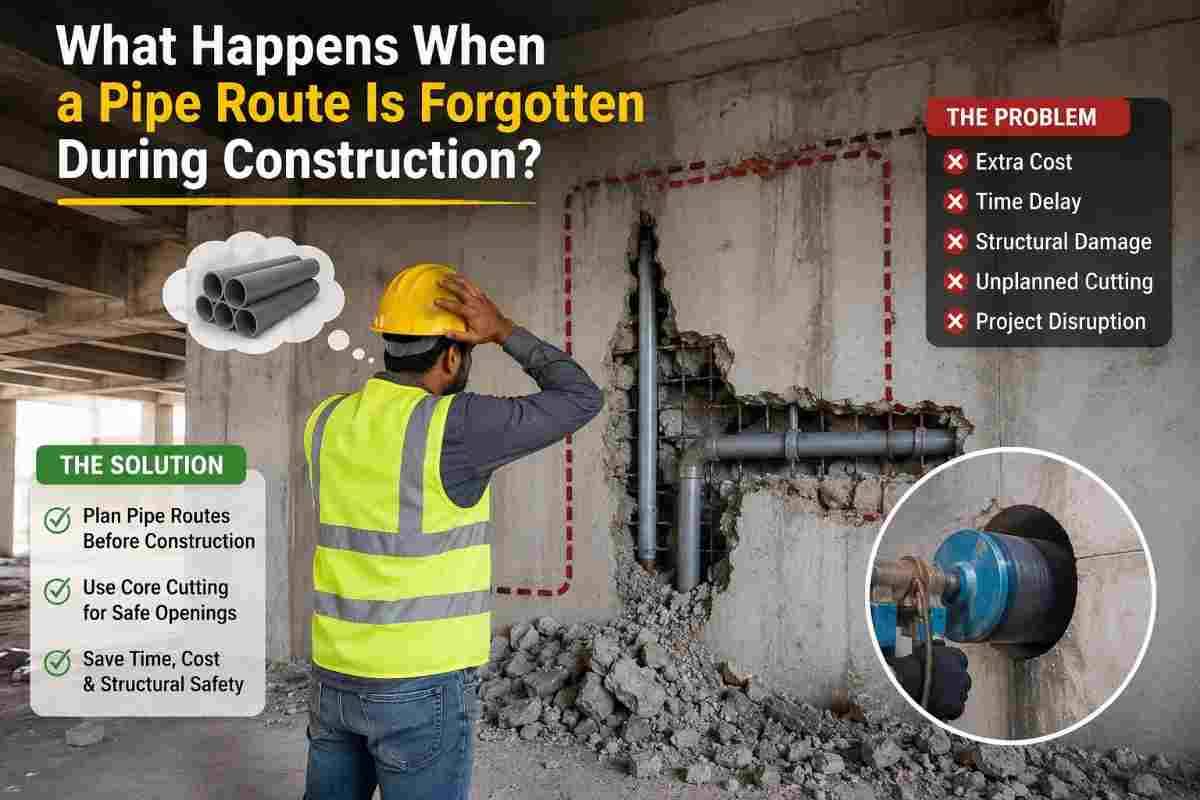
Construction projects run on precision. Every beam, slab, and wall is placed according to a plan that has been checked and rechecked by architects, structural engineers, and MEP (Mechanical, Electrical, Plumbing) consultants. Yet even with the best planning, one of the most common — and most frustrating — mistakes still happens on Indian construction sites: a pipe route gets forgotten.
It could be a drainage line missed during slab casting, a plumbing riser left out of a shear wall, or an HVAC duct route that was never marked before the concrete was poured. Whatever the cause, the result is the same: a structure that is now complete, but missing a critical passage for water, waste, gas, or air to travel through.
So what actually happens when this oversight is discovered — sometimes weeks or months after the concrete has cured? This blog walks through the real consequences of a forgotten pipe route, the risks of fixing it the wrong way, and how professional core cutting services like those offered by Core Cutting India solve the problem without compromising the building's structural integrity.
How Does a Pipe Route Get Forgotten in the First Place?
Before looking at the consequences, it helps to understand why this happens so often on live construction sites.
1. Poor coordination between civil and MEP teams In many projects, the civil contractor pours slabs and walls based on structural drawings, while the plumbing, electrical, and HVAC routes are finalized separately by MEP consultants. If these two teams don't cross-check their drawings before casting, sleeves and openings for pipes are easily missed.
2. Last-minute design changes A change in floor layout, bathroom position, or kitchen placement after the structural drawings are locked can leave the concrete work out of sync with the final plumbing requirement.
3. Site-level communication gaps Even when drawings are correct, site engineers and casting crews may miss marking sleeve positions on shuttering, especially on fast-track projects with tight pouring schedules.
4. Renovation and retrofit projects In older buildings undergoing renovation, original drawings are often incomplete or lost altogether, so new pipe routes are needed in structures that were never designed with sleeves in mind.
Regardless of the cause, once the concrete sets, the missing pipe route becomes a real, physical obstacle rather than a line on a drawing.
The Immediate Consequences on Site
When a forgotten pipe route is discovered — usually during the plumbing or HVAC fit-out stage — it triggers a chain reaction across the project.
1. Project Delays
Plumbing, drainage, and duct work are usually sequenced tightly with other finishing trades like flooring, false ceiling, and painting. A missing route stalls the entire finishing schedule until a fix is found, pushing back handover dates and increasing pressure on every downstream contractor.
2. Coordination Chaos
The discovery usually sparks urgent meetings between the civil contractor, MEP consultant, and site engineer to figure out an alternate routing solution. This eats into project management time that should be spent on other critical tasks.
3. Budget Overruns
Any unplanned structural intervention costs money — equipment mobilization, skilled labor, and potential rework of finished surfaces all add up. What should have been a ₹500 sleeve pipe embedded during casting can turn into a multi-thousand-rupee core cutting and repair job.
4. Client and Stakeholder Frustration
For commercial and residential clients alike, discovering that a basic plumbing or drainage route was missed erodes confidence in the contractor's execution quality, even if the rest of the build is excellent.
Why You Can't Just "Break Through" the Concrete
The instinctive reaction on many sites is to simply hammer or chisel through the slab or wall to create the missing opening. This is one of the most damaging decisions a contractor can make, for several reasons:
- Uncontrolled cracking: Manual breaking with hammers or chisels sends shock waves through the concrete, often causing cracks that extend well beyond the intended opening.
- Rebar damage: Reinforcement bars inside slabs and walls carry structural load. Careless breaking can sever or expose rebar, weakening the very element that holds the building up.
- Irregular openings: Hand-broken holes are rarely the correct shape or size for pipe fittings, forcing plumbers to use excess sealant or oversized collars that reduce long-term durability.
- Vibration damage to adjacent structures: In occupied buildings, hammering can crack plaster, tiles, and finishes in nearby rooms or even neighboring units.
- Safety hazards: Flying concrete debris and unstable partial breaks put workers at risk.
This is exactly why professional core cutting and core drilling has become the standard method for correcting forgotten pipe routes in Indian construction — residential, commercial, and industrial alike.
What Is Core Cutting, and Why Is It the Right Fix?
Core cutting (also called core drilling) uses diamond-tipped, water-cooled cutting equipment to bore precise, clean, circular or rectangular openings through concrete slabs, walls, and beams. Unlike manual breaking, it is a controlled, engineered process.
Key advantages of core cutting for forgotten pipe routes:
- Precision sizing: Openings are cut to the exact diameter needed for the pipe, duct, or conduit — whether it's a 2-inch plumbing line or a large HVAC duct penetration.
- Minimal vibration: Diamond core drilling generates far less vibration than hammering, protecting surrounding structural elements and finishes.
- Rebar-safe process: Experienced core cutting teams use rebar scanners (GPR - Ground Penetrating Radar or rebar detectors) before cutting to avoid damaging reinforcement, or to plan the cut position around it.
- Dust and mess control: Wet core cutting techniques minimize dust, which matters greatly in occupied or semi-finished buildings.
- Speed: A professional crew can complete openings in hours rather than the days it might take with manual demolition and patch repair.
- Works on any structural element: Slabs, load-bearing walls, beams, columns (with engineering approval), and even post-tensioned structures can be cored safely when handled by trained technicians.
The Step-by-Step Process of Fixing a Forgotten Pipe Route
When a project team calls in a specialist like Core Cutting India to resolve a missed pipe route, the process typically follows these steps:
1. Site Assessment and Drawing Review The team reviews structural drawings alongside the MEP layout to understand exactly where the pipe needs to pass and which structural elements are involved.
2. Rebar and Utility Scanning Before any cutting begins, the exact position is scanned to detect embedded reinforcement, electrical conduits, or existing utilities, avoiding accidental damage.
3. Structural Engineer Sign-Off For load-bearing walls, beams, or transfer slabs, a structural engineer typically reviews and approves the cutting location and size to confirm it won't compromise the building's load path.
4. Marking and Core Cutting The exact opening is marked, and diamond core drilling equipment is used to cut a clean, accurately sized hole through the concrete.
5. Debris and Slurry Removal Wet-cut slurry and core samples are cleared from the site, keeping the work area clean and safe.
6. Pipe Installation and Sealing The plumbing, drainage, or HVAC contractor installs the pipe or duct through the newly cut opening, followed by proper fire-rated or waterproof sealing around the penetration, as required.
7. Surface Finishing Any surrounding surface — plaster, tile, or waterproofing membrane — is reinstated to match the original finish.
This structured approach turns what feels like a construction disaster into a manageable, engineered correction.
Cost Implications: Prevention vs. Correction
It's worth being direct about cost, since this is often the client's biggest concern.
Embedding a pipe sleeve during original construction costs very little — usually just the price of a PVC or GI sleeve pipe and a few minutes of the casting crew's time. Once concrete has cured, correcting a forgotten route through core cutting involves specialized equipment, skilled technicians, structural review, and finishing work.
That said, professional core cutting remains far more economical than the alternative costs of:
- Structural repair from damage caused by manual breaking
- Extended project delays and penalty clauses
- Rework of finishes damaged during improper demolition
- Potential legal or safety liability from a compromised structural element
In short, core cutting isn't just the safer option — over the life of the project, it's usually the more cost-effective one too.
Preventing Forgotten Pipe Routes on Future Projects
While core cutting is an excellent solution after the fact, prevention is always better than correction. A few practices that reduce the chance of this happening again:
- Joint drawing reviews: Hold a formal coordination meeting between civil and MEP teams before every major casting stage, using overlaid drawings (BIM clash detection is ideal for larger projects).
- Sleeve checklists: Maintain a physical checklist at the site that is signed off before shuttering is closed, confirming all sleeves and openings are placed.
- Photographic documentation: Photograph shuttering and rebar layouts before pouring, so any missed sleeve is easy to identify and cross-check against drawings.
- BIM and clash detection software: For larger commercial and industrial projects, Building Information Modeling helps catch these conflicts digitally before they ever reach the site.
- Keep a core cutting partner on standby: Even the best-managed projects occasionally need a correction. Having a trusted core cutting contractor identified in advance means faster response if an issue does arise.
Why Choose Core Cutting India
At Core Cutting India, we specialize in precisely this kind of structural correction work — core cutting and core drilling for pipe routes, HVAC ducts, electrical conduits, and plumbing lines that were missed or changed after construction. Our teams work with rebar scanning equipment, diamond core drilling machinery, and close coordination with structural engineers to ensure every opening is cut safely, accurately, and with minimal disruption to your project timeline.
Whether it's a residential building, a commercial tower, an industrial facility, or a renovation project, a forgotten pipe route doesn't have to mean months of delay or costly structural rework. With the right core cutting partner, it becomes a quick, controlled fix that gets your project back on schedule.
Conclusion
A forgotten pipe route during construction is more common than most people realize — and it's rarely anyone's fault alone. What matters most is how it's handled once discovered. Manual breaking might seem like the fast option, but it risks structural damage, safety hazards, and even bigger delays. Professional core cutting offers a precise, engineered, and cost-effective way to correct the mistake without putting the building at risk.
If your project has hit this exact problem, reach out to Core Cutting India for a site assessment and a safe, fast correction.
Frequently Asked Questions (People Also Ask)
1. Can you add plumbing after construction is complete? Yes. Plumbing lines, drainage pipes, and HVAC ducts can be added after construction using core cutting techniques, which create precise openings in concrete walls and slabs without the structural risk of manual demolition.
2. How do you fix a missed pipe route in concrete? A missed pipe route is fixed by scanning the area for rebar and utilities, getting structural sign-off if needed, and then using diamond core drilling equipment to cut a clean, accurately sized opening at the required location.
3. What is core cutting in construction? Core cutting, or core drilling, is a construction technique that uses diamond-tipped, water-cooled tools to cut precise circular or rectangular openings through concrete for pipes, ducts, conduits, and other utility passages.
4. Is core drilling safe for structural walls and slabs? Yes, when performed by trained professionals who scan for reinforcement first and, where necessary, get approval from a structural engineer on the cutting location and size, core drilling is a safe and controlled way to create openings.
5. How much does core cutting cost in India? Core cutting costs in India vary based on the diameter of the opening, the thickness and type of concrete element, and site accessibility. It is generally far more cost-effective than the delays and structural repairs caused by improper manual breaking.