
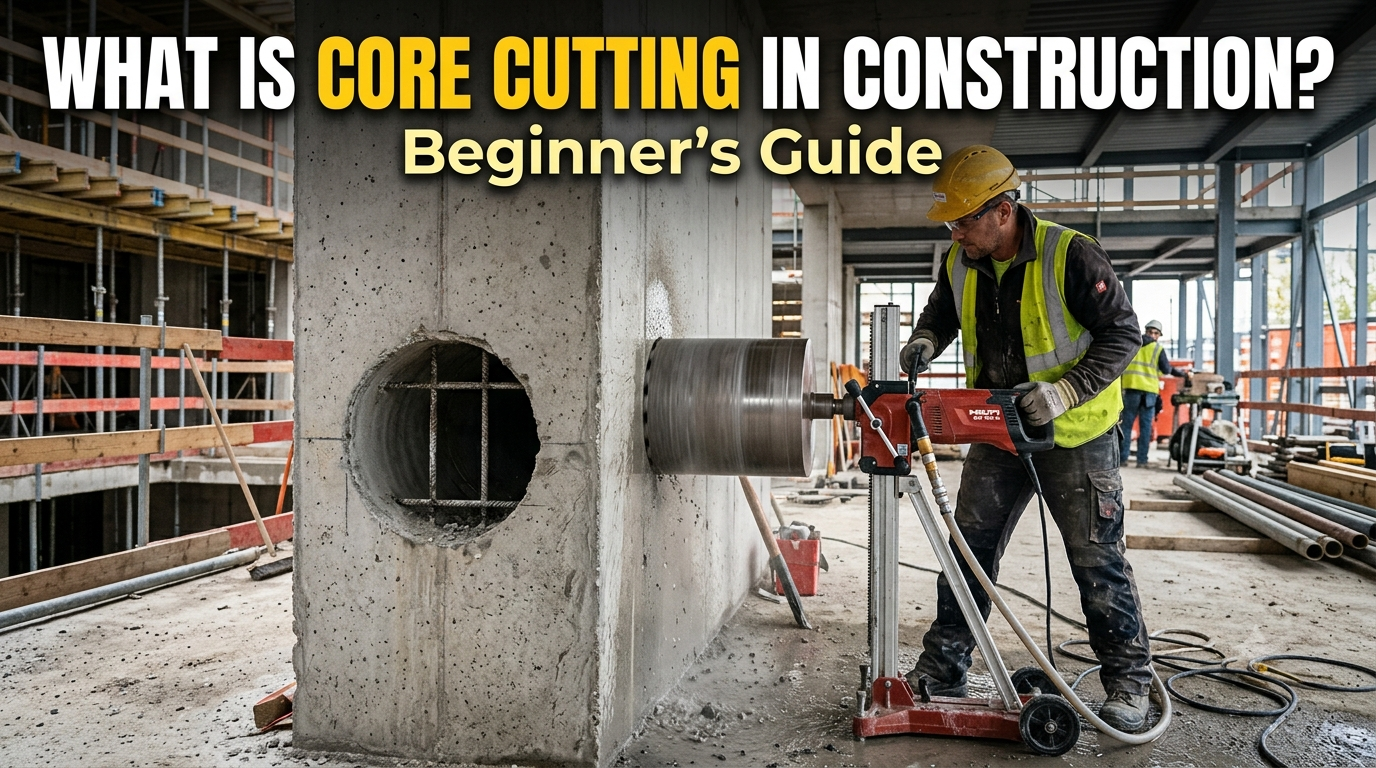
Introduction: Understanding Core Cutting in Modern Construction
In the Indian construction industry—where reinforced cement concrete (RCC) dominates high-rise apartments, metro transit hubs, commercial complexes, and industrial sites—modifying cured concrete without causing structural damage is a constant necessity. Whether installing plumbing lines, HVAC ducting, fire sprinkler systems, or electrical conduits, traditional hammering and jackhammering methods cause micro-fractures, excessive noise, and messy structural damage.
This is where core cutting (also known as diamond core drilling) comes into play. Core cutting is a non-destructive, high-precision technique used to drill clean, perfectly cylindrical holes through hard materials such as reinforced concrete, brick masonry, asphalt, and natural stone.
If you are a homeowner remodeling an apartment in Mumbai, a site engineer managing a commercial build in Bengaluru, or an MEP (Mechanical, Electrical, Plumbing) contractor in Delhi-NCR, understanding core cutting is essential for maintaining structural integrity while installing utility lines.
Target-Related Searches
-
core cutting near me
-
RCC core cutting cost per inch in India
-
diamond core cutting machine Hilti
-
concrete slab core cutting procedure
-
core cutting for AC piping and plumbing in residential buildings
What Is Core Cutting?
Core cutting is the specialized process of removing a cylindrical core or slug of concrete, masonry, or rock using a hollow, cylindrical drill bit tipped with industrial diamond segments.
Unlike standard impact drilling that relies on percussive force to shatter material, core drilling relies on rotational grinding powered by electric, hydraulic, or pneumatic motors. The industrial diamonds embedded in the cutting edge slice through heavy steel rebar and dense concrete aggregates with ease.
Key Characteristics of Core Cutting
-
Cylindrical Precision: Creates clean openings ranging from 1 inch (25 mm) to over 24 inches (600 mm) in diameter.
-
Vibration-Free: Prevents micro-cracks from spreading across the surrounding concrete slab or beam.
-
Rebar Cutting: Slices through high-yield strength deformed (HYSD) or TMT steel reinforcement bars embedded inside RCC without jamming.
-
Dust Control: Uses wet drilling (water lubrication) to flush out debris as slurry, preventing silica dust hazards.
How Does Core Cutting Work? The Technical Mechanism
The process uses specialized diamond core drilling machinery mounted on a rigid rig or base plate attached securely to the wall or slab.
Core Components of a Core Cutting Setup
-
Core Drill Motor: High-torque electric or hydraulic power unit providing controlled RPM.
-
Drill Stand / Rig: Heavy-duty frame anchored to the surface using expansion anchors or vacuum suction to eliminate wobble.
-
Diamond Core Bit: Hollow steel tube featuring matrix-bonded industrial diamonds at the crown.
-
Water Feed System: Pressurized water supply routed through the center of the bit to cool the diamond segment and flush slurry out of the cut zone.
-
Core Core / Plug: The solid cylinder of concrete removed after the cut completes.
Step-by-Step Core Cutting Process on Site
To ensure safety and structural compliance, professional contractors follow a standardized operating procedure:
-
Structural Scanning & Rebar Location:
-
Engineers use ground-penetrating radar (GPR) or cover meters to detect hidden rebar, post-tension cables, and embedded electrical conduits before drilling.
-
-
Marking & Diameter Selection:
-
The MEP engineer marks the precise center point and selects the bit diameter (typically 2", 3", 4", 6", or 8" depending on pipe dimensions).
-
-
Rig Anchoring:
-
The drill stand is firmly bolted to the wall or floor. Any movement during drilling can bind the bit or ruin the clean circumference.
-
-
Water Line Hookup:
-
Water cooling is engaged to handle friction heat and capture fine concrete slurry in a wet vacuum container.
-
-
Drilling Execution:
-
The operator lowers the rotating bit smoothly into the concrete slab or wall until it penetrates completely through the thickness.
-
-
Core Slug Extraction:
-
The drill is retracted, and the remaining concrete core slug is extracted cleanly.
-
Key Applications in Indian Construction Projects
Core cutting is widely used across residential, commercial, and infrastructure sectors throughout India:
1. Plumbing and Sanitation Lines
In multi-story residential towers (e.g., Slum Rehabilitation Authority or luxury high-rise projects in Mumbai and Pune), core cutting creates vertical penetrations through RCC floor slabs for soil waste pipes, drainage stacks, and water supply lines.
2. Air Conditioning and HVAC Ducts
Splitting AC copper lines and drainage pipes through external brick or RCC walls requires neat 2.5-inch to 4-inch core holes. For commercial VRV/VRF systems in office parks, multi-core cluster drilling is common.
3. Electrical and Fiber-Optic Cable Routing
Creating wall penetrations for main power trunking, internet fiber backbones, and server room cabling without creating ugly wall breaks.
4. Firefighting Sprinkler Systems
Large-diameter core cuts (4 inches to 8 inches) are drilled through floor beams and slabs to route steel fire-suppression pipes across shopping malls and IT parks.
5. Infrastructure & Concrete Sampling
-
Metro Rail Projects: Cable passageways in Delhi Metro, Namma Metro (Bengaluru), and Maha Metro.
-
Quality Testing: Quality control laboratories extract core samples from newly cast bridges or highways to perform compressive strength testing in labs under Indian Standard (IS 516) norms.
Advantages of Core Cutting over Traditional Hammering
| Feature | Core Cutting (Diamond Drilling) | Traditional Chiseling / Jackhammering |
| Structural Impact | Zero vibration; preserves surrounding concrete integrity | High vibration; causes micro-fractures and bond loss in rebar |
| Accuracy | Perfectly smooth, rounded edges matching exact pipe dimensions | Rough, jagged, unpredictable holes requiring costly plaster patch-ups |
| Rebar Handling | Effortlessly cuts through dense TMT steel bars | Stalls on steel; requires gas cutting torch or manual grinding |
| Noise & Dust | Low noise; wet operation traps 99% of concrete dust | Extreme noise pollution; creates hazardous airborne silica dust |
| Speed | Highly efficient; single core completed in 15–30 minutes | Labor-intensive; takes hours and leaves heavy cleanup |
Equipment Used in Core Cutting
Top-tier contractors rely on professional equipment from globally recognized brands like Hilti, Bosch, Milwaukee, and Husqvarna:
-
Handheld Core Drills: Used for small diameters (up to 3 inches) in soft brick or light concrete blocks.
-
Rig-Mounted Core Drills: Essential for heavy RCC slabs, beams, and sheer walls with diameters up to 24 inches.
-
Diamond Core Bits: Tipped with synthetic diamond dust bonded in a cobalt-metal matrix designed specifically for hard Indian granite aggregates.
Cost of Core Cutting in India (Price Breakdown)
The cost of core cutting in India depends on factors like concrete grade (M25, M30, M40), slab thickness, rebar density, and total hole quantity.
Estimated Price Range in India (INR)
| Hole Diameter | Typical Application | Estimated Cost per Hole (INR)* |
| 1 inch to 2 inch | RO water purifier outlets, electrical conduits | ₹300 – ₹500 |
| 3 inch to 4 inch | Split AC drain pipes, 3-inch PVC drain pipes | ₹500 – ₹900 |
| 5 inch to 6 inch | Kitchen chimney duct, 4-inch soil pipes | ₹900 – ₹1,500 |
| 8 inch to 12 inch | Heavy MEP pipes, commercial HVAC ducts | ₹1,800 – ₹3,500 |
*Note: Prices vary across tier-1 cities like Mumbai, Delhi, Bengaluru, Hyderabad, and Chennai. Minimum mobilization charges usually apply for small jobs.
For customized site estimates or project tenders, contact our technical team directly at [email protected].
Safety and Structural Precautions
While core cutting is safe for structures, operators must adhere to standard safety protocols:
-
Avoid Critical Structural Zones: Never cut through primary load-bearing column cores or main beam tension zones without structural engineer approval.
-
Personal Protective Equipment (PPE): Safety goggles, waterproof gloves, steel-toe boots, and ear protection are mandatory.
-
Water & Slurry Management: Concrete slurry is alkaline and slippery. Use slurry collection rings and industrial wet vacuums to keep floors dry.
-
Electrical Safety: Ensure all drill rigs are powered through Residual Current Circuit Breakers (RCCB/GFCI) to prevent electrical hazards from cooling water.
Core Cutting vs. Saw Cutting vs. Wire Sawing
To clear up common industry jargon, here is how core cutting compares to other concrete cutting techniques:
-
Core Cutting: Rotational hollow bit drilling for circular holes (1" to 24" diameter).
-
Wall Sawing / Floor Sawing: Flat circular diamond blade cutting for straight lines, window openings, or floor expansion joints.
-
Diamond Wire Sawing: A diamond-studded wire pulled around thick concrete masses (like bridge piers or heavy dam walls) where conventional blades cannot reach.
Summary Checklist for Site Engineers & Homeowners
Before hiring a core cutting contractor, keep this quick checklist handy:
-
Verify Pipe Sizes: Add 0.5 inches of clearance over the pipe outer diameter for smooth installation.
-
Locate Rebar & Cables: Use a scanner before anchor bolting or drilling.
-
Ensure Power & Water Lines: Core cutting rigs require steady 220V power and a continuous water supply.
-
Plan Slurry Containment: Protect finished tiled floors or lower flat ceilings from water drippage.
For professional diamond core drilling, concrete saw cutting, and anchor rebar rebarring services across India, drop your query to [email protected].