
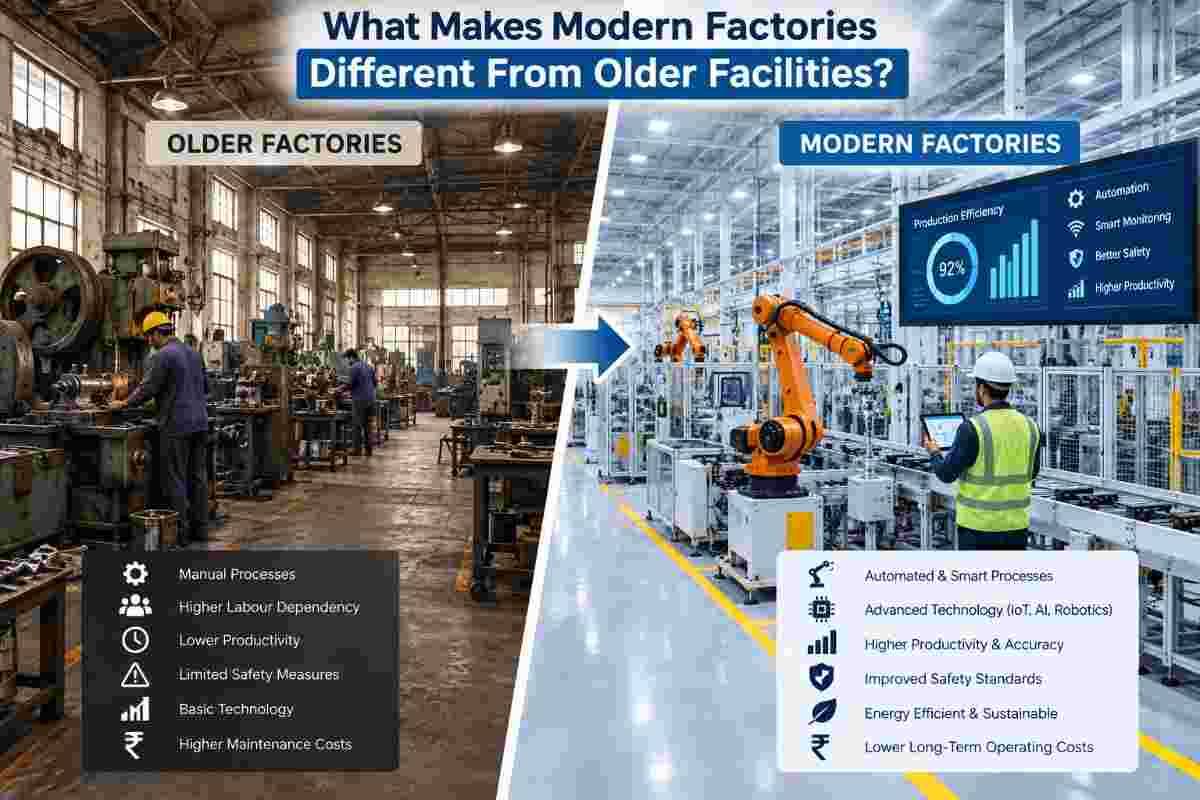
Walk onto a factory floor today and it barely resembles the industrial plants of even twenty years ago. Where older facilities relied heavily on manual labor, mechanical machinery, and disconnected processes, modern factories run on data, automation, and precision engineering. This shift hasn't happened overnight — it's the result of decades of technological evolution, changing safety standards, and a growing demand for speed, accuracy, and sustainability in production.
At Core Cutting India, we work at the intersection of this transformation every day, supplying advanced cutting technology to manufacturers who are upgrading their operations for the modern era. In this article, we'll break down exactly what separates today's factories from yesterday's facilities — and why that difference matters for businesses trying to stay competitive.
1. From Manual Labor to Intelligent Automation
Older factories were built around human hands. Workers operated machines individually, moved materials manually, and made real-time decisions based on experience and instinct. This system worked, but it was slow, inconsistent, and physically demanding.
Modern factories, by contrast, are built around automation. Robotic arms handle repetitive tasks with tireless precision. Conveyor systems move materials without human intervention. Programmable Logic Controllers (PLCs) and computer numerical control (CNC) systems execute production steps with a level of consistency no human hand could match, shift after shift, day after day.
This doesn't mean people have disappeared from the factory floor — far from it. Instead, their role has shifted from manual operators to skilled supervisors, programmers, and quality controllers who manage and optimize automated systems rather than performing repetitive physical tasks themselves.
2. Precision Engineering Has Replaced Guesswork
One of the most significant differences between old and new facilities is the level of precision achievable in production. Traditional cutting and shaping processes depended on manual measurement, hand-guided tools, and the skill of individual workers. Even highly experienced machinists couldn't fully eliminate small variances from piece to piece.
Modern manufacturing has changed that equation entirely. Technologies like CNC plasma cutting, laser cutting, and fiber cutting allow manufacturers to achieve tolerances measured in fractions of a millimeter. A design file is loaded into the system, and the machine executes it exactly the same way every single time — whether it's the first part of the day or the ten-thousandth.
This precision isn't just about aesthetics or convenience. It directly impacts material usage, production speed, and product reliability. When cuts are accurate the first time, there's less waste, less rework, and fewer defects moving down the production line. Companies like Core Cutting India specialize in supplying this kind of precision cutting technology, helping manufacturers make the leap from approximate results to exact, repeatable outcomes.
3. Data-Driven Decision Making
Old factories operated largely on intuition and historical experience. A plant manager might know that a machine "usually" needed maintenance around a certain time, but there was no real way to predict failures before they happened. Production planning was often based on rough estimates rather than real numbers.
Modern factories run on data. Sensors embedded throughout the production line continuously monitor temperature, vibration, speed, and output quality. This data feeds into software systems that can flag anomalies, predict equipment failures before they occur, and optimize production schedules in real time.
This is often referred to as the foundation of Industry 4.0 — the fourth industrial revolution, characterized by the integration of digital technology, the Internet of Things (IoT), and data analytics into manufacturing. Instead of reacting to problems after they happen, modern facilities anticipate and prevent them.
4. Energy Efficiency and Sustainability
Older industrial facilities were often energy-intensive by design, built at a time when energy costs were lower and environmental regulations were minimal. Machinery ran continuously regardless of actual demand, and heat, waste material, and emissions were rarely optimized.
Modern factories are designed with sustainability as a core consideration, not an afterthought. Energy-efficient motors, smart lighting systems, and automated shutoff protocols reduce unnecessary power consumption. Cutting technologies have also evolved to minimize material waste — for instance, advanced nesting software used with CNC cutting machines arranges parts on sheet material to maximize yield and reduce scrap.
This focus on efficiency isn't just good for the environment; it's good for the bottom line. Lower energy consumption and reduced material waste translate directly into lower operating costs, which is a major reason manufacturers continue to invest in upgrading their facilities.
5. Workplace Safety Has Transformed
Safety standards in older factories were, by modern measures, often inadequate. Heavy machinery operated with minimal guarding, protective equipment was basic, and injury rates in industrial settings were significantly higher than they are today.
Modern factories prioritize safety through both design and technology. Automated systems reduce the need for workers to be physically present near dangerous machinery during operation. Sensors can detect when a person enters a restricted zone and automatically pause equipment. Ventilation systems manage fumes and particulates generated during processes like plasma or laser cutting, protecting workers from long-term health risks.
Beyond the physical safeguards, there's also a cultural shift. Modern facilities embed safety training, regular audits, and compliance monitoring into daily operations, rather than treating safety as a secondary concern behind output targets.
6. Flexible, Small-Batch Production Capabilities
Older factories were generally optimized for mass production of identical items. Retooling a production line for a new product could take days or weeks, making it impractical to produce small batches or highly customized items cost-effectively.
Modern manufacturing technology has made flexibility a core strength. CNC-based cutting and fabrication systems can switch between different designs almost instantly — the machine simply loads a new digital file. This allows manufacturers to produce custom, one-off, or small-batch orders without the massive retooling costs and downtime that would have made such orders unprofitable in the past.
This shift has opened the door for industries ranging from architectural metalwork to specialized machinery components to order exactly what they need, when they need it, without committing to large minimum order quantities.
7. Integration Across the Entire Supply Chain
Perhaps one of the most underappreciated differences between old and new facilities is how connected they are to the broader supply chain. In older setups, a factory often operated as an isolated unit — orders came in, products went out, and there was limited real-time visibility into inventory, supplier status, or downstream logistics.
Modern factories are typically integrated with enterprise resource planning (ERP) systems, supplier databases, and even customer order platforms. This means raw material orders can be triggered automatically when stock runs low, production schedules can adjust based on real-time order data, and customers can often track the status of their order as it moves through production.
This level of integration reduces delays, improves accuracy in order fulfillment, and allows manufacturers to respond much faster to changes in demand.
8. Skilled Workforce, Redefined
It's a common misconception that automation simply eliminates jobs. In reality, modern factories require a different kind of skilled workforce — one trained in programming, robotics maintenance, quality assurance systems, and data analysis, rather than purely manual machine operation.
This shift has raised the bar for technical education and training within the manufacturing sector. Workers today are expected to understand how to operate and troubleshoot CNC systems, interpret sensor data, and work alongside automated equipment safely and efficiently. Facilities that invest in ongoing employee training tend to see better returns on their automation investments, since well-trained staff can identify inefficiencies and fine-tune systems that fully automated processes might miss.
9. Quality Control at Every Stage
In older facilities, quality control was often a final checkpoint — a batch of finished products would be inspected, and defective items would be pulled out at the end of the line. This meant defects were often only caught after significant time and material had already been invested.
Modern factories build quality control into every stage of production. Automated measurement systems check dimensions in real time during the cutting or fabrication process itself. If a deviation occurs, the system can flag it immediately, sometimes even before the part reaches the next stage of production. This dramatically reduces waste and rework, and it ensures that the final product meets exact specifications far more consistently than traditional end-of-line inspection ever could.
10. The Role of Advanced Cutting Technology in This Transformation
Cutting technology sits at the heart of much of this evolution. Traditional cutting methods — hand tools, basic mechanical shears, or early oxy-fuel torches — required significant manual skill and produced inconsistent results. Modern plasma, laser, and fiber cutting systems have redefined what's possible in metal fabrication, offering speed, precision, and repeatability that simply weren't achievable before.
This is where companies like Core Cutting India play a central role in helping manufacturers modernize. By providing advanced CNC cutting solutions, Core Cutting India enables businesses across industries — from structural steel fabrication to precision component manufacturing — to move away from outdated cutting methods and toward the kind of accuracy, efficiency, and flexibility that defines today's competitive manufacturing landscape.
Why This Shift Matters for Manufacturers Today
The differences between old and new factories aren't just technical trivia — they have real business implications. Manufacturers still relying on outdated processes face higher labor costs, more material waste, slower turnaround times, and greater difficulty competing on both price and quality against modernized facilities.
On the other hand, businesses that invest in modern equipment and processes position themselves to:
- Reduce production costs through improved efficiency and reduced waste
- Offer faster turnaround times to customers
- Maintain tighter quality control and fewer defects
- Improve workplace safety and reduce liability
- Adapt more easily to custom or small-batch orders
- Stay competitive as industry standards continue to rise
Final Thoughts
The gap between modern factories and older facilities continues to widen as automation, data integration, and precision cutting technologies advance. What was considered cutting-edge a decade ago is now often standard practice, and manufacturers who delay modernization risk falling behind competitors who have already made the shift.
Whether you're planning to upgrade an existing facility or building a new production line from the ground up, understanding these differences is the first step toward making informed investment decisions. For manufacturers looking to modernize their cutting operations specifically, Core Cutting India offers the technology and expertise to help bridge the gap between traditional methods and the precision-driven, efficient factories of today.