
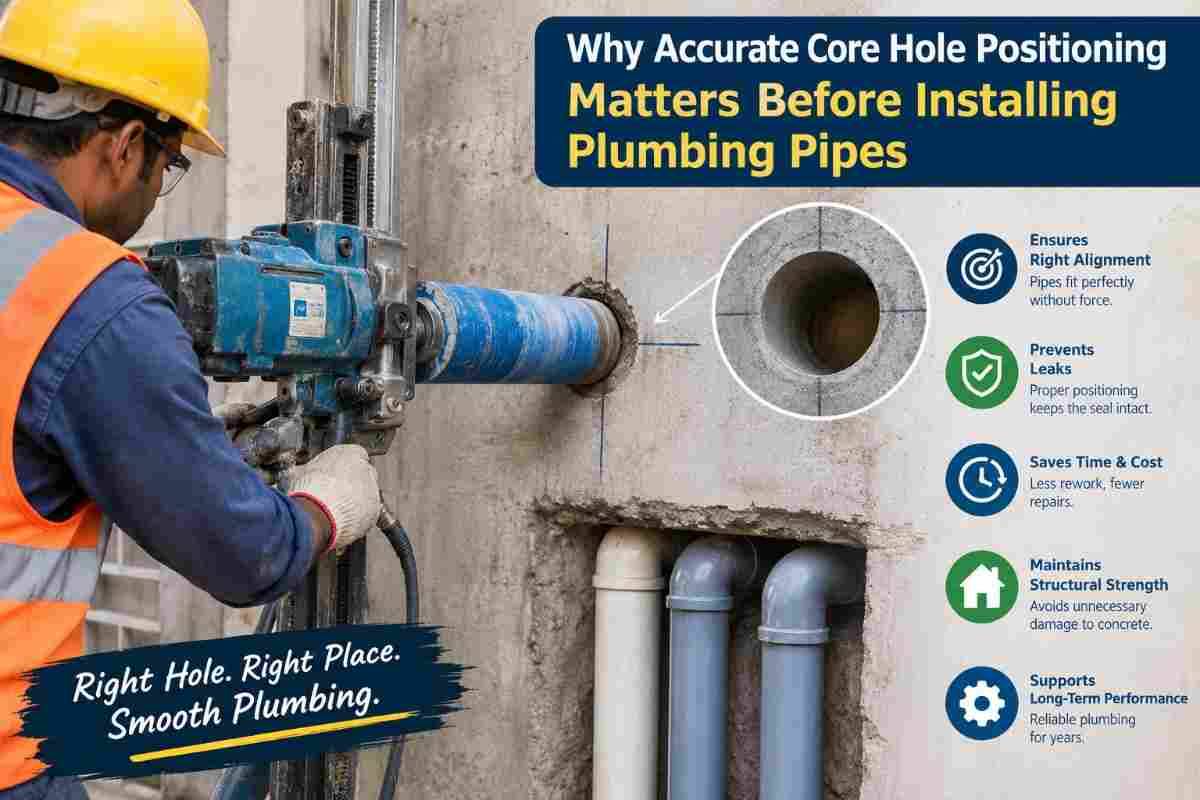
Every plumbing system starts with a decision that most building owners never see: where exactly the pipe will pass through the concrete. Before a single length of pipe is fixed, a hole has to be made through a slab, wall, beam-adjacent zone or foundation. That hole is created by core cutting, and its position decides how well the whole plumbing system will work for decades.
At Core Cutting India, we have seen projects where a core hole shifted by just a few centimetres led to weeks of rework, damaged reinforcement, leaking joints and unhappy clients. The lesson is simple. Accurate core hole positioning is not a minor detail. It is the foundation of a reliable plumbing installation.
This guide explains what core hole positioning means, why it matters, what goes wrong when it is ignored, and how professionals get it right.
What Is Core Hole Positioning?
Core hole positioning is the process of planning, marking and verifying the exact location, angle, diameter and depth of a hole before it is drilled in concrete, brick or masonry. In plumbing work, these holes carry drainage pipes, water supply lines, soil pipes, vent stacks and sleeves for future services.
Accurate positioning involves four things:
- Location: the precise horizontal and vertical coordinates on the slab or wall
- Alignment: the angle of the drill, which is usually perpendicular to the surface
- Diameter: the hole size matched to the pipe and any sleeve or insulation
- Clearance: the distance from beams, columns, rebar, edges, electrical conduits and other holes
Unlike a hole in wood or drywall, a core hole in reinforced concrete cannot be easily corrected. Once the concrete is cut, the decision is permanent, and repairing a wrong hole is expensive, slow and sometimes structurally risky.
Why Accurate Core Hole Positioning Matters
1. Proper Pipe Alignment and Slope
Drainage systems depend on gravity. Waste pipes must run at a consistent slope so water and solids flow freely. If a core hole is placed even slightly off the planned line, the pipe has to bend or shift to reach it. That creates low spots where waste collects, causing slow drainage, blockages, odour and repeated maintenance calls.
A well-positioned core hole lets the pipe pass straight through at the intended gradient. This reduces the number of fittings and elbows, which are the usual points of failure in any plumbing network.
2. Preventing Leaks and Water Damage
A pipe that is forced through a misaligned hole is under constant stress. Over time, this tension loosens joints, cracks fittings and opens small leaks. In multi-storey buildings, a leak in one floor slab can damage the ceiling, walls and belongings of the floor below, leading to disputes and costly repairs.
Accurate positioning ensures the pipe sits naturally in its sleeve. Waterproofing and sealing can then be applied evenly around it, which matters especially in bathrooms, kitchens, balconies and terraces where water exposure is high.
3. Protecting Structural Integrity
Reinforced concrete gets its strength from steel bars embedded in it. Cutting through rebar, post-tension cables or structural members without planning can weaken the element. A hole placed too close to a beam, column or slab edge can also create stress concentrations and cracks.
Correct positioning keeps holes away from critical load-bearing zones and avoids unnecessary cutting of reinforcement. For anything that might affect structural elements, the layout should be reviewed by a qualified structural engineer. A professional core cutting team works with those drawings rather than guessing.
4. Avoiding Hidden Services
Concrete often conceals electrical conduits, telecom ducts, gas lines and older water pipes. Drilling blindly through any of these can cause power outages, fire hazards, gas leaks or flooding. Scanning the area first and positioning the hole to avoid these services protects both the building and the people working on it.
5. Saving Time and Money
Mistakes in core drilling are costly to fix. A misplaced hole may need to be patched with grout or repair mortar, and a new hole drilled nearby. Both steps cost money, delay the pipe fitters, and may require the structural engineer to approve the repair. Projects with a tight schedule feel these delays quickly.
Spending a little extra time on measurement, marking and scanning at the start usually prevents far larger losses later.
6. Meeting Building Codes and Approvals
Municipal authorities and project consultants expect plumbing penetrations to follow approved drawings. Holes that deviate from the plan can fail inspection, require rework and delay completion certificates. Accurate positioning keeps the work compliant and documented.
What Goes Wrong When Core Holes Are Misplaced
It helps to see how small errors turn into big problems.
Misalignment between floors. In a multi-storey building, soil and waste stacks must line up vertically from one floor to the next. If one slab’s core hole is shifted, the stack needs an offset, which adds fittings and increases the chance of blockage and leakage.
Hole too close to rebar or beams. The drill either hits steel, which damages the diamond bit and slows work, or the team cuts the bar, which weakens the slab. Either outcome is avoidable with proper scanning.
Wrong diameter. A hole that is too small forces the pipe or sleeve to be reamed or recut. A hole that is too large leaves gaps that need extra grouting and can compromise fire-stopping and waterproofing.
Angled drilling. If the drill rig is not levelled and anchored properly, the hole tilts. The pipe then sits unevenly, and sealing it becomes difficult.
Overlapping or crowded holes. Placing core holes too close to each other weakens the concrete between them and can cause cracking or spalling.
Damaged finishes. In occupied buildings, a poorly planned hole can ruin tiles, false ceilings, furniture and flooring. Clean, accurate cutting with dust and water control avoids this.
Key Factors to Consider Before Marking a Core Hole
Study the Drawings First
Plumbing, architectural, structural and electrical drawings should be read together. The plumbing layout shows where pipes are meant to go, while the structural drawings reveal beams, columns and slab thickness. Clashes between them should be resolved before any drilling begins.
Scan for Rebar and Embedded Services
Modern core cutting relies on non-destructive scanning tools. Ground-penetrating radar (GPR) and rebar detectors help locate reinforcement, conduits and voids inside concrete. Scanning does not replace engineering judgement, but it gives the team a clear picture and prevents accidental strikes.
Match the Hole Size to the Pipe
The core diameter should account for the pipe’s outer diameter, any sleeve, insulation, and room for sealing materials. Standard practice leaves a small, even gap around the pipe for firestop or waterproof sealant. Choosing the right bit size from the start avoids enlargement later.
Maintain Safe Clearances
Keep a sensible distance from slab edges, beams, columns and other holes. The correct clearance depends on slab thickness, hole size, reinforcement and loading, so it should be confirmed by the structural engineer rather than assumed.
Consider Future Maintenance
Pipes will need inspection and repair at some point. Placing holes where there is reasonable access for tools and workers makes later maintenance far easier.
Plan for Slope and Pipe Routing
Work backwards from the discharge point. Calculate the fall required for each run so that the hole on each floor is placed correctly relative to the next fitting. A hole that looks fine on a plan can be wrong once slope is taken into account.
Step-by-Step Process for Accurate Core Hole Positioning
Professional teams follow a disciplined sequence that minimises mistakes.
Step 1: Site survey. Visit the site, check the slab or wall condition, confirm access and note any obstructions.
Step 2: Review drawings and approvals. Confirm hole locations, sizes and any structural clearances with the project engineer or consultant.
Step 3: Scan the concrete. Use rebar locators or GPR to map reinforcement and embedded services around the planned position.
Step 4: Mark the centre point. Use a measuring tape, laser level or plumb bob to mark the centre of the hole from fixed reference points such as gridlines or wall faces. Mark the circumference too, so the team can visualise the cut.
Step 5: Double-check from both sides. For slab penetrations, verify the position on the floor below as well, since the underside often reveals ducts, beams or services that are not visible from above.
Step 6: Set up the drilling rig. Anchor or vacuum-mount the rig firmly, level the stand and confirm the drill is perpendicular to the surface. A rigid, level setup prevents wandering and tilted holes.
Step 7: Start slowly and cool the bit. Begin with light pressure so the bit seats properly, and use water cooling to control heat and dust. Diamond core bits cut cleanly when set up correctly.
Step 8: Inspect the finished hole. Check diameter, straightness and edge quality before the plumbers move in. Any issue is far easier to address at this stage than after the pipe is installed.
Why Diamond Core Drilling Is the Right Method
Traditional breaking with hammers and chisels is noisy, dusty and imprecise. It cracks the surrounding concrete, damages finishes and makes accurate positioning almost impossible. Diamond core drilling avoids these problems.
- Precision: The bit cuts a clean, circular hole exactly where it is positioned.
- Minimal vibration: The surrounding structure is not shaken or cracked.
- Smooth walls: The finished hole is clean, which helps sleeves and sealants fit properly.
- Reduced dust and noise: Wet drilling keeps the workspace safer and cleaner.
- Flexibility: Core drills handle everything from small holes for supply lines to large openings for drainage stacks, in concrete, RCC, brick and stone.
This precision is exactly why accurate marking matters so much. Because the machine does precisely what it is told, a wrong mark leads to a wrong hole.
Common Mistakes to Avoid
- Skipping the scan. Assuming the concrete is clear because a drawing shows no steel is risky. Actual reinforcement can differ from the plan.
- Marking from memory. Always measure from fixed reference points, and never eyeball positions.
- Ignoring the floor below. A hole that looks perfect from above may land on a beam or a service line underneath.
- Using the wrong bit size. Matching pipe, sleeve and sealing allowance is part of planning, not an afterthought.
- Hiring inexperienced operators. Core cutting looks simple, but experience shows in alignment, rig setup and how the team handles unexpected obstructions.
- Not coordinating trades. Plumbers, electricians and structural teams should agree on locations before anyone drills.
- Poor sealing after installation. Even an accurate hole leaks if the gap around the pipe is not waterproofed and fire-stopped properly.
Benefits of Hiring Professional Core Cutting Services
A trained core cutting team brings more than a drill. It brings process, equipment and accountability.
- Experience with different structures: residential, commercial, industrial and infrastructure projects each have their own challenges.
- Proper equipment: rigs, diamond bits in various sizes, scanners and dust control systems.
- Safety awareness: correct handling of power, water, vibration and working at height.
- Cleaner results: accurate holes mean faster, neater plumbing installation.
- Less rework: getting it right the first time protects your schedule and budget.
For anyone planning new construction, renovation or retrofit work, choosing a specialist is one of the simplest ways to protect the project. You can explore professional services at Core Cutting India.
Practical Tips for Builders, Contractors and Homeowners
- Finalise plumbing layouts before slab casting where possible, and use sleeves or cast-in openings for major penetrations. Core cutting is then reserved for changes and retrofits.
- Mark holes clearly and get a second person to verify the layout.
- Share drawings with the core cutting team in advance.
- Ask about scanning before work begins.
- Photograph and record each hole position for future reference, especially in older buildings.
- Do not enlarge or relocate a hole on site without approval from the engineer.
- Coordinate timing so that waterproofing, plumbing and finishing teams can follow the core cutters without delay.
Frequently Asked Questions
What is core hole positioning in plumbing work?
It is the process of planning and marking the exact location, size and alignment of holes drilled through concrete or masonry so that plumbing pipes can pass through correctly.
Can you core drill near rebar?
Yes, but it should be done carefully. Scanning locates the reinforcement so the hole can be positioned to avoid cutting steel wherever possible. If a bar must be cut, a structural engineer should approve it first.
What happens if a core hole is drilled in the wrong place?
The pipe may need extra bends, leading to blockages and leaks. The structure may be weakened, and the hole may need to be repaired and redrilled, which adds cost and delay.
How do you choose the right core hole size for a pipe?
The hole should be slightly larger than the pipe’s outer diameter, allowing for any sleeve, insulation and sealing material. The exact size depends on the pipe type and the project specification.
Is core cutting safe for the building structure?
When planned and carried out correctly, core cutting is one of the safest ways to create openings in concrete. It causes minimal vibration and cracking compared with traditional breaking methods.
Why should the hole be checked from both sides of a slab?
The underside may contain beams, ducts or services that are not visible from above. Checking both sides prevents accidental damage and misalignment between floors.
Is core cutting better than breaking concrete manually?
Generally, yes. Core drilling is cleaner, more accurate and less damaging than chiselling or hammering, and it produces smooth, round holes ready for pipe installation.
Conclusion
Plumbing quality starts long before the first pipe is joined. It starts with the hole. A core hole in the right place, at the right size and angle, lets pipes run straight, drain properly and stay leak-free. A core hole in the wrong place causes problems that surface months or years later, often when repair is hardest and most expensive.
Accurate core hole positioning protects your structure, keeps hidden services safe, supports proper slope and drainage, keeps you compliant, and saves time and money. Careful drawing review, scanning, precise marking, secure rig setup and skilled operators make all the difference.
If you are planning a plumbing installation, renovation or new build, get your core holes right the first time. Contact the experts at Core Cutting India for precise, professional core cutting services built around accuracy, safety and clean results.