
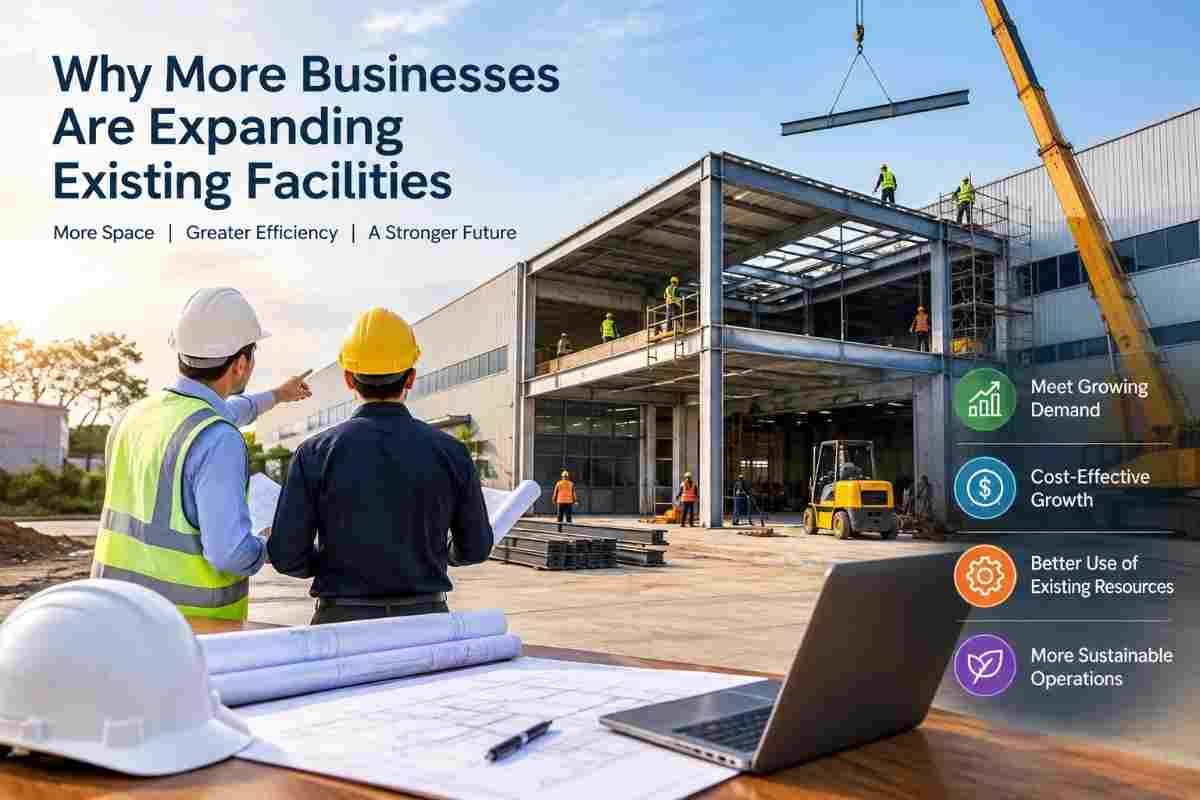
Across India's industrial and commercial landscape, a quiet but significant shift is underway. Rather than uprooting operations and building new premises from scratch, a growing number of businesses are choosing to expand the facilities they already own or occupy. From manufacturing plants in Pune to IT parks in Hyderabad and warehousing hubs around Delhi NCR, expansion — not relocation — has become the strategy of choice for companies looking to grow.
This trend isn't accidental. It reflects a combination of economic pragmatism, operational continuity, evolving construction technology, and a maturing real estate market that makes retrofitting and expanding existing structures more viable than ever before. In this article, we explore the key reasons behind this shift, what facility expansion actually involves, and why specialized structural services — like those offered by Core Cutting India — have become indispensable to this process.
1. Relocation Is Expensive — Expansion Is Often Cheaper
The most straightforward reason businesses favor expansion is cost. Relocating an entire operation involves far more than just moving furniture and equipment. It means acquiring new land, securing fresh approvals and licenses, rebuilding infrastructure from the ground up, and often absorbing months of reduced productivity during the transition.
Expansion, by contrast, allows a business to build on an asset it already owns. The land is already acquired, utility connections already exist, and much of the regulatory groundwork has already been done. Businesses only need to invest in the incremental cost of adding space or capacity — not an entirely new ecosystem. For companies operating on tight capital budgets, especially small and mid-sized enterprises, this cost differential can be the deciding factor.
2. Business Continuity Is Protected
Every relocation carries an inherent risk: operational disruption. Moving a factory floor, a warehouse, or an office means halting or slowing production, retraining staff on new layouts, and risking the loss of customers or supply chain relationships during the transition period.
Expanding an existing facility, on the other hand, can often be done in phases — allowing a business to continue operating while construction happens in a separate wing, an adjoining plot, or during off-peak hours. This phased approach minimizes downtime and protects revenue continuity, which is especially critical for manufacturing units running on tight production schedules or retail businesses that cannot afford to close their doors.
3. Established Locations Carry Strategic Value
A business rarely chooses its original location arbitrarily. Proximity to suppliers, transportation corridors, a trained local workforce, and an existing customer base are all reasons a facility was set up where it was in the first place. Relocating means giving up these accumulated advantages and starting over in an unfamiliar market.
Expansion allows a business to retain everything that made its original location valuable while simply scaling up capacity. This is particularly relevant in India, where industrial clusters — such as the pharmaceutical belt in Hyderabad, the auto component hub in Chennai, or the textile centers in Gujarat — offer ecosystem benefits that are nearly impossible to replicate elsewhere.
4. Real Estate and Land Costs Are Rising
Land prices in and around major Indian cities have climbed steadily over the past decade, particularly in industrial corridors and logistics parks near urban centers. Acquiring a new plot large enough to house an entire relocated operation has become significantly more expensive than it was even five years ago.
Given this trend, businesses are increasingly asking: why buy new land when the existing plot has unused vertical or horizontal capacity? Adding a floor, extending a building footprint, or converting underutilized space into productive area often costs a fraction of what a new land acquisition would require — while avoiding the long approval timelines associated with new construction on undeveloped land.
5. Modern Construction and Cutting Technology Makes Expansion Easier
One of the biggest enablers of this shift is technology. In the past, modifying an existing structure — adding new floors, cutting openings for plumbing and electrical routing, or reinforcing load-bearing walls — was a disruptive, imprecise, and risky process. Traditional demolition methods created excessive vibration, dust, and structural stress that could compromise the integrity of an existing building.
Today, precision techniques like diamond core cutting and controlled concrete cutting have transformed what's possible. Diamond-tipped core drills can create clean, accurate openings in reinforced concrete, brick, and stone without generating the vibration or cracking associated with older methods. This means businesses can now cut precise holes for HVAC ducts, plumbing lines, electrical conduits, and structural connections between old and new sections of a building — all while the rest of the facility remains structurally sound and operational.
This is where companies like Core Cutting India play a critical role. Specialized core cutting and concrete cutting services allow contractors to integrate new construction seamlessly with existing structures, whether that means connecting a new wing to an old building, creating service openings through slabs and walls, or preparing foundations for additional floors — all without compromising safety or structural integrity.
6. Regulatory and Environmental Approvals Are Simpler
Setting up an entirely new facility typically requires a fresh round of environmental clearances, zoning approvals, fire safety certifications, and municipal permissions — a process that can take months or even years depending on the location and industry.
Expanding an existing, already-approved facility usually involves a lighter regulatory burden. In many cases, businesses only need to secure amendments to existing approvals rather than starting the entire compliance process from scratch. This significantly shortens project timelines and reduces the administrative overhead associated with growth.
7. Sustainability and ESG Considerations
Environmental, Social, and Governance (ESG) priorities are increasingly shaping corporate decision-making, and facility strategy is no exception. Building a new structure from the ground up consumes significantly more raw material, energy, and carbon than retrofitting or expanding an existing one.
Reusing existing infrastructure — foundations, structural frames, utility connections — aligns with sustainability goals that many companies are now required to report on, whether for investor relations, regulatory compliance, or corporate responsibility commitments. Expansion, in this sense, is not just economically efficient but also environmentally responsible.
8. Post-Pandemic Shifts in Space Utilization
The years following the pandemic reshaped how businesses think about physical space. Companies re-evaluated everything from warehousing needs (driven by e-commerce growth) to manufacturing capacity (driven by supply chain diversification and the "China Plus One" strategy) to office layouts (driven by hybrid work models).
Rather than committing to entirely new real estate in an uncertain environment, many businesses chose the more flexible path: reconfiguring and expanding what they already had. This allowed for faster response to changing demand without the long lead times and capital commitment of a completely new facility.
9. Industrial and Warehousing Growth in India
India's manufacturing and logistics sectors have seen substantial growth in recent years, fueled by government initiatives like Production Linked Incentive (PLI) schemes and the broader push for domestic manufacturing. As demand for industrial and warehousing space rises, many businesses already operating in established industrial zones are choosing to add capacity on-site rather than compete for new land in increasingly crowded and expensive industrial parks.
This is particularly visible in sectors like automotive components, pharmaceuticals, FMCG, and electronics manufacturing, where existing facilities are being expanded with additional production lines, storage areas, and support infrastructure to meet growing order volumes.
What Does Facility Expansion Actually Involve?
Expanding an existing facility is a multi-disciplinary process that typically includes:
- Structural assessment — evaluating whether the existing foundation and structure can support additional load, floors, or extensions.
- Core cutting and concrete cutting — creating precise openings for utilities, structural connections, and service routing without damaging surrounding structures.
- Demolition of select sections — selectively removing walls, slabs, or partitions to accommodate new layouts.
- Utility integration — extending electrical, plumbing, HVAC, and fire safety systems into new areas.
- Regulatory compliance — securing amended building approvals, fire safety certifications, and occupancy permissions.
- Coordination between old and new construction — ensuring seamless integration between existing and newly built sections.
Each of these steps requires specialized expertise, particularly when it comes to safely modifying reinforced concrete structures. This is where professional core cutting and structural modification services become essential — not just for the technical execution, but for ensuring that expansion work doesn't compromise the safety or longevity of the existing building.
Why Precision Matters in Expansion Projects
When businesses expand existing facilities, precision is non-negotiable. Unlike ground-up construction, expansion work happens around and within an operational or partially operational structure. Mistakes — such as cutting into a load-bearing wall without proper assessment, or creating excessive vibration near sensitive equipment — can lead to costly delays, safety hazards, or structural damage.
Professional core cutting services address this challenge directly. Using diamond-tipped drilling equipment and water-cooled cutting systems, trained technicians can create clean, accurate openings with minimal dust, noise, and vibration — allowing expansion work to proceed safely even in facilities that remain partially operational. This level of precision is particularly critical in industrial settings, where nearby machinery, storage, or personnel cannot be exposed to unnecessary risk during construction.
The Road Ahead
As India's economy continues to grow and businesses across manufacturing, warehousing, retail, and commercial real estate scale their operations, facility expansion is likely to remain the preferred growth strategy for many companies. The combination of cost efficiency, operational continuity, regulatory simplicity, and advances in construction and cutting technology has made expanding existing infrastructure a smarter, faster, and more sustainable path to growth than starting over elsewhere.
For businesses planning an expansion — whether it's adding a new production line, extending a warehouse, or reconfiguring commercial space — working with experienced structural and core cutting professionals is essential to ensuring the project is executed safely, efficiently, and without compromising the integrity of the existing facility.
Core Cutting India specializes in precision core cutting, concrete cutting, and structural modification services designed to support exactly this kind of expansion work — helping businesses grow within the space they already have, safely and efficiently.