
Introduction
Reinforced Cement Concrete, or RCC, is the backbone of almost every modern building — homes, offices, factories, and high-rise towers all depend on it. It's strong, durable, and built to last for decades. But that strength comes from a hidden system working inside the concrete: a dense network of steel reinforcement bars, electrical conduits, plumbing lines, and sometimes post-tensioned cables, all buried where you can't see them.
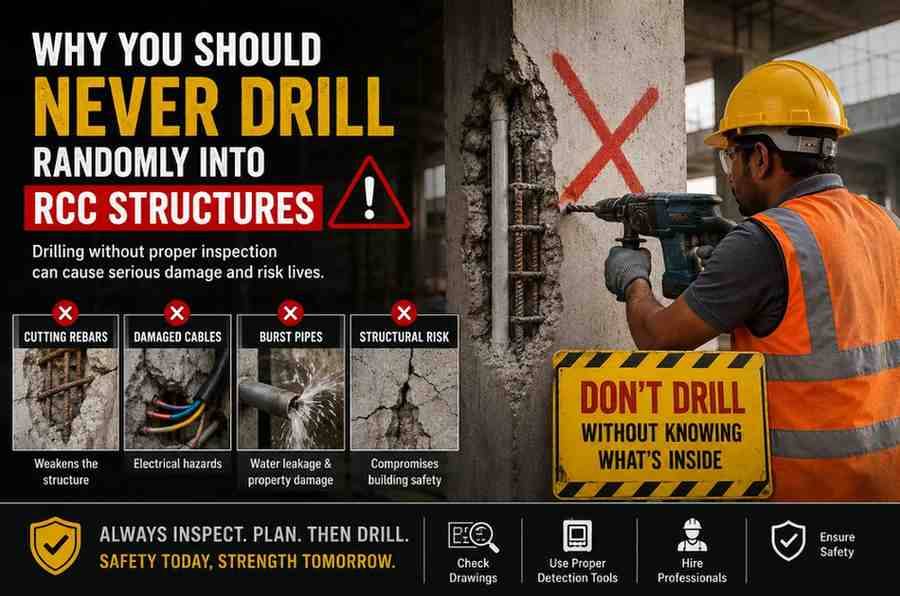
This is exactly why drilling randomly into RCC is one of the most common — and most costly — mistakes made on construction and renovation sites. A single uninformed drill hole can sever a live electrical cable, puncture a water pipe, cut through a load-bearing rebar, or trigger cracks that compromise the structural integrity of the entire building. What looks like a simple five-minute job can turn into a safety hazard, a repair bill running into lakhs of rupees, or in worst cases, a structural failure.
At Core Cutting India, we've seen firsthand what happens when drilling is done without proper planning. In this blog, we'll break down exactly why random drilling into RCC is so risky, what's really hiding inside your walls and slabs, and why professional core cutting is the safer, smarter alternative.
What Exactly Is RCC and Why Is It Different From Plain Concrete?
RCC is concrete that has been reinforced with steel bars (rebar) to give it tensile strength that plain concrete lacks on its own. Concrete is excellent at handling compression but weak under tension — steel reinforcement fills that gap, allowing RCC structures to support heavy loads, resist bending, and withstand seismic and wind forces.
This means every RCC column, beam, slab, and wall has a designed pattern of steel reinforcement running through it. Engineers calculate the exact placement, spacing, and diameter of these bars based on load requirements. When you drill randomly, you're essentially gambling with a carefully engineered system — one you cannot see and cannot predict just by looking at the surface.
In addition to rebar, modern RCC structures often conceal:
- Electrical wiring and conduits
- Water supply and drainage pipes
- HVAC ducting
- Post-tensioned (PT) cables under high stress
- Fire sprinkler lines
- Data and network cabling
None of these are visible from the outside, and their exact location can vary significantly from what you'd expect based on standard building layouts.
The Real Risks of Drilling Randomly Into RCC
1. Hitting and Damaging Structural Rebar
The most immediate risk of random drilling is striking a reinforcement bar. Rebar is placed to carry tensile loads at specific points in a slab, beam, or column. Cutting through even one or two bars — especially in a load-bearing member — can reduce the load-carrying capacity of that section.
In columns and beams, where reinforcement works together with concrete to resist bending and shear forces, damaging rebar can lead to localized weakening that may not show visible symptoms for months or years, until cracks, deflection, or in extreme cases, partial collapse occurs.
2. Severing Live Electrical Lines
Concealed conduits carrying live electrical wiring are extremely common in walls and slabs, especially in residential and commercial buildings. Drilling into one without warning can cause:
- Electric shock to the person drilling
- Short circuits and power outages
- Fire hazards from exposed live wires
- Expensive electrical repair and re-wiring work
Because these conduits often don't follow a predictable straight-line pattern, visual estimation is unreliable.
3. Puncturing Water and Drainage Pipes
Plumbing lines embedded in RCC slabs and walls are another major hazard. A drilled hole through a water pipe can lead to:
- Water leakage inside walls, causing dampness and mold
- Damage to flooring, false ceilings, and finishes in the affected area
- Hidden leaks that go unnoticed until visible water damage appears
- Costly repiping and re-plastering work
4. Cutting Post-Tensioned (PT) Cables
In many modern high-rises and commercial buildings, RCC slabs use post-tensioning — high-strength steel cables stressed and anchored within the concrete to improve load capacity and allow thinner slabs. These cables are under enormous tension.
Accidentally drilling into a PT cable is one of the most dangerous scenarios possible. Because the cable is under high stress, cutting it can cause a sudden, violent release of energy, sometimes referred to as a "cable snap," which can cause serious injury and significant structural distress in the slab.
5. Creating Micro-Cracks and Long-Term Structural Weakness
Even when a drill doesn't directly hit rebar or utilities, uncontrolled or excessive drilling can create micro-cracks in the surrounding concrete. Over time, these cracks allow moisture ingress, which accelerates corrosion of nearby reinforcement — a slow-developing problem known as reinforcement corrosion, which weakens concrete from within and reduces the service life of the structure.
6. Uneven or Oversized Holes Compromising Fittings
Random drilling with standard drill bits often produces rough, oversized, or irregular holes, especially in dense concrete. This can compromise the fit and load-bearing capacity of anchors, bolts, and fixtures installed afterward — a particular concern for heavy equipment mounts, railings, or structural connections.
Why "It Looks Fine From Outside" Is a Dangerous Assumption
One of the biggest misconceptions in construction and renovation work is assuming that if a wall or slab looks solid and uniform, it's safe to drill anywhere. In reality:
- Reinforcement patterns are rarely visible or predictable from the surface
- As-built construction frequently differs from original architectural drawings
- Electrical and plumbing routes are sometimes altered during construction without proper documentation
- Older buildings may have undocumented modifications from past renovations
This is why relying on guesswork, experience alone, or "we've always done it this way" thinking is simply not reliable when it comes to RCC structures.
The Professional Alternative: Scanning Before Cutting
Before any responsible core cutting or drilling work begins, professional teams use non-destructive scanning technology to map what's inside the concrete. This typically includes:
Rebar Detectors / Rebar Locators: These devices use electromagnetic induction to detect the position, depth, and sometimes diameter of steel reinforcement within concrete, allowing drilling positions to be adjusted to avoid critical bars.
Ground Penetrating Radar (GPR): GPR sends radar pulses into the concrete and analyzes the reflected signals to identify rebar, conduits, pipes, voids, and even post-tensioned cables at various depths. This is considered one of the most reliable methods for comprehensively scanning slabs and walls before cutting.
Structural Drawing Review: Wherever available, reviewing the original structural and MEP (mechanical, electrical, plumbing) drawings helps cross-verify scan results and plan cutting locations more accurately.
Once the scan results are analyzed, a qualified team can mark safe zones for drilling, adjust hole placement where needed, and proceed using controlled, precise equipment.
Why Core Cutting Is the Safer Choice Over Random Drilling
Core cutting is a specialized technique that uses diamond-tipped core bits mounted on precision-controlled machines to cut clean, accurately sized holes through concrete and RCC. Compared to random or improvised drilling, professional core cutting offers several advantages:
Precision and Accuracy: Core cutting machines are anchored and aligned before cutting begins, ensuring the hole is exactly where it needs to be, at the correct diameter and angle, minimizing the chance of drifting into unintended areas.
Reduced Vibration and Impact: Unlike hammer drilling, core cutting works through rotary abrasion rather than repeated impact, which significantly reduces the vibration transmitted into the surrounding structure. This lowers the risk of micro-cracking in adjacent concrete.
Clean, Dust-Controlled Cutting: Most professional core cutting is done using water-cooled diamond bits, which keeps dust levels low and extends the tool's cutting life, making it suitable for occupied buildings, hospitals, and finished interiors.
Ability to Cut Larger and Deeper Holes Safely: Core cutting equipment is designed to handle openings for HVAC ducts, plumbing risers, cable routing, and structural penetrations that would be difficult or unsafe to attempt with standard hand drills.
Combined With Scanning for Safety: When paired with rebar detection and GPR scanning beforehand, core cutting becomes a controlled, engineered process rather than a guess — protecting both the structure and the people working on it.
Common Situations Where Random Drilling Causes the Most Damage
- Retrofitting HVAC or plumbing lines in existing buildings without checking for embedded utilities
- Installing heavy wall-mounted equipment (machinery, signage, railings) without verifying rebar location
- Renovation work in older buildings where original drawings are missing or outdated
- Electrical and network cable routing through walls and slabs without conduit mapping
- Anchor bolt installation for structural connections without confirming reinforcement placement
In each of these cases, a scan-first, cut-with-precision approach dramatically reduces risk compared to drilling based on assumption.
What to Do Before Any Drilling or Cutting Work on RCC
- Never assume — treat every RCC wall, slab, beam, or column as if it contains hidden rebar and utilities, because in most cases, it does.
- Get the area scanned using rebar detectors and/or GPR before marking any drilling or cutting points.
- Cross-check with drawings where available, especially structural and MEP layouts.
- Use the right equipment — diamond core cutting tools designed for controlled, precise penetration rather than generic hammer drills for structural openings.
- Bring in trained professionals for any work involving structural members like columns, beams, and load-bearing walls, where the margin for error is smallest.
- Document and mark safe zones clearly before work begins, especially on larger sites with multiple contractors.
Conclusion
RCC structures are engineered systems, not just solid blocks of material. Every rebar, cable, and pipe hidden inside plays a role in either the safety of the building or the systems that keep it running. Drilling randomly into RCC — without scanning, planning, or the right equipment — puts all of that at risk for the sake of saving a small amount of time.
The smarter, safer approach is to scan first and cut with precision, using professional core cutting methods designed specifically for RCC structures. This protects the structural integrity of the building, avoids damage to hidden utilities, and keeps everyone on site safe.
If you have an upcoming project that involves cutting or drilling into RCC walls, slabs, beams, or columns, it's worth consulting a specialized team before any tool touches the concrete.
Core Cutting India specializes in safe, precise, and professional core cutting and drilling solutions for residential, commercial, and industrial RCC structures. Get in touch with our team at [email protected] to discuss your project and get expert guidance before you drill.
Frequently Asked Questions (People Also Ask)
Q1. What happens if you drill into a rebar in RCC? Drilling into rebar can weaken the load-carrying capacity of that section of the structure, especially in beams, columns, and slabs where reinforcement is doing critical structural work. It can also quickly damage or blunt standard drill bits, since rebar is hardened steel.
Q2. How do you know what's inside a concrete wall before drilling? Professionals use rebar detectors and Ground Penetrating Radar (GPR) to scan the concrete and identify the position of reinforcement bars, conduits, and pipes before any drilling or cutting begins.
Q3. Is core cutting better than normal drilling for concrete? Yes, for structural or precision work, core cutting offers cleaner, more accurate holes with lower vibration and less risk of surrounding damage compared to standard hammer drilling, especially when combined with pre-scanning.
Q4. Can drilling into RCC weaken the structure? Yes. Damaging reinforcement, creating micro-cracks, or cutting oversized and irregular holes can all reduce a structural member's strength and, over time, contribute to issues like corrosion and reduced durability.
Q5. What tools are used for safe core cutting in RCC? Safe core cutting typically involves diamond-tipped core bits, precision-mounted core drilling machines, rebar detectors, and sometimes GPR scanners to identify hazards before cutting.
Q6. How much does professional core cutting cost in India? Costs vary depending on the diameter and depth of the cut, the type of structural member, accessibility, and whether scanning services are required. For an accurate quote based on your specific project, reach out to Core Cutting India at [email protected].
Core Cutting India | Professional Core Cutting & Concrete Drilling Services | [email protected]