
Target-Related Searches
-
Robotic concrete cutting technology
-
Automated vs. manual concrete sawing
-
Future of concrete core cutting contractors
-
AI and robotics in demolition and cutting
-
Precision core cutting services India
People Also Ask (PAA) Questions
-
Are construction robots replacing human workers?
-
What are the benefits of robotic concrete cutting?
-
How does diamond core cutting work with automation?
-
Is manual concrete cutting becoming obsolete?
The construction industry stands on the precipice of a massive technological evolution. For decades, shaping concrete—the backbone of modern infrastructure—has relied heavily on brute human force, specialized handheld machinery, and seasoned craftsmanship. From drilling utility holes to slicing through reinforced cement concrete (RCC) slabs, manual labor has been the primary driver.
However, with rapid advancements in artificial intelligence, sensor precision, and heavy-duty machinery, a pressing question echoes across job sites worldwide: Will robots replace manual concrete cutting?
To answer this, we must examine the current state of concrete cutting, the rise of automation, the limitations of robots, and how industry leaders are adapting to this seismic shift.
The Evolution of Concrete Cutting: From Manual Grit to High-Tech Rigor
Traditionally, concrete cutting and core drilling have been demanding, high-risk tasks. Workers utilize heavy diamond-bladed wall saws, handheld rotary hammers, and core drills to carve openings for plumbing, electrical conduits, and HVAC systems. While effective, manual operations come with steep trade-offs:
-
Physical Toll: Operators face extreme hand-arm vibration syndrome (HAVS), heavy lifting, and chronic joint strain.
-
Health Hazards: Inhalation of silica dust poses severe long-term respiratory risks, even with wet-cutting methods.
-
Safety Risks: Working near collapsing structures, unstable walls, or deep structural voids exposes human crews to constant danger.
Enter construction automation. Today, engineering firms and specialized contractors are deploying semi-autonomous and fully autonomous robotic systems to handle dangerous, repetitive, and high-precision tasks. But does this mean manual laborers are headed for extinction, or is a collaborative future on the horizon?
How Robots Are Transforming Concrete Cutting
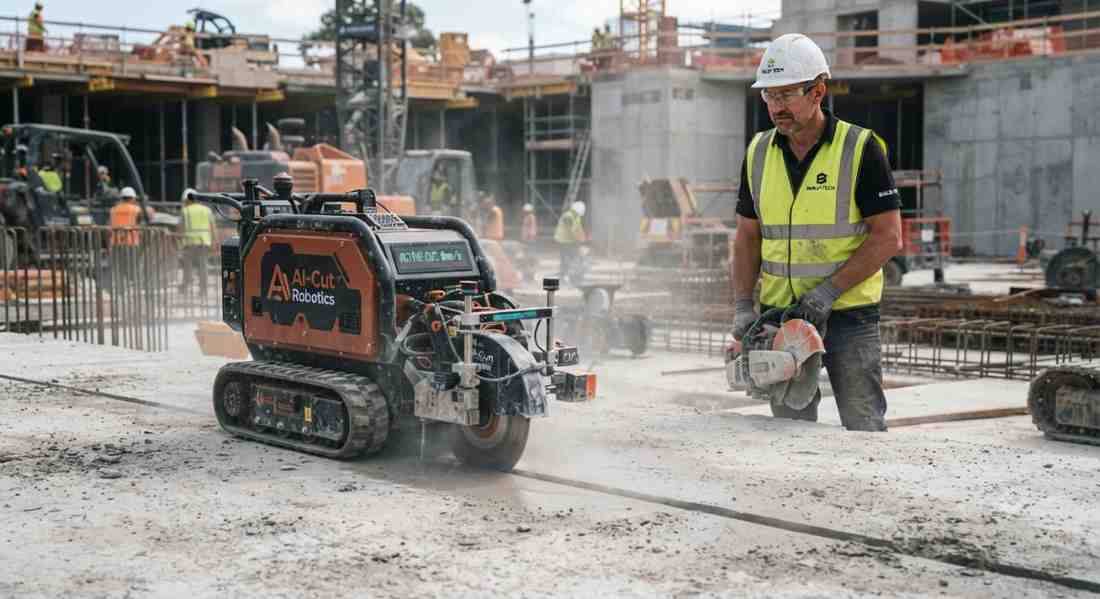
Robotic technology in concrete intervention is no longer a futuristic sci-fi concept; it is actively reshaping job sites. Modern robotic systems bring unprecedented capabilities to concrete modification:
1. Unmatched Precision and Depth Control
Robotic wall saws and track-mounted diamond cutting systems can execute complex geometric cuts based entirely on pre-programmed Computer-Aided Design (CAD) files. This eliminates human error, ensuring that core holes and structural expansions match architectural blueprints down to the millimeter.
2. Enhanced Operator Safety
Demolition and deep concrete cutting involve high risks of kickbacks, structural collapses, and flying debris. Remote-controlled robotic demolition units and autonomous cutters allow operators to manage heavy-duty tasks from a safe distance, drastically reducing on-site injuries and corporate liabilities.
3. Increased Productivity and Reduced Downtime
Unlike human workers, robotic systems do not suffer from fatigue. They can operate continuously under grueling conditions, significantly cutting down project timelines and keeping large-scale infrastructure projects on schedule.
Will Robots Completely Replace Human Workers?
Despite the rapid ascent of automation, a complete replacement of manual concrete cutting is unlikely in the near term. Several distinct factors anchor human expertise firmly into the construction ecosystem:
-
Job Site Unpredictability: Controlled factory floors are predictable, but construction sites are chaotic. Buildings settle, reinforcement bars (rebar) shift unexpectedly, and hidden utilities pop up where they shouldn't. Robots currently struggle with real-time, unstructured problem-solving that requires human intuition.
-
Cost and Capital Investment: Fully autonomous, high-end concrete cutting robots carry exorbitant acquisition and maintenance costs. For smaller contractors, manual equipment combined with skilled labor remains far more economically viable.
-
The Need for Supervision and Setup: Robots do not set themselves up. They require skilled technicians to transport, calibrate, program, and monitor them.
Rather than a total replacement, the industry is witnessing a transition toward human-robot collaboration (cobotics). Humans provide the strategic thinking, quality control, and adaptive troubleshooting, while robots execute the high-risk, high-fatigue labor.
The Indian Infrastructure Landscape and Specialized Services
In rapidly developing urban hubs, the demand for precision structural modifications is soaring. Whether it is commercial high-rises in metropolitan sectors or residential renovations, the need for clean, vibration-free core drilling is paramount.
Contractors specializing in structural alterations rely heavily on a blend of robust machinery and experienced technicians to maintain structural integrity. Companies looking for reliable, tech-enabled execution often partner with certified professionals who understand the nuances of reinforced concrete. For expert consultations, project inquiries, or specialized technical executions, stakeholders can reach out directly via [email protected] to navigate modern infrastructure requirements seamlessly.
Advantages and Challenges of Robotic Integration
| Aspect | Manual Concrete Cutting | Robotic Concrete Cutting |
| Precision | Dependent on steady hands; prone to minor deviations | Millimeter-accurate via digital mapping |
| Safety | High exposure to dust, vibration, and structural hazards | Operators work remotely, minimizing physical risk |
| Speed | Limited by human fatigue and mandatory rest breaks | High endurance; capable of continuous operation |
| Cost Flexibility | Lower upfront equipment costs; higher recurring labor costs | High initial investment; optimized long-term efficiency |
| Adaptability | Excellent for sudden, unmapped site alterations | Requires reprogramming or human intervention for changes |
The Road Ahead: What to Expect in the Coming Decade
As artificial intelligence and machine learning mature, the capabilities of concrete cutting robots will expand exponentially. We can expect to see:
-
AI-Driven Diagnostics: Robots that scan concrete using radar, automatically identifying rebar placement and voids before executing a cut.
-
Compact, Modular Units: Lighter, more affordable robotic attachments designed for small-scale residential and commercial contractors.
-
Green Construction Integration: Smart cutting systems optimized to reduce water usage, minimize slurry waste, and recycle diamond-cutting debris.
Conclusion
So, will robots replace manual concrete cutting? The short answer is no, but they will fundamentally transform it.
Manual cutting carried out by unskilled labor without safety gear is fading into obsolescence. In its place rises a sophisticated era where traditional craftsmanship meets robotic precision. The future belongs not to machines alone, but to skilled operators who know how to harness robotic technology safely and efficiently.
To stay ahead in a competitive construction market, embracing these hybrid methodologies is no longer optional—it is essential. For cutting-edge structural solutions and professional project execution, connect with industry experts at [email protected] today.