
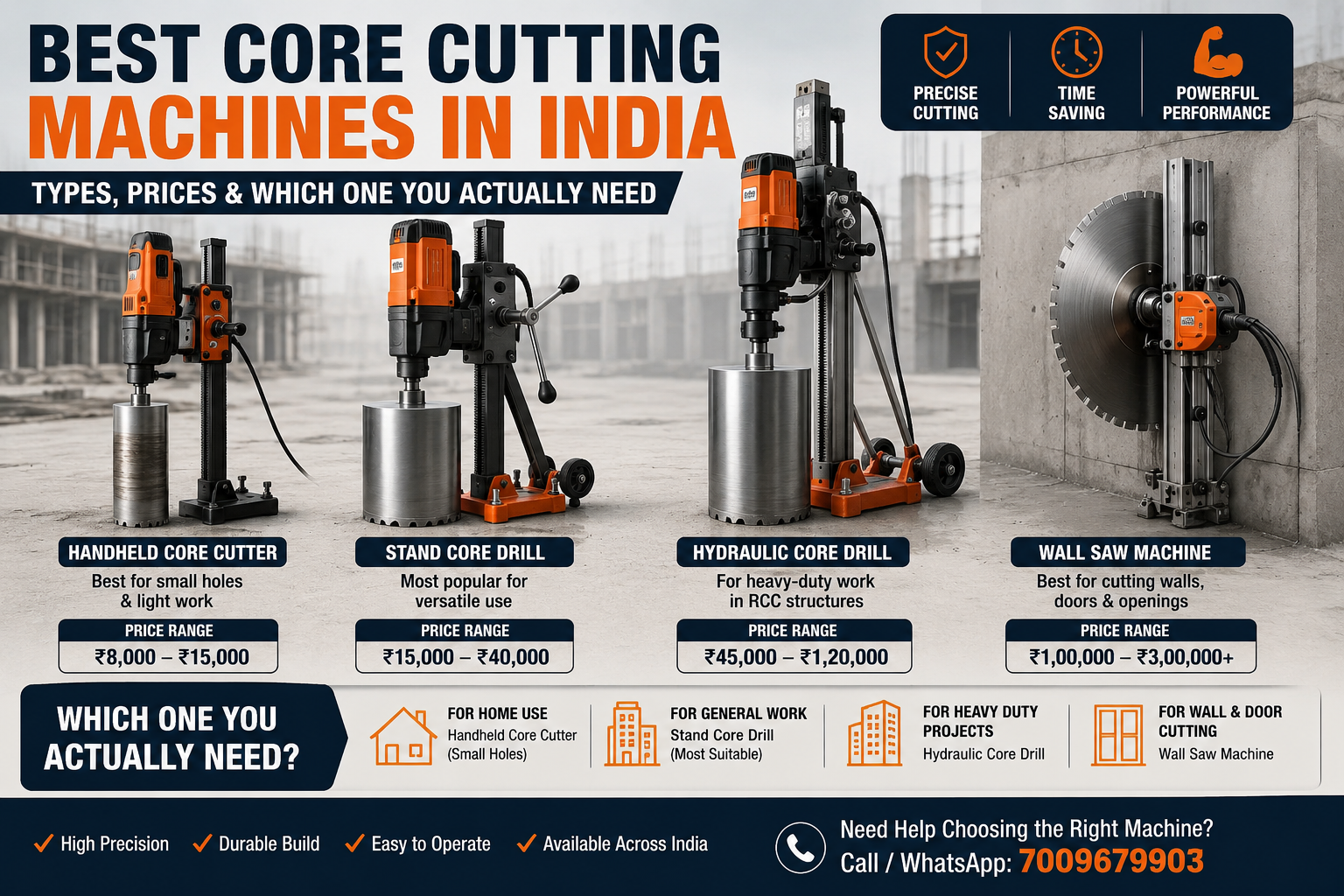
If you've ever tried to buy a core cutting machine in India, you already know the problem: search results throw everything at you — hand-held drills, hydraulic rigs, diamond cutters, even paper-core slitting machines — with prices ranging from a few thousand rupees to over ₹10 lakh. Most buyers don't need a comparison of every model on the market. They need a straight answer to one question: which machine actually fits my work?
This guide breaks down the real types of core cutting machines used across India, what they cost in 2026, and how to pick the right one whether you run a ready-mix concrete (RMC) testing lab, a construction site, a government project, or an industrial unit. For product-specific queries or a custom recommendation, you can also reach out to Core Cutting India at [email protected].
Target-related searches: core cutting machine price list India, best core cutting machine for concrete testing, core cutting machine manufacturers in India, concrete core drill machine price, diamond core cutter for RMC lab, hand-held core cutting machine, road core cutting machine hire India, core cutting machine near me, paper tube core cutting machine, core cutting machine specifications
What Is a Core Cutting Machine?
A core cutting machine (also called a core drilling machine or core cutter) is used to extract cylindrical samples — "cores" — from concrete, bituminous pavement, rock, beams, slabs, or road surfaces. These cores are then tested in a laboratory to check compressive strength, thickness, density, and overall quality of the construction work.
Core cutting machines are a mandatory part of quality control on almost every major Indian infrastructure project — from national highways built under NHAI contracts to metro rail viaducts, residential towers, and government buildings. Municipal corporations, PWD departments, IIT and NIT civil engineering labs, and private RMC plants all rely on them for routine testing.
There's also a completely different category that shares the name: paper and industrial core cutting machines, used in the packaging, textile, and tape manufacturing industries to cut paper or cardboard cores/tubes to size. If your requirement is industrial (not construction-related), skip to the relevant section below — the machine, price, and supplier ecosystem are entirely different.
Types of Core Cutting Machines Available in India
1. Manual / Hand-Held Core Cutting Machines
These are lightweight, drill-style machines operated by hand, often resembling a heavy-duty pistol-grip drill with a diamond core bit attached. They're commonly used by site engineers, small contractors, and testing labs for quick, low-diameter core extraction (typically 25mm to 100mm).
Best for: Small sites, spot-checks, testing labs that don't need to cut large slabs or thick pavements daily.
Typical use case in India: A civil contractor in Coimbatore checking slab strength on a residential project, or a lab technician in Salem pulling test cores from cured concrete cubes.
2. Motorized Concrete Core Drilling Machines
These are rig-mounted machines with an anchor base, leveling screws, a mast, and a motor (often called "Core Bore" type rigs). Water is fed through a hose to cool the bit while cutting, and the rig keeps the drill perfectly vertical — important for accurate testing.
Best for: Medium to heavy-duty work on beams, slabs, columns, and pavements where precision and repeat use matter.
Typical use case in India: RMC quality control teams in Ahmedabad and Pune routinely use these on live construction sites for third-party lab certification.
3. Diamond Core Cutting Machines
Fitted with diamond-tipped bits, these machines cut through the hardest concrete and rock with minimal wear on the tool. They're available as both hand-held and rig-mounted variants, and are the most widely recommended option for professional testing because diamond bits stay sharp far longer than standard TCT (tungsten carbide tipped) bits.
Best for: High-frequency use, harder aggregates, government and NABL-accredited lab work where consistent core quality is essential.
4. Hydraulic & Pneumatic Core Cutting Machines
Built for heavy industrial and road-cutting applications, these machines run on hydraulic pressure or compressed air rather than a standard electric motor. They're typically used where continuous, high-torque cutting is required — for example, cutting cores from thick highway pavements or old bridge decks.
Best for: Highway authorities, large infrastructure contractors, and agencies handling road quality audits across states like Maharashtra, Tamil Nadu, and Uttar Pradesh.
5. Paper & Industrial Core Cutting Machines
A separate product category entirely — these machines cut paper or cardboard cores/tubes (used for adhesive tape rolls, textile yarn, film, and packaging) to precise lengths. They range from semi-automatic pneumatic slicers to fully automatic, high-speed cutting lines, and are used by manufacturers in industrial clusters around Mumbai, Delhi NCR, and Gujarat's textile belt.
Core Cutting Machine Price in India (2026)
Prices vary sharply by type, build quality, brand, and whether you're buying from a regional dealer or a larger manufacturer. Based on current listings across major Indian B2B platforms, here's a realistic price range:
| Machine Type | Approximate Price Range (INR) |
|---|---|
| Basic hand-held core cutter/drill | ₹1,800 – ₹20,000 |
| Entry-level motorized core cutting machine | ₹15,000 – ₹75,000 |
| Diamond core drilling machine (rig-mounted) | ₹56,000 – ₹1,80,000 |
| Heavy-duty / high-capacity core drilling rig | ₹2,00,000 – ₹5,00,000+ |
| Industrial road/pavement core cutting rigs | ₹5,00,000 – ₹12,50,000+ |
| Paper/industrial core cutting machine (semi-automatic) | ₹40,000 – ₹1,50,000 |
| Fully automatic industrial core cutting line | ₹2,00,000 and above |
These figures reflect what's currently listed by suppliers such as those based out of Chennai, Kolkata, Salem, and Ahmedabad on platforms like IndiaMART, TradeIndia, and ExportersIndia — actual quotes will depend on motor power, bit size range, brand, and after-sales service included. Always get a written quotation with warranty terms before purchase, and confirm whether accessories (bits, water hose, anchor kit) are included in the base price.
Key Factors That Affect Core Cutting Machine Price
- Motor power and cutting capacity — Machines with higher HP motors and larger maximum cutting diameters (up to 400mm+) cost significantly more.
- Bit type — Diamond bits cost more upfront but last far longer than standard TCT bits, lowering cost-per-cut over time.
- Build material — Stainless steel and mild-steel frames with corrosion-resistant coating add to the price but improve durability on wet sites.
- Automation level — Manual machines are cheapest; fully automatic feed systems (mainly on the industrial/paper-core side) push prices up considerably.
- Brand and warranty — Established manufacturers typically charge more but offer better spare-parts availability and after-sales support, which matters if you're running the machine daily.
- Location and freight — Machines sourced from manufacturing hubs (Chennai, Kolkata, Rajkot, Delhi NCR) may cost less locally but attract freight charges for out-of-state delivery.
Which Core Cutting Machine Do You Actually Need?
This is the part most buying guides skip. Here's a practical way to decide:
- You're a small contractor or site supervisor doing occasional testing → A hand-held diamond core cutter is enough. Low cost, portable, and sufficient for standard 100mm cores.
- You run an RMC plant or a testing lab with daily core extraction → Go for a motorized, rig-mounted diamond core drilling machine. The vertical accuracy and reduced technician fatigue pay off quickly.
- You work on highway, metro, or large infrastructure projects → A hydraulic or heavy-duty rig is necessary — these projects involve thicker pavements, tougher aggregates, and stricter NHAI/PWD testing protocols.
- You're a government department or municipal corporation auditing multiple sites → Consider a portable but rugged motorized unit that can be transported easily between locations, paired with a reliable water-cooling setup.
- You manufacture tape, textile cores, or packaging tubes → You need an industrial paper core cutting machine, not a concrete core cutter — these are entirely different product lines, so double-check with your supplier before ordering.
If you're unsure which category fits your exact use case, it's worth sending your requirement (site type, expected core diameter, frequency of use, and budget) directly to a supplier for a tailored recommendation — you can write in to [email protected] with these details.
Top Applications of Core Cutting Machines in India
- Compressive strength testing of concrete for building approvals
- Quality audits on NHAI and state highway projects
- Metro rail and bridge construction quality control
- RMC batching plant certification
- Academic and research testing at engineering colleges
- Pavement thickness verification for municipal road contracts
- Post-construction structural assessments and forensic investigations
How to Choose the Right Core Cutting Machine: A Buying Checklist
- Confirm the cutting diameter range you need — most Indian standards (like IS 516) specify minimum core diameters for valid strength testing.
- Check motor power against your typical material — harder aggregate or thicker pavement needs a stronger motor.
- Ask about bit compatibility — can it take both TCT and diamond bits, or is it locked to one bit type?
- Verify water-cooling arrangement — dry cutting overheats bits quickly and shortens their life.
- Look for a stable anchor/base system — a wobbly rig produces inaccurate, angled cores that labs may reject.
- Compare warranty and spare parts availability locally, not just the machine price.
- Request a demo or site trial where possible, especially for high-value purchases above ₹1 lakh.
Maintenance Tips to Extend Machine Life
- Flush the water-cooling system after every use to prevent slurry buildup inside the motor housing.
- Store diamond bits separately and check for segment wear before each big job.
- Re-tighten anchor bolts and mast alignment periodically — vibration loosens them over time.
- Service the motor as per the manufacturer's schedule, even if the machine "seems fine" — most failures on Indian sites come from skipped preventive maintenance, not manufacturing defects.
Frequently Asked Questions
What is a core cutting machine used for? It's used to extract cylindrical samples from concrete, rock, or pavement so they can be lab-tested for strength, density, and quality — a standard requirement on most construction and infrastructure projects in India.
How much does a core cutting machine cost in India? Prices range from around ₹1,800 for a basic manual core cutter to over ₹10 lakh for heavy-duty hydraulic road-cutting rigs, depending on capacity, brand, and automation level.
What is the difference between core cutting and core drilling? In practice, the two terms are used interchangeably in India — both refer to extracting a cylindrical sample using a rotating bit. "Drilling" is sometimes used specifically for the boring action, while "cutting" refers to the overall process including sample extraction.
Which core cutting machine is best for concrete strength testing? A diamond-tipped, rig-mounted motorized core drilling machine is generally the most reliable choice for labs and contractors doing regular compressive strength testing, since it produces consistent, vertically accurate cores.
Can core cutting machines be used on roads and pavements? Yes. Hydraulic and heavy-duty motorized core cutting machines are specifically designed for pavement and road-surface core extraction, commonly used by highway authorities and road contractors.
What core sample sizes can these machines cut? Depending on the machine, core diameters typically range from 25mm (small lab samples) up to 400mm or more for heavy-duty rigs used on thick pavements and structural elements.
Is a core cutter the same as a core cutting machine? Broadly yes — "core cutter" is often used for smaller, portable or manual units, while "core cutting machine" can refer to any size, from hand-held to fully rig-mounted industrial equipment.
How do I choose the right core cutting machine for my business? Match the machine to your typical job: portability and low cost for occasional site checks, a motorized diamond rig for daily lab or RMC use, and a hydraulic heavy-duty unit for highway or large infrastructure work. When in doubt, share your exact requirement with a supplier for a tailored recommendation.
Need help picking the right machine for your project or lab? Get in touch with Core Cutting India at [email protected] for pricing, specifications, and supplier recommendations tailored to your requirement.