
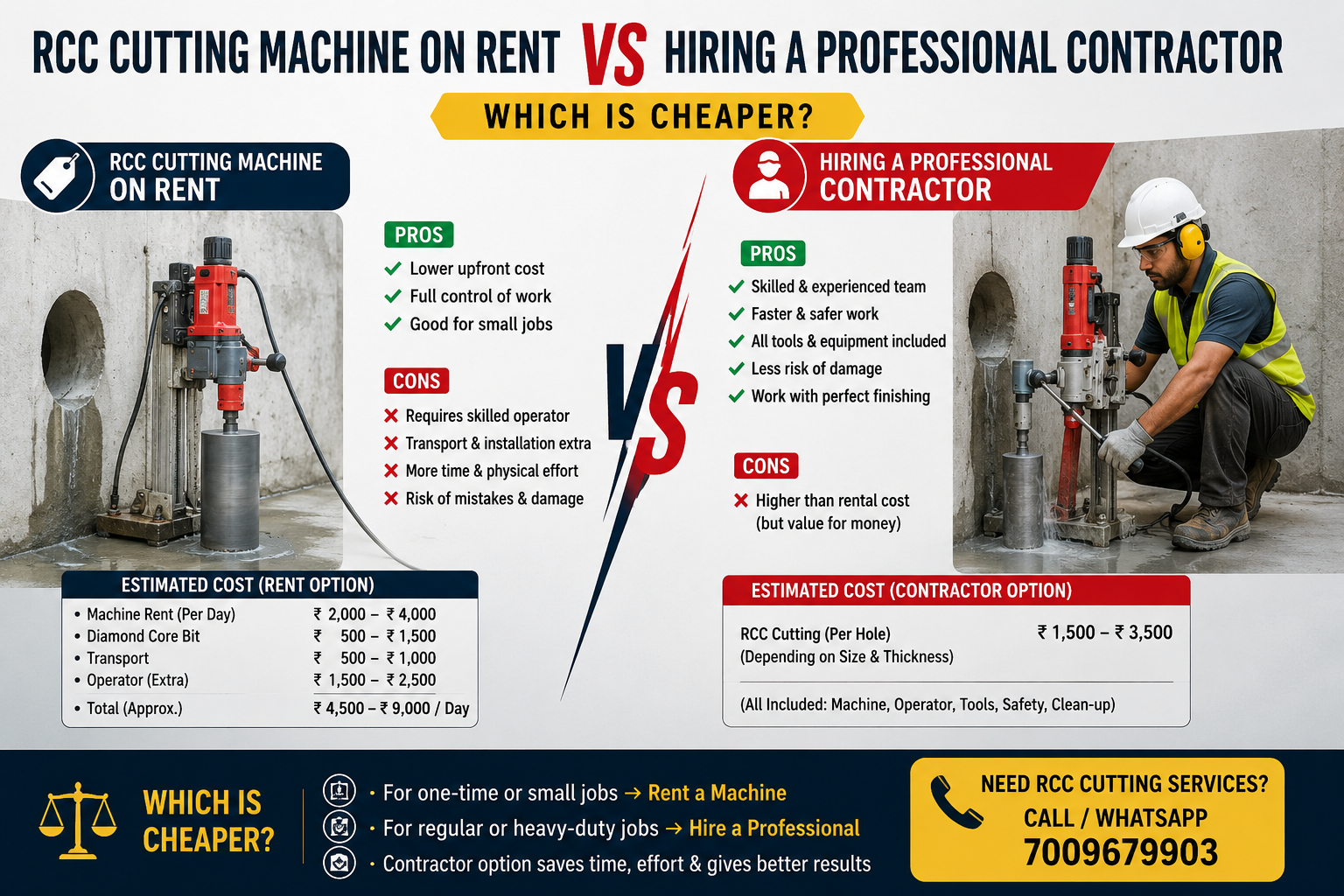
If you are planning a renovation, a balcony extension, a new door opening, or a demolition job anywhere in India, sooner or later you will run into the same question: should you put an RCC cutting machine on rent and do the job yourself, or should you hire a professional RCC cutting contractor to handle everything from start to finish?
At first glance, renting a machine looks like the obvious money-saver. You pay a daily rental fee, cut the concrete yourself, and return the equipment. No contractor markup, no labour charges, no "extra" costs. But anyone who has actually tried this on a real construction site in Mumbai, Pune, Delhi NCR, Bangalore, or Hyderabad will tell you that the real story is far more complicated — and often far more expensive than it looks on paper.
In this article, we break down the true cost of both options with real Indian pricing examples, explain the hidden expenses most people forget, and help you decide which route actually saves you money, time, and stress.
Target-related searches: RCC cutting machine rent price India, concrete cutting contractor cost per sq ft, wall cutting machine on rent Mumbai/Delhi/Bangalore, RCC cutting charges India, hire vs rent concrete cutting equipment, diamond blade wall saw rental rate, RCC column cutting cost, slab cutting machine rental price, concrete cutting labour charges India, core cutting services cost
Understanding RCC Cutting: Why It's Not a Simple DIY Job
RCC (Reinforced Cement Concrete) is not ordinary concrete. It contains steel reinforcement bars embedded inside a dense concrete matrix, specifically designed to be strong and difficult to break. Cutting through RCC — whether it's a wall, slab, beam, column, or floor — requires specialised diamond-tipped equipment such as wall saws, core cutting machines, floor saws, or wire saws, depending on the thickness and location of the cut.
This is very different from cutting a brick wall or a simple partition. RCC cutting involves:
- Diamond blades rated for reinforced concrete and steel
- Water-cooled cutting systems to prevent blade overheating and dust
- Structural knowledge to avoid cutting load-bearing elements
- Precision measurement to avoid damaging plumbing, electrical conduits, or adjacent structures
- Heavy machinery that can weigh 40–150 kg depending on the type
This complexity is exactly why the "rent vs hire" decision matters so much — get it wrong, and you could end up damaging your structure or injuring yourself.
Option 1: Renting an RCC Cutting Machine — What It Actually Costs
Across Indian cities, RCC cutting machine rental rates vary based on machine type, city, and rental duration. Here is a realistic breakdown based on common market rates:
| Machine Type | Approx. Daily Rent (India) | Approx. Weekly Rent |
|---|---|---|
| Handheld wall/floor cutter | ₹1,500 – ₹3,000 | ₹8,000 – ₹15,000 |
| Diamond core cutting machine | ₹1,200 – ₹2,500 | ₹6,000 – ₹12,000 |
| Wall saw (track-mounted) | ₹3,500 – ₹7,000 | ₹18,000 – ₹35,000 |
| Wire saw machine | ₹5,000 – ₹10,000 | ₹25,000 – ₹50,000 |
On top of the base rental, here is what most first-time renters don't budget for:
1. Diamond blade cost: A single diamond blade suited for RCC cutting costs anywhere from ₹3,000 to ₹15,000 depending on diameter and quality. Blades wear out fast when cutting through steel reinforcement, and a botched cut can destroy a blade in minutes.
2. Security deposit: Rental companies in cities like Delhi and Mumbai typically ask for a refundable deposit of ₹5,000 to ₹20,000 depending on the machine's value.
3. Transportation: Moving heavy equipment like a wall saw to your site can cost ₹1,000–₹3,000 each way, especially in dense urban areas like South Mumbai or Central Delhi where access is tricky.
4. Water supply setup: RCC cutting generates enormous dust and heat, so a continuous water supply is mandatory for wet cutting. If your site (say, a 3rd floor apartment in a Pune housing society) doesn't have easy water access, you may need additional pumps or tanks.
5. Safety gear: Dust masks, ear protection, safety goggles, gloves, and steel-toe boots — often overlooked, but essential and an added cost of ₹1,500–₹3,000.
6. Your own time: Whether you're a homeowner or a site supervisor, operating heavy cutting equipment isn't a quick task. A single beam cut that a trained operator finishes in 40 minutes could take an inexperienced person 3–4 hours — and that's before accounting for mistakes.
7. Risk of damage: This is the big one. RCC cutting without experience risks cutting through live electrical wiring, water pipes, or — worse — a load-bearing structural member. A miscalculated cut in a residential building in Bangalore, for example, could compromise structural integrity and lead to repair costs running into lakhs of rupees, not to mention safety hazards for the building's occupants.
Estimated "true cost" of a DIY rental job (for a mid-sized job like cutting a new door opening in an RCC wall): ₹8,000 to ₹20,000 once you add rental, blades, transport, safety gear, and your own time — assuming nothing goes wrong.
Option 2: Hiring a Professional RCC Cutting Contractor — What It Actually Costs
Professional RCC cutting contractors, such as Core Cutting India, typically charge based on the type of cutting work, the thickness of the RCC element, and the total area or length to be cut. Here are typical market rates seen across Indian metros:
| Service | Approx. Rate |
|---|---|
| Wall cutting (per sq. ft, up to 6 inch thick) | ₹80 – ₹180 per sq. ft |
| Slab/floor cutting (per sq. ft) | ₹120 – ₹250 per sq. ft |
| Core cutting (per hole, up to 6 inch dia.) | ₹500 – ₹1,500 per hole |
| Column/beam cutting | ₹2,000 – ₹6,000 per cut (depends on size) |
| Wire saw cutting (heavy structural work) | ₹300 – ₹600 per sq. ft |
For example, if a homeowner in Gurgaon wants to cut a new window opening (roughly 3 ft x 4 ft, or 12 sq. ft) in an 6-inch RCC wall, a professional contractor might charge somewhere between ₹1,500 and ₹3,000 for the complete job — including labour, machine, blades, water arrangement, dust control, and debris cleanup.
Compare that to the DIY rental route for the same job, which — after renting the machine, buying a blade, arranging water, and buying safety gear — could easily cross ₹6,000 to ₹10,000, especially if a blade is damaged or a second visit is needed.
What's Included When You Hire a Contractor (and Usually Missing in DIY)
- Trained, experienced operators who know how to read structural drawings and avoid load-bearing elements
- Their own equipment and blades — no separate rental or blade-buying cost to you
- Dust and water management systems to keep your site clean, especially important for occupied residential buildings or offices in cities like Mumbai where neighbours and housing societies are strict about mess and noise
- Insurance and liability cover — reputable contractors carry liability insurance, so if something does go wrong, you're not left covering repair costs out of pocket
- Speed — a job that might take a DIY renter an entire day (or more) is often completed by a professional crew in 2–4 hours
- Debris removal — most contractors include cleanup and disposal of cut concrete debris in their quote, saving you an entirely separate cost and hassle
- Warranty/guarantee on the cut — professional cuts are precise, meaning no unnecessary widening of gaps that require patch-up plaster work later
Real-World Cost Comparison: A Practical Example
Let's take a common Indian scenario: a 3 BHK flat owner in Pune wants to combine two rooms by cutting a 10 ft x 8 ft opening in a non-load-bearing 5-inch RCC wall.
DIY Rental Route:
- Machine rental (2 days, since first-timers work slower): ₹4,000
- Diamond blade (1–2 needed): ₹6,000
- Transport to and from rental shop: ₹1,500
- Security deposit (refundable, but ties up cash): ₹10,000
- Safety gear: ₹2,000
- Water arrangement: ₹500
- Debris removal (separate labour hired): ₹1,500
- Total out-of-pocket cost: ₹15,500, plus 2 full days of personal time and real risk of an uneven or unsafe cut
Professional Contractor Route:
- 80 sq. ft wall cutting @ ₹120/sq. ft (mid-range): ₹9,600
- Includes machine, blades, water, dust control, debris cleanup, and a trained crew
- Total cost: ₹9,600, completed in half a day, with a clean, structurally safe finish
In this example — which mirrors thousands of real renovation jobs across Indian cities — hiring a professional contractor works out roughly 35–40% cheaper than the DIY rental route, once every hidden cost is accounted for.
When Does Renting Actually Make Sense?
To be fair, there are situations where renting an RCC cutting machine genuinely is the cheaper and more practical choice:
- You already have trained manpower — for instance, a construction company with its own skilled labour that regularly handles concrete work, and just needs the equipment for a short duration
- Very small, low-risk jobs — like cutting a small non-structural core hole for a single pipe, where the risk of error is minimal
- Long-duration projects — if you need a machine continuously for weeks (say, a large commercial fit-out project), renting long-term and using your own crew can bring the per-day cost down significantly
- You have prior experience — some site engineers and experienced contractors themselves rent machines because they already have the skill and simply need equipment access
For everyone else — homeowners, small business owners, housing societies, and even builders working on tight timelines — hiring a professional contractor is almost always the safer and, once hidden costs are factored in, the cheaper option.
Safety: The Cost You Can't Put a Price On
Beyond the numbers, there's a factor that matters even more: safety. RCC cutting involves high-speed diamond blades, heavy machinery, dust inhalation risks, and the very real danger of hitting embedded electrical wiring or structural rebar. Every year, incidents linked to improper concrete cutting — from minor injuries to serious structural damage in buildings — are reported across Indian cities, often traced back to inexperienced operators using rented equipment without proper training.
A professional RCC cutting contractor doesn't just bring a machine — they bring years of hands-on experience reading structural layouts, identifying load-bearing elements, and executing precise, safe cuts. That expertise is difficult to put a rupee value on, but it's often the single biggest reason experienced builders and architects across India recommend hiring professionals over DIY rental for anything beyond the smallest, simplest jobs.
Final Verdict: Which Is Actually Cheaper?
On paper, renting an RCC cutting machine looks like the budget option. But once you factor in blade costs, transport, security deposits, safety gear, your own time, and — most importantly — the risk of structural damage or an unsafe cut, the "cheap" DIY route often ends up costing more than hiring a professional contractor, while delivering a lower-quality, riskier result.
For most homeowners, businesses, and even small contractors in India, hiring an experienced RCC cutting service is the smarter financial decision — not just the safer one. You pay for precision, speed, insurance, and peace of mind, and in most real-world cases across Mumbai, Delhi, Pune, Bangalore, and beyond, that ends up being the more economical choice too.
If you're planning an RCC cutting, core cutting, or concrete demolition project anywhere in India, Core Cutting India offers professional, insured, and experienced RCC cutting services — from wall openings and slab cutting to core drilling and structural demolition — with transparent, upfront pricing.
Get in touch with Core Cutting India today: [email protected]