
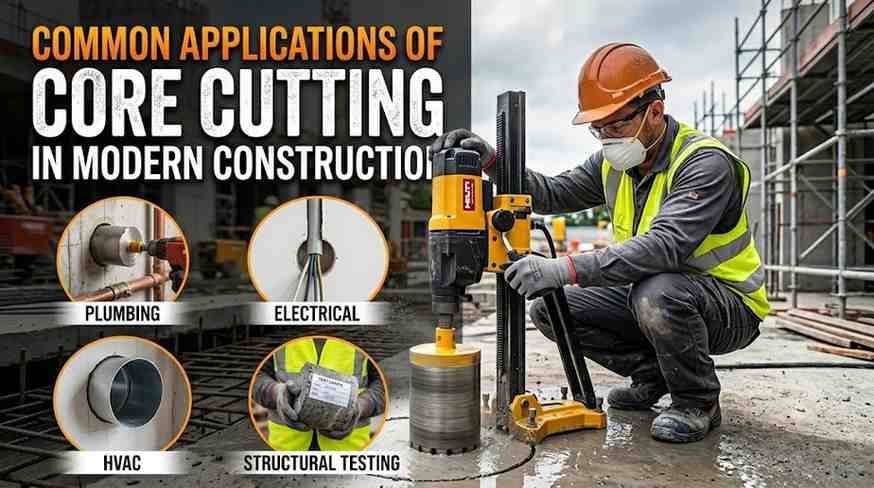
Modern buildings are dense with pipes, cables, ducts, and conduits running through walls, slabs, and beams — and someone has to create clean, structurally safe openings for all of it. That's where core cutting comes in. It has quietly become one of the most essential techniques in Indian construction and renovation, used by everyone from individual homeowners installing a split AC to large contractors fitting out commercial towers.
If you've ever wondered exactly where core cutting is used and why it has replaced traditional hammering methods, this guide breaks down the most common real-world applications — and shows you how to find a verified core cutting expert near you in minutes.
Need a contractor today? Call or WhatsApp 7009679903 or email [email protected] for an instant quote. You can also book verified core cutting contractors online in 500+ Indian cities.
What Is Core Cutting?
Core cutting is a precision drilling method that uses diamond-tipped drill bits to create clean, circular holes through concrete, RCC (Reinforced Cement Concrete), brick walls, and stone slabs. Unlike hammer-and-chisel work, core cutting is dust-minimal, low-vibration, and doesn't compromise the structural integrity of the surrounding material. This is exactly why it has become the standard for both new construction and retrofitting older properties. To understand the full process and equipment involved, see our detailed guide on what core cutting is and how it works.
Top Applications of Core Cutting in Construction
1. AC Pipe and Outdoor Unit Installation
This is, by far, the most common reason homeowners and businesses across India search for core cutting near them. Split AC units require a clean hole through an external wall for the copper piping, drain line, and wiring to pass through. A precisely cut hole — usually 50mm to 75mm in diameter — prevents water seepage and keeps the wall finish intact. Our detailed breakdown on core cutting services for AC installation covers ideal hole sizes, sealing tips, and common mistakes to avoid.
2. Plumbing and Drainage Lines
Bathrooms, kitchens, and utility areas need precise openings for inlet pipes, outlet drains, and sewage lines, often through RCC slabs or load-bearing walls. Since these are structural elements, accuracy matters — an off-center or oversized hole can weaken the slab or cause leakage problems later. Read more in our guide to RCC core cutting for plumbing pipes.
3. Electrical Conduits and Cabling
Running concealed wiring, internet cabling, or CCTV lines between rooms or floors often requires drilling through concrete walls and slabs. Core cutting allows electricians to route cables without exposed wiring or unsightly surface-mounted conduits, keeping the finished look clean in both residential and commercial spaces.
4. Exhaust Fans and Ventilation Openings
Kitchens, bathrooms, and commercial kitchens need dedicated openings for exhaust fans to vent smoke, steam, and odor outside. These holes need to be cut at the right height and angle for proper airflow without compromising the wall. Our guide on exhaust fan core cutting services explains sizing standards for residential versus commercial setups.
5. CCTV and Security Camera Wiring
As home and office security becomes standard, core cutting is widely used to route CCTV cable runs discreetly through exterior and interior walls, connecting cameras to DVR units without visible cable clutter.
6. Fire Sprinkler and HVAC Duct Openings
Large commercial and industrial buildings rely on core cutting for fire suppression sprinkler lines and HVAC ductwork that needs to pass through multiple floor slabs and fire-rated walls. Precision here is critical, since incorrect cutting near reinforcement bars can affect a slab's load-bearing capacity. For large-scale projects, our piece on diamond core cutting for commercial buildings goes into the safety protocols followed for high-rise and industrial sites.
7. Structural Modifications — Beams and Slabs
Renovation projects sometimes require modifying existing beams or slabs to create new openings for staircases, lift shafts, or additional plumbing risers. This is specialized work that should only be handled by trained beam cutting professionals, since incorrect cutting can affect structural load distribution. You can browse our beam cutting service listings for verified specialists.
8. Door and Window Openings (Wall Cutting)
While round core cutting handles pipes and cables, square or rectangular openings for new doors and windows fall under wall cutting services, which use diamond saw blades instead of cylindrical bits. Many renovation projects need both techniques together — for example, a new door opening alongside a core-cut hole for a doorbell or intercom wire.
9. Anchor Fixing and Rebaring
In structural reinforcement work, core cutting is used to drill precise holes for rebar dowels and chemical anchors, which are essential when extending slabs, joining old and new concrete structures, or reinforcing foundations.
10. Solar Panel and Water Tank Installation
Rooftop solar panel installations and overhead water tank setups often require core-cut openings in rooftop slabs for cabling, piping, and support brackets — a growing application as solar adoption increases across Indian homes and businesses.
Why Core Cutting Is Preferred Over Traditional Methods
- Minimal dust and debris compared to hammer drilling
- No micro-cracking of surrounding concrete or brickwork
- Precise diameters from 50mm to 300mm+, matched exactly to pipe or cable size
- Faster turnaround — most residential holes are completed within 30–60 minutes
- Safe for reinforced structures when performed by trained contractors who know how to avoid rebar damage
How to Find a Reliable Core Cutting Contractor
Whether you need a single AC pipe hole or a full commercial fit-out with multiple slab penetrations, working with a verified contractor protects your property from structural damage and rework costs. On Core Cutting India, you can search by city and service type to view contractor ratings, past work, and get instant quotes — covering 500+ cities across all 28 Indian states, including Delhi, Mumbai, Bengaluru, Hyderabad, Chennai, Pune, Gurugram, Noida, and Kolkata.
Not sure what your project will cost? Use the free Core Cutting Rate Calculator for an instant estimate before you book.
Get Expert Core Cutting Help Today
Whether it's a single AC hole at home or large-scale slab and beam cutting for a commercial project, the right contractor makes all the difference between a clean job and costly repair work later. Core Cutting India connects you with verified, experienced professionals near you — with same-day availability in most major cities.
📞 Call or WhatsApp now: 7009679903 📧 Email: [email protected] 🌐 Visit: corecuttingindia.com
Get an instant quote, compare verified contractors, and book your core cutting service today — no waiting, no guesswork.
Frequently Asked Questions (FAQ)
1. What is core cutting used for in construction? Core cutting is used to create clean, precise holes in concrete, RCC, and brick for AC pipes, plumbing, electrical conduits, exhaust fans, CCTV wiring, fire sprinkler lines, and structural modifications like beam and slab openings.
2. Is core cutting safe for load-bearing walls and slabs? Yes, when performed by a trained professional. Core cutting contractors check reinforcement positions and structural drawings before drilling to avoid cutting through rebar or compromising load-bearing capacity.
3. How much does core cutting cost in India? Core cutting typically costs between ₹150 and ₹800 per hole, depending on diameter, material, wall thickness, and city. Use the free rate calculator on Core Cutting India for an instant, location-based estimate.
4. How long does a core cutting job take? A standard residential hole (for an AC pipe or exhaust fan) usually takes 30 to 60 minutes. Larger commercial jobs involving multiple slab or beam penetrations can take a few hours depending on scope.
5. What's the difference between core cutting and wall cutting? Core cutting creates round holes using a cylindrical diamond bit — ideal for pipes and cables. Wall cutting creates square or rectangular openings using a diamond saw blade — used for doors, windows, and larger ducts.
6. How do I book a verified core cutting contractor near me? Visit corecuttingindia.com, select your city and service type, and compare ratings and quotes from verified contractors. You can also call or WhatsApp 7009679903 directly for immediate assistance.
7. Do core cutting contractors handle both residential and commercial projects? Yes. Core Cutting India's network of 10,000+ verified contractors handles everything from single residential AC holes to large-scale commercial and industrial slab, beam, and duct cutting projects.
Looking for trusted core cutting services near you? Get an instant quote or call/WhatsApp 7009679903 today. Explore related services: Core Cutting Service | Wall Cutting Service | Slab Cutting Service | Beam Cutting Service | Door Cutting Service