
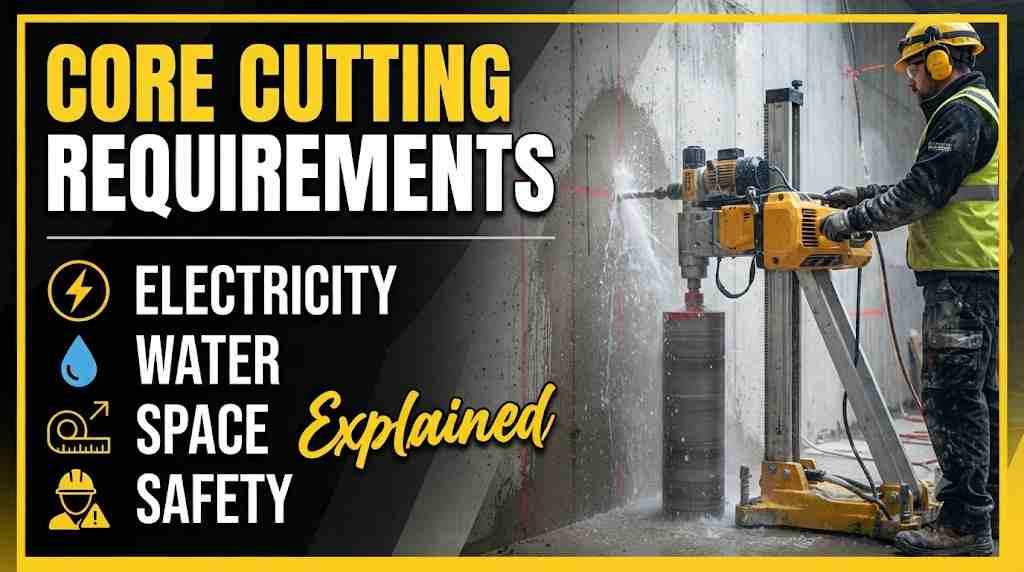
Most guides tell you what to arrange for core cutting. This one explains why. When you understand why a machine needs steady power, why water isn't optional, why the crew needs elbow room and why safety rules exist, you make better decisions on the day, and you can spot a careless contractor in minutes.
We've organised the guide around four pillars: electricity, water, space and safety. For each one you'll find what it does, what goes wrong without it, and who normally arranges it. If you're after a to-do list instead, our guide on what to arrange before core cutting is the practical companion to this explainer.
Not sure what your site needs? Ask us before the crew arrives. 📞 Call: 7009679903 | 💬 WhatsApp: Ask about site requirements | ✉️ info@corecuttingindia.com
A Quick Picture of How Core Cutting Works
A core cutting machine spins a hollow steel barrel whose rim is set with diamond segments. The diamonds grind through concrete, brick or stone, while water flows to the cutting edge. The result is a round hole and a solid cylinder of material, the "core," that is removed intact.
Every requirement below follows from that simple description: a motor turns the bit (electricity), water cools and clears it, the rig needs somewhere stable to stand (space), and the process creates noise, dust and slurry that need managing (safety). For a deeper look at the method, see our core cutting service page.
Pillar 1: Electricity
Why it's needed
The drilling motor must turn the bit at a steady speed. Concrete is hard and uneven, so the motor works under load. A weak or fluctuating supply can make the bit slow down, stall or bind in the hole.
What goes wrong without it
- The machine trips repeatedly, so a one-hour job becomes three
- A stalled bit can jam in the hole
- Long, thin extension cables overheat, which is a safety hazard
- Work stops mid-hole, which can leave a rough or uneven edge
What the site should provide
- A working power point reasonably close to the cutting spot
- A supply that isn't shared with heavy loads such as geysers or air conditioners at the same time
- Dry, tidy cable routes away from where water will flow
What the contractor should bring
- A properly rated extension cable
- Earth-leakage protection such as an RCCB, so a fault trips the circuit instead of shocking a person
Power cuts and backup
Heavy machines don't always run on household inverters. If power cuts are common in your area, mention it when booking. Ask whether a generator is suitable rather than assuming. The machine's exact power rating varies, so ask your contractor for the figure for your specific job.
Who normally arranges it
The owner provides the socket and a stable supply. The contractor brings cables and protection.
Pillar 2: Water
Why it's needed
Cutting through concrete generates intense heat. Water cools the diamond segments, flushes out the ground material and reduces dust. This is also why wet cutting leaves cleaner holes and lets the bit last longer.
What goes wrong without it
- The bit overheats, glazes over and cuts poorly
- The diamond segments wear out far faster, raising costs
- Dust rises into the air, which is bad for breathing and for your furnishings
- The hole edge can become rough
What the site should provide
- A tap, bucket or tank within reach of the work area
- Enough supply for the number and size of holes. Tell the contractor if water is limited, since several large holes need more than one small hole
Managing slurry
The water and concrete powder combine into a grey slurry. Plan for it:
- Use a collection tray or wet vacuum where possible
- Lay plastic sheets around the spot
- Avoid flushing large amounts into household drains, where it can settle and block pipes
- Clean up promptly, because dried slurry is much harder to remove
Outside and high-level holes
Slurry from terraces, balconies and outer walls can run down a building's facade or onto a neighbour's property. Mention this when booking so the crew can plan catchment.
Who normally arranges it
The owner provides the water source. The contractor manages the flow and cleanup.
Pillar 3: Space
Why it's needed
A core drill rig has to be held firmly in place. Any movement during cutting can bend the bit, scar the hole or cause an unsafe kickback. Crews therefore need room to set up, position and secure the rig, and to move around it.
What goes wrong without it
- The machine can't be positioned square to the wall, leading to angled or oversized holes
- The crew works in awkward postures, which increases the chance of mistakes
- Furniture and fittings get bumped or splashed
What the site should provide
- A clear working area around the cutting spot, with furniture moved back a few feet
- A free route from the entrance to the work area for people, equipment and the removed cores
- A stable surface to stand on, especially for ladders or scaffolds
- Parking or unloading space near the building, which matters in crowded Punjab market lanes
Height and access
Holes above shoulder height may need a ladder or scaffold. Tell the contractor the height in advance, since extra equipment can affect price and timing. If your building has no lift, mention it so the crew can plan carrying the equipment up.
Space behind the wall
This one is often missed. Check the other side of the wall for a cupboard, window, neighbour's property or pipe. The hole must have somewhere safe to exit, and the removed core must have a safe place to fall or be caught.
Who normally arranges it
The owner clears the area. The contractor decides the final rig position.
Pillar 4: Safety
Safety is the pillar that makes the other three work. It covers people, property and the building itself.
Personal protection
A responsible crew typically uses:
- Eye protection
- Ear protection, since core drilling can be loud
- Gloves and sturdy footwear
- Dust masks where needed
- Non-slip footing around wet floors
Dust and health
Concrete dust can contain fine particles that are harmful to breathe over time. Wet cutting reduces airborne dust, which is one of its practical advantages. Even so, keep children, pets and anyone with breathing problems away from the work zone and ventilate the area.
Electrical safety
Water and electricity need careful separation.
- Keep sockets and cable joints away from wet areas
- Use earth-leakage protection
- Ask the crew to switch off nearby circuits if they request it
- Never touch cables with wet hands
Structural safety
Beams, columns and some walls carry the building's load. Cutting them without a qualified structural engineer's approval isn't safe. See our note on beam cutting for more. In certain commercial or large-span slabs, tensioned steel cables may be embedded, and cutting one can be dangerous. Always confirm with an engineer or building records before drilling in such structures.
Hidden services
Concrete can hide reinforcement bars, electrical conduits and pipes. Ask the contractor how they check before drilling. For a concrete-specific walkthrough, see what you need before concrete core cutting.
Working at height
Ladders should be stable, scaffolds properly set up, and the crew should never lean out unsupported. If you see unsafe setups, speak up.
Who normally arranges it
Mostly the contractor, with the owner keeping people clear and providing information.
At a Glance: The Four Pillars
| Pillar | Why it matters | Owner provides | Contractor provides |
|---|---|---|---|
| Electricity | Turns the bit steadily | Power point, stable supply | Cables, earth-leakage protection |
| Water | Cools bit, clears material, controls dust | Water source | Flow control, slurry cleanup |
| Space | Keeps the rig stable and the crew safe | Clear area, access, parking | Rig positioning, ladder or scaffold |
| Safety | Protects people, property and structure | Information, keeping people clear | PPE, scanning, safe methods |
How These Requirements Affect Your Price and Timeline
Missing requirements aren't just inconvenient. They change the job.
- No water or power on site can mean extra setup time or a revisit
- Difficult access or height may need extra equipment
- Unclear hole positions slow decisions
- Thick, heavily reinforced concrete takes longer to cut
Final cost depends on diameter, thickness, material, access, number of holes and your city. For a starting estimate, try our Core Cutting Rate Calculator. Our platform's general guide suggests roughly ₹150 to ₹800 per hole, but larger or complex jobs can fall outside that. Confirm your final quote on a call or by WhatsApp and ask what's included.
A Short Pre-Arrival Checklist
- [ ] Power point tested
- [ ] Water source running
- [ ] Working area cleared and floors covered
- [ ] Access route and parking sorted
- [ ] Hole positions marked and photographed
- [ ] Other side of the wall checked
- [ ] Permissions confirmed
- [ ] People and pets kept clear
- [ ] Contractor has your phone number and address
Red Flags in a Contractor
- Doesn't ask about power, water or access before the visit
- Has no plan for slurry or protection
- Doesn't check for hidden steel or wiring
- Avoids explaining safety steps
- Won't confirm the quote or inclusions in writing
Core Cutting India displays ratings and reviews on each contractor profile so you can compare before you call. Begin on the homepage and pick your city.
Local Note for Punjab Customers
Conditions across Punjab vary. Summer demand can strain electricity supply in some areas, so mention power reliability when you book. In older neighbourhoods and crowded market lanes in cities like Ludhiana, Amritsar and Jalandhar, parking and unloading space can be tight, and many buildings have no lift. Mentioning your locality, floor and access situation up front helps the crew bring the right equipment.
To compare contractors, ratings and reviews near you, see our Punjab core cutting service page. For Jalandhar kitchens and bathrooms, our guides on chimney hole cutting and exhaust fan hole cutting cover typical household jobs.
Frequently Asked Questions
What are the basic requirements for core cutting?
A working power supply, water for cooling and slurry control, clear working space and access, safety measures such as protective gear and electrical protection, and clear hole positions.
Why does core cutting need water?
Water cools the diamond bit, flushes out cuttings and reduces dust, which gives cleaner holes and longer bit life.
Does core cutting need a special electrical connection?
Usually a standard working power point is needed, but machine ratings vary. Ask your contractor what your specific job requires, and whether they bring protection such as an earth-leakage device.
How much space is needed for core cutting?
Enough clear room to position and secure the rig and for the crew to move safely. Move furniture back a few feet and clear a route to the work area.
Is core cutting safe?
Yes, when done by trained crews who check for hidden services and structural elements, use protective equipment and manage water, dust and electricity properly.
How much does core cutting cost?
It depends on diameter, thickness, material, access and city. Our general range is about ₹150 to ₹800 per hole. Use the Rate Calculator and confirm with your contractor.
How do I book core cutting?
Call or WhatsApp 7009679903 with your city, hole sizes, wall type and photos for guidance and a quote.
Get Your Site Ready, and Your Core Cutting Done Right
Tell us about your site and we'll explain exactly what to arrange, then connect you with a verified contractor.
📞 Call or 💬 WhatsApp: 7009679903
✉️ Email: info@corecuttingindia.com 🌐 Website: corecuttingindia.com 🧮 Instant estimate: Rate Calculator