
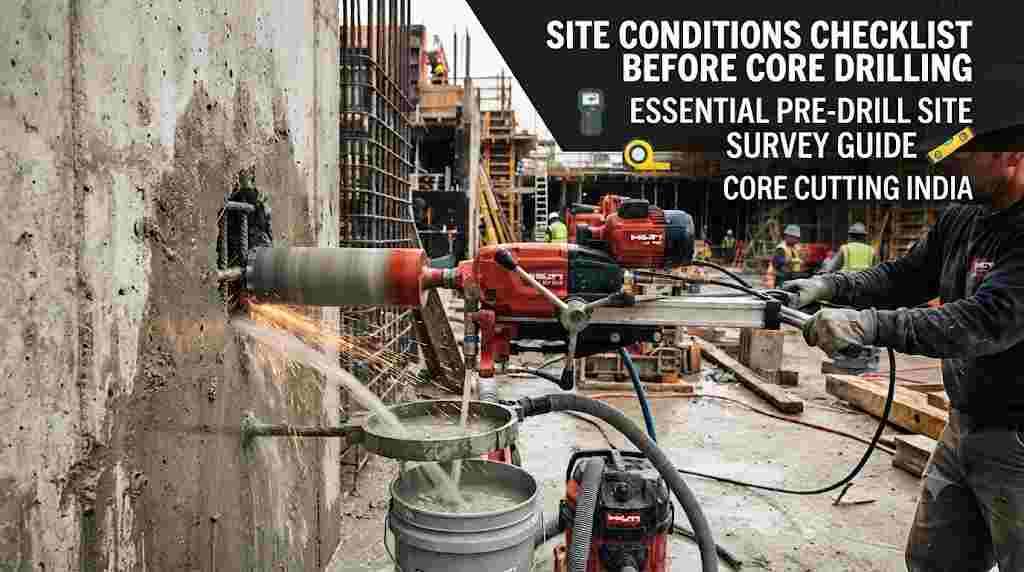
Picture this. The core drilling team arrives at 10 a.m., the machine is set up on the wall, and then someone asks, "Where is the water supply?" Nobody knows. The only tap is two floors down, the extension cable is too short, and the homeowner has just remembered that the bedroom behind this wall has a hidden electrical conduit. The job that should have taken an hour now eats the whole day.
Almost every delay in diamond core drilling comes from the site, not the machine. This guide lists the conditions worth checking before the crew turns up, so the work is quick, clean and safe.
📞 Want a second pair of eyes on your site? Call or WhatsApp 7009679903 and we will help you plan it.
What Diamond Core Drilling Actually Needs
Diamond core cutting uses a hollow, diamond-tipped bit that rotates at speed, usually with water to cool the bit and flush out slurry. It creates a clean round hole without the hammering and cracking of conventional breaking. That is why it is used for AC pipes, drains, ducts, cables and sleeves.
But it is not "plug in and go". The machine depends on a stable mounting point, steady power, controlled water and a wall or slab that has been checked for surprises. Think of the site as the second half of the machine.
1. Structural Condition of the Concrete
Start with the material itself, because everything else follows from it.
What to look for:
- Type of surface: RCC, plain concrete, brick, block or stone. Each cuts differently and affects time and cost.
- Thickness: a 150 mm wall and a 450 mm slab are very different jobs.
- Age and condition: old concrete may be weaker, carbonated or patchy. Fresh concrete that has not cured may crumble at the edges.
- Existing cracks or damage: drilling near a crack can make it worse.
If the opening is near a beam, column, slab edge or load-bearing zone, ask for a structural opinion before cutting. A small round hole in a plain wall is routine. The same hole in a main beam is not. Our article on checks before making openings in concrete slabs explains this in more depth.
2. Reinforcement and Embedded Services
This is the condition people underestimate most.
Reinforced concrete contains steel bars, and walls and slabs often carry electrical conduits, water lines, gas lines or data cables. A diamond bit will happily cut through all of them.
Before drilling, do the following:
- Review electrical, plumbing and structural drawings if available.
- Check the other side of the wall, because a bathroom, kitchen or switchboard behind it is a warning sign.
- Use a rebar and conduit scanner where the risk is real. Professionals use these before marking final points.
- Switch off the relevant electrical circuits and water supply near the drilling zone if there is any doubt.
If a bit meets steel, a good operator will stop, reassess and shift the position rather than force through. That is only possible if the team knows early that steel is likely, so share any drawings you have.
3. Power Supply on Site
Core drilling rigs run on electricity, and an unstable supply causes motor strain, uneven cutting and stoppages.
Check these points:
- Is there a working socket within reach of the drilling location?
- Is the voltage steady? Frequent fluctuation is bad for the motor.
- Is the cable length enough, and is the extension rated for the load?
- Is there a backup option if the building loses power often?
On new construction sites, temporary power can be unreliable, so confirm it a day earlier. If the job is high up or in a shaft, ask the team about cable routing so nobody trips on a live wire near wet floors.
4. Water Supply and Slurry Control
Wet core drilling needs a steady water feed. Without it, bits overheat, wear faster and cut poorly.
Water-side checklist:
- A tap, tank or bucket supply close to the work.
- A plan for the slurry, the grey muddy water that comes out during cutting.
- Floor protection: plastic sheets, tape, or a slurry collection ring around the hole.
- Drainage direction, especially in bathrooms, balconies and terraces.
Slurry stains tiles, wood and fabric, and it can stain the outer facade if the hole goes through to the outside. Ask your contractor how they will contain it. A tidy team will use vacuum collection or catch-rings and mop up before leaving.
If you want to see who is responsible for what, our core cutting preparation guide splits tasks between customer and contractor.
5. Access, Height and Working Space
Can the team actually reach the spot, and can they work there safely?
- Doorways, lifts and stairs: machines, stands and water tanks need to be carried in.
- Working height: a hole at ceiling level needs a stable ladder or scaffold, not a wobbly stool.
- Clearance around the point: the rig needs space to be anchored and operated.
- Outer-face access: if the drill breaks through outside, is there a balcony or a safe zone, and is anyone below?
Work at height, narrow corridors and basement sites usually raise cost and time. Mention them upfront so the quote reflects reality.
6. Surroundings: Furniture, Finishes and Nearby People
Concrete drilling is cleaner than hammering, but it is still work in your living space.
- Move furniture, electronics and fragile items away.
- Cover floors, kitchen counters and nearby appliances.
- Protect fresh paint, wooden panelling and modular cabinets.
- Keep children, pets and elderly family members away from the drilling zone.
- Ask whether any resident has a medical or noise sensitivity.
In shops and offices, plan the work for a low-footfall slot. In apartments, tell your neighbours, because the sound of drilling carries through the structure.
7. Permissions and Society Rules
This part is dull but can stop a job completely.
- Apartment societies may need approval, limits on working hours, or a deposit.
- Rented homes need the landlord's consent.
- Shared walls and common areas may involve neighbours or the association.
- Heritage or older buildings may have additional restrictions.
Get the approval in writing where possible, and confirm the allowed drilling hours.
8. Hole Position, Angle and Purpose
A hole that is perfectly cut in the wrong place is still a wrong hole.
Confirm with the person who will use the opening (the AC installer, plumber, electrician or chimney fitter):
- The exact diameter the sleeve or pipe needs.
- The height from the finished floor, not the bare slab.
- The angle or slope, which matters for drains and AC condensate.
- Whether a sleeve or waterproofing will be installed afterwards.
Mark the centre clearly with tape or a marker on both sides of the wall if possible. For a wider look at how to plan holes for different installations, see our guide on planning concrete drilling for AC, chimney, exhaust fan and plumbing.
9. Weather and Timing
Weather matters more than most people think, especially for outdoor faces and terraces.
- Rain makes outer-face work slippery and complicates slurry control.
- Extreme heat is tiring for crews working at height.
- Dense fog and low light in winter reduce safety on exterior walls.
Schedule drilling in good light and, ideally, when you can supervise. If a project has several holes, group them into one visit to avoid repeating setup and cleanup.
10. Safety Basics at the Site
Even a small job needs safety discipline.
- Operators should use appropriate protective gear.
- Wet floors near electrical equipment must be managed carefully, with residual-current protection where possible.
- The area below an outside opening must be kept clear.
- The core, the cylindrical piece of concrete that comes out, should be removed in a controlled way, as it can be heavy.
- Emergency contact and first-aid access should be known.
A responsible contractor will talk about these things without being asked. If they don't, ask.
Quick Pre-Drilling Checklist
| Check | Why it matters |
|---|---|
| Concrete type and thickness | Affects tool choice, time and cost |
| Rebar and hidden services | Prevents damage and safety risk |
| Power point and voltage | Keeps the machine running smoothly |
| Water supply and slurry plan | Protects bits and finishes |
| Access and working height | Decides equipment and safety setup |
| Furniture and finishes covered | Avoids stains and damage |
| Permissions and timing | Prevents stoppages |
| Hole size, angle, level | Avoids rework |
Cost: How Site Conditions Change the Price
Diamond core drilling is usually priced by hole diameter and depth, but site conditions quietly change the final number. Heavy reinforcement, thick slabs, high or awkward locations, long water or power setup, and cleanup requirements can all raise the cost. As a general reference, our platform shows indicative rates of roughly ₹150 to ₹800 per hole for common jobs, though complex jobs can exceed that.
For a fast estimate, use the core cutting rate calculator and then confirm with a short site description or photos on WhatsApp.
A Punjab-Specific Note
Site conditions in Punjab often come with local patterns. In older parts of Amritsar, Jalandhar and Patiala, buildings may have thick brick walls, mixed construction ages and unmarked wiring, so scanning is wise before cutting. In fast-growing areas around Mohali and Ludhiana, new RCC apartments and commercial blocks tend to have tight society rules and fixed working hours, which makes advance approvals important.
Dust and winter fog can also affect outdoor work, and farmhouses or large independent houses often need longer water or power routing. If you are in the state, browse our core cutting service in Ludhiana, Punjab page to compare verified contractors with local experience.
Frequently Asked Questions
What is the most important thing to check before diamond core drilling?
Checking for reinforcement and hidden services such as electrical conduits and water pipes. Hitting these causes the most expensive and dangerous problems.
Do I need to provide water and electricity for core drilling?
Usually yes. The team brings the machine and bits, but a power socket and water source at the site are normally needed. Confirm responsibilities with your contractor in advance.
Can core drilling be done without a scanner?
It can, but it carries more risk in RCC and walls with unknown wiring or plumbing. Scanning is strongly recommended where drawings are missing.
Does diamond core drilling make a lot of dust?
Wet drilling controls dust well because water suppresses it. The trade-off is slurry, which needs to be contained and cleaned.
Can I drill near a beam or column?
This should be avoided unless a structural engineer approves it. Beams and columns carry loads and contain dense reinforcement.
How can I get a quick quote?
Use the rate calculator or send your hole size, wall type, location and a photo on WhatsApp at 7009679903.
Conclusion
A smooth diamond core drilling job is rarely about luck. It comes from simple checks done early: know what is inside the wall, make sure power and water are ready, protect your finishes, confirm the hole size and position, and sort out permissions. Ten minutes of site review can save hours of delay and a great deal of repair cost.
Ready to book diamond core drilling?
📞 Call: 7009679903 💬 WhatsApp: Chat now on 7009679903 ✉️ Email: info@corecuttingindia.com 🌐 Website: corecuttingindia.com
Call or WhatsApp 7009679903 today for a quick quote, verified contractors and clean, precise drilling.