
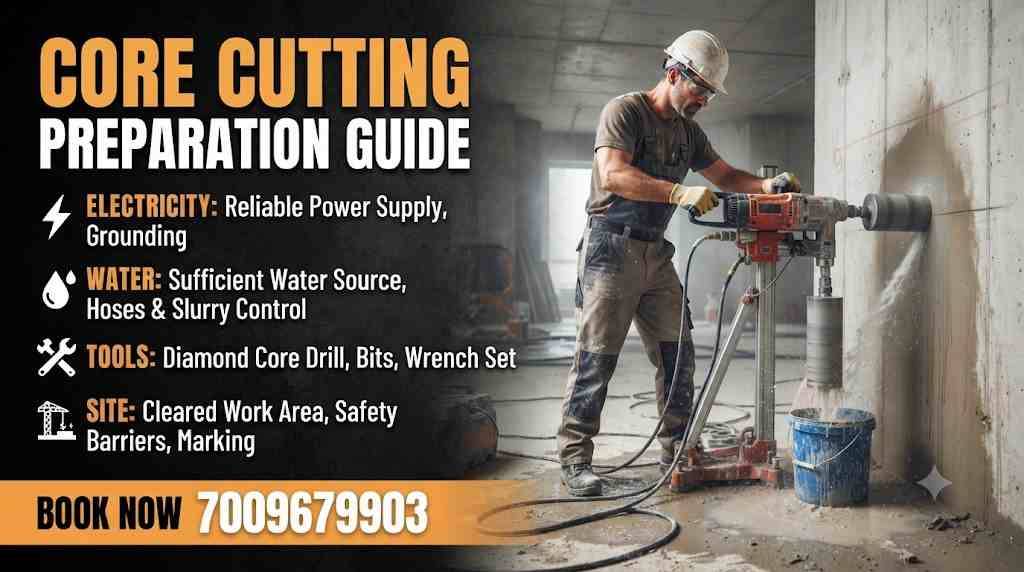
The most common question we hear before a core cutting job isn't about price or time. It's this: "What do I need to arrange, and what will the contractor bring?"
When that question isn't answered clearly, two things happen. Either the customer scrambles to find equipment they were never supposed to supply, or the crew arrives and finds there's no water or power, because everyone assumed someone else had it covered.
This guide settles it. We'll go through the four things every core cutting job needs, electricity, water, tools and site requirements, and for each one spell out who normally provides what. Use the responsibility table in the middle as your quick reference, and the checklist at the end as your final check.
Not sure what you need to arrange and what the contractor brings? 📞 Call: 7009679903 | 💬 WhatsApp: Ask before you book | ✉️ info@corecuttingindia.com
The Responsibility Split at a Glance
| Item | Usually the owner or site provides | Usually the contractor provides |
|---|---|---|
| Electricity | A working power point near the work area | Cables, earth-leakage protection |
| Water | A tap, tank or container within reach | Hoses, feed system, collection tools |
| Tools and equipment | Nothing, apart from access | Drill machine, rig stand, bits, accessories, protective gear |
| Space and access | A clear area, route and parking | Rig positioning, ladders or scaffolds as agreed |
| Permissions | Society, landlord and building approvals | Compliance with site rules |
| Hole marking | Final positions and decisions | Verification and checks |
Arrangements vary, so always confirm in your quote. Treat the table as the usual pattern, not a guarantee.
Part 1: Electricity
What it does
Core drilling machines use an electric motor to spin the bit at a steady speed through hard material. If the supply is weak or fluctuating, the bit can slow, stall or bind.
What you arrange
- A working power point within reasonable reach of each cutting spot
- A stable supply, ideally not shared with heavy loads running at the same time, such as a geyser or air conditioner
- Safe routing: a clear, dry path for cables, away from where water will flow
What the contractor arranges
- A properly rated extension cable
- Earth-leakage protection, so a fault trips the circuit rather than shocking a person
Power cuts and backup
If cuts are common in your area, say so when you book. Ask whether a generator is suitable, and don't assume a household inverter will run the machine. Machine ratings differ, so ask your contractor for the specific figure for your job.
Quick power checklist
- [ ] Socket works and is close to the work area
- [ ] No heavy appliances sharing the circuit
- [ ] Backup plan discussed
- [ ] Cable route dry and clear
Part 2: Water
What it does
Water cools the diamond bit, flushes out ground material and keeps dust low. It is a big reason wet core drilling leaves clean edges and why bits last longer.
What you arrange
- A water source within reach: a tap, tank or large container
- Enough volume for the number and size of holes. Tell the contractor if supply is limited
- A slurry plan: where will the grey paste go?
What the contractor arranges
- Hoses and water feed to the cutting point
- Collection tools such as trays or a wet vacuum, where included in the service
Slurry basics
- Catch it at the source, rather than letting it run
- Never flush large amounts into household drains, where it can settle and block pipes
- Wipe up promptly, since dried slurry is much harder to remove
- Check what's below the hole, particularly on upper floors and outside walls
Quick water checklist
- [ ] Tap running or container full
- [ ] Overhead tank motor and municipal timings checked
- [ ] Slurry plan agreed
- [ ] Area below the hole checked
Part 3: Tools and Equipment
This is the part most homeowners never see, which is why it causes the most confusion. Here's what a professional crew typically brings and why each item matters.
The core drilling machine
A motor-driven drill designed for heavy-duty use. Machines vary in power and size, and the crew picks one suited to your hole diameter and material.
The rig stand
A frame that holds the machine steady and square to the wall or floor. Stability is what produces straight, accurate holes. Stands are typically anchored in place, so the crew needs a suitable surface.
Diamond core bits
Hollow steel barrels with diamond-set segments. Different diameters, lengths and segment types suit different materials, such as reinforced concrete, brick or stone. A worn or wrong bit cuts slowly and poorly, so ask whether the contractor brings the right size for your job.
Water feed and collection equipment
Hoses, valves, trays and wet vacuums to deliver water and capture slurry.
Scanning equipment
Rebar scanners or ground-penetrating radar are sometimes used to detect steel, conduits and pipes before cutting. Ask your contractor whether scanning is part of their process and whether it's included in the price.
Access equipment
Ladders, platforms or scaffolds for holes above shoulder height. Tell the contractor the working height in advance.
Protective equipment
Eye and ear protection, gloves, sturdy footwear and dust masks where needed.
Cleaning and protection materials
Plastic sheets, tapes, cloths and tools for sleeving and sealing, if included in the scope.
Questions to ask about tools
- Which machine and bit sizes will you bring for my holes?
- Do you scan for hidden steel and wiring?
- Is scaffolding or ladder work included?
- What protection and cleanup materials do you provide?
For more on how the method works, see our core cutting service page. For larger openings that use different equipment, see wall cutting and slab cutting.
Part 4: Site Requirements
Space
The rig and crew need room to set up safely. Move furniture back a few feet, clear fixtures near the wall and keep the area free of clutter.
Access
- A clear route from the entrance to each cutting spot
- Information about stairs, lift availability and parking or unloading space
- The working height for each hole
The other side of the wall
Check what's behind each hole: a cupboard, window, neighbour's property or pipe. The hole needs somewhere safe to exit, and the removed core needs somewhere safe to land.
Hole marking
Mark each centre point with chalk or tape, write the diameter beside it, and note any slope for pipes. Photograph each mark and send it to the contractor before the visit.
Hidden services
Share drawings if you have them. Ask how the contractor checks for steel, conduits and pipes. For concrete-specific questions, see what you need before concrete core cutting.
Structural limits
Beams, columns and some walls carry the building's load. Cutting them needs a qualified structural engineer's approval, and slabs that might be post-tensioned need expert confirmation. See our note on beam cutting.
Permissions
Apartments often need society approval and have set working hours. Rented homes need the landlord's written consent. A courtesy notice to neighbours helps.
Protection
Cover floors and furniture, and keep children, elderly family members and pets away from the work area.
For the reasoning behind electricity, water, space and safety, see our explainer on core cutting requirements. For a room-by-room walkthrough, see how to prepare your home for core cutting.
Preparation Timeline
A week before
- Finalise hole positions and sizes
- Get permissions
- Share photos with the contractor and confirm the quote
The day before
- Test the power point and water supply
- Clear the area and move furniture
- Confirm arrival time and contact numbers
On the day
- Cover floors and fixtures
- Walk the crew through each marked spot
- Keep people and pets away
- Stay reachable for quick decisions
After cutting
- Inspect each hole before the crew leaves
- Confirm cleanup is complete
- Photograph the openings
- Plan sleeving and sealing
What Affects the Cost
Price depends on:
- Hole diameter and depth
- Wall or slab material and reinforcement
- Height and access
- Number of holes
- Whether scanning, scaffolding, cleanup and protection are included
- Your city and urgency
Use the Core Cutting Rate Calculator for a starting estimate. Our platform's general guide suggests roughly ₹150 to ₹800 per hole, though larger, harder or hard-to-reach jobs can cost more. Confirm the final quote after the contractor has seen photos, and ask exactly what's included.
Choosing a Contractor Who Brings the Right Gear
A well-equipped contractor will ask about wall type, hole size, height and access before quoting. They'll explain their method, tools, safety and cleanup, and be clear about what they need from you. Core Cutting India shows ratings and reviews on each contractor profile, so you can compare before you call. Start from the homepage and choose your city. For a full hiring walkthrough, see what to arrange before hiring a core cutting service.
Final Preparation Checklist
- [ ] Hole positions marked and photographed
- [ ] Power point tested, backup discussed
- [ ] Water supply ready, slurry plan agreed
- [ ] Tools, bits and scanning confirmed with the contractor
- [ ] Space, access and parking arranged
- [ ] Other side of the wall checked
- [ ] Structural concerns raised with an engineer where needed
- [ ] Permissions confirmed
- [ ] Floors and furniture protected
- [ ] People and pets kept clear
- [ ] Quote and inclusions confirmed
Local Note for Punjab Customers
Punjab homes and workplaces vary widely, and so does preparation. Summer demand can strain electricity in some areas, so mention power reliability when you book. In dense areas of Ludhiana, Amritsar and Jalandhar, narrow lanes, limited parking and no-lift buildings affect how equipment is carried in, and older houses may have thick, repaired walls that call for photos before quoting. Tell the contractor your locality, floor and building age so they can bring the right gear.
To compare contractors, ratings and reviews near you, see our Punjab core cutting service page. For Jalandhar kitchens and bathrooms, our guides on chimney hole cutting and exhaust fan hole cutting are useful starting points.
Frequently Asked Questions
What do I need to arrange before core cutting?
A working power point, a water source and slurry plan, clear space and access, marked hole positions and the right permissions. The contractor normally brings the machine, bits and related equipment.
Does the contractor bring the core cutting machine?
Usually yes. Professional crews bring the drilling machine, rig stand, bits and accessories, but confirm this in your quote.
Do I need to provide water and electricity?
Usually yes. The site typically provides a power point and water source, while the contractor brings cables, hoses and protection. Always confirm the arrangement beforehand.
Is scanning for steel and wiring included?
It depends on the contractor and the job. Ask whether scanning is part of their process and whether it's included in the price.
How much does core cutting cost?
It depends on diameter, thickness, material, access, inclusions and city. Our general range is about ₹150 to ₹800 per hole. Use the Rate Calculator and confirm with your contractor.
Can core cutting be done without water?
Wet cutting is the standard for clean holes and longer bit life. If water is a problem, discuss it with your contractor before booking.
How do I book core cutting?
Call or WhatsApp 7009679903 with your city, hole sizes, wall type and photos for guidance and a quote.
Conclusion: Clear Roles Make a Smooth Job
Core cutting goes best when everyone knows their part. You provide the power, water, access and decisions. Your contractor brings the machine, bits, protection and skill. When both sides are clear, the job is quick, clean and accurate.
📞 Call or 💬 WhatsApp: 7009679903
✉️ Email: info@corecuttingindia.com 🌐 Website: corecuttingindia.com 🧮 Instant estimate: Rate Calculator