
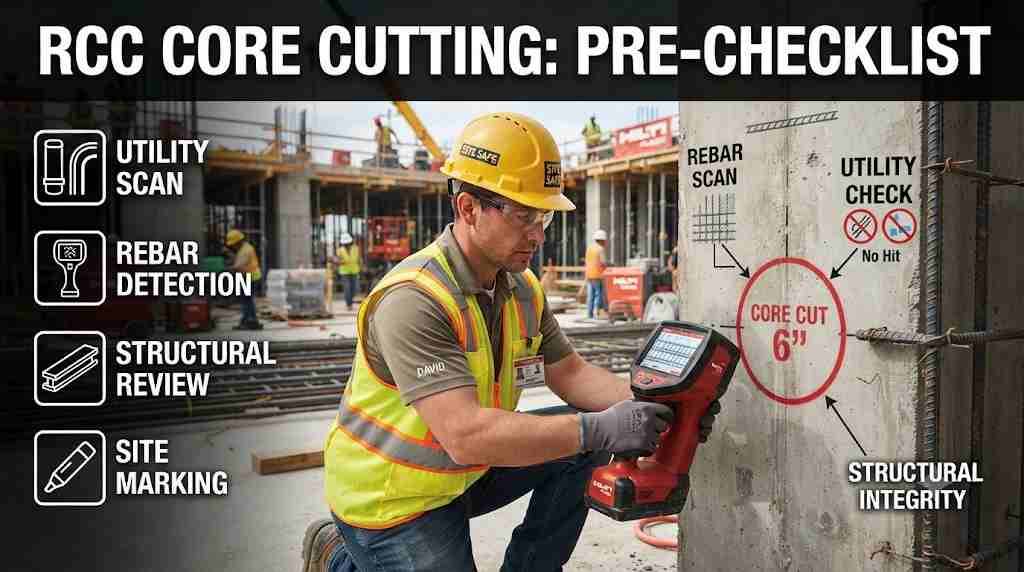
When a core cutting crew walks onto a construction site, the drilling is the last thing a careful contractor does. Before the machine is even unloaded, there is a quiet round of checks. Is it safe? Is it allowed? Is it accurate? Is the site ready? If any answer is "no," a good contractor stops and sorts it out first.
This guide opens that process up. If you're a builder, site engineer, project manager or property owner hiring an RCC core cutting contractor, you'll learn what a competent contractor checks before starting, why each check exists, and what you can do to make the checks go smoothly. It also doubles as a way to judge contractors: if yours isn't asking these questions, ask yourself why.
For the site owner's side of preparation, see our companion guide on how to prepare a construction site for RCC core cutting and diamond drilling.
Need an RCC core cutting contractor for your site? 📞 Call: 7009679903 | 💬 WhatsApp: Send drawings and site photos | ✉️ info@corecuttingindia.com
The Idea: A Go / No-Go Gate
Think of the checks as a gate with three outcomes:
- Go: everything is confirmed, cutting begins
- Conditional go: a small issue is fixed on the spot, such as moving a hole slightly or adding barricades
- No-go: work stops until a bigger issue is resolved, such as missing structural approval
Experienced contractors accept that a no-go decision costs a few hours. A rushed cut can cost far more. For the basics of the method itself, see our core cutting service page.
Check 1: The Scope Matches the Site
The first check is simple but often overlooked: does what was quoted match what's actually there?
- Number, diameter and depth of holes against the agreed list
- Which floors and elements are involved
- Whether the work is core cutting, wall cutting or slab cutting, because each needs different equipment
- Any changes since the quote was given
If scope has grown, a good contractor raises it now, not after the work.
How you help: share an up-to-date hole schedule with drawing references and mark each position in the field.
Check 2: Structural Clearance
This is the check that separates professionals from risk-takers.
A contractor typically wants to know:
- Which elements are being cut: slab, wall, beam or column
- Whether a structural engineer has approved the openings
- Whether any hole is near a beam, column, wall junction or slab edge
- Whether the approval is written, not verbal
Cutting beams or columns is structural work, not routine drilling. See our note on beam cutting. If clearance is missing for a risky hole, that's a no-go until it's resolved.
How you help: keep structural approvals with the hole schedule and hand them over at the start.
Check 3: Post-Tensioned or Special Elements
Some structures contain steel cables held under high tension. Cutting one can be extremely dangerous and can damage the structure.
A careful contractor asks:
- Is any part of this building post-tensioned or pre-stressed?
- Are there records showing where the tendons run?
- Has a specialist confirmed safe locations?
If the answer is uncertain, they stop and ask. We don't give numeric rules here, because safe practice depends on the structure's design.
How you help: tell the contractor in advance if your slabs may be post-tensioned, and share the designer's contact or drawings.
Check 4: What Is Inside the Concrete?
In RCC, the unseen matters. Before cutting, contractors want to understand:
- Reinforcement: position, spacing and cover
- Conduits: electrical lines that could be live
- Embedded pipes: water, drainage or gas
- Voids or repairs: older patches or honeycombing
Methods include reviewing drawings, using rebar scanners or ground-penetrating radar (GPR), and inspecting the opposite face or the floor below. A contractor may adjust the hole position slightly to avoid steel, within what the engineer allows.
For more on concrete itself, see what you need before concrete core cutting.
How you help: provide as-built drawings and tell the contractor about any known services.
Check 5: Concrete Age and Condition
- When was the element cast?
- Has the concrete had enough time to gain strength for cutting? Very young concrete can suffer edge damage, so the structural team may need to advise
- Are there visible cracks, honeycombing or weak zones near the hole?
How you help: share casting dates for recent slabs and flag any repaired or defective areas.
Check 6: Hole Position, Marking and the Other Side
Before drilling, the contractor verifies:
- The marked centre point and diameter match the schedule
- The hole doesn't clash with nearby openings, edges or fixtures
- What's on the other side: a room, a void, a service shaft or another trade's work
- Whether there's anything below the opening that could be hit by slurry or falling cores
A hole drilled in the wrong place is permanent. A professional will happily pause to confirm.
How you help: mark positions clearly, number them, and tell the contractor who is authorised to approve changes.
Check 7: Access, Height and Logistics
Contractors look at how the work will physically happen.
- Route for people and equipment: lifts, stairs, hoists, crane access
- Whether scaffolding, platforms or ladders are needed, and whether they're stable
- Unloading and storage space
- Whether other trades are working nearby
- Working hours and any restrictions
Difficult access affects safety, time and price, so contractors prefer to know early.
How you help: share photos of the working area and tell the contractor about access limits.
Check 8: Power Supply
- Where is power available, and is it stable?
- Does the supply suit the machine's load? The contractor knows the rating of their own equipment, so ask them for it
- Are cables properly rated and routed away from water?
- Is earth-leakage protection in place?
- Is there a generator on site, and is it suitable?
Sharing power with heavy loads like welding sets can cause tripping and delays.
How you help: identify a power point near each working area and tell the contractor about power reliability.
Check 9: Water and Slurry Control
Wet diamond drilling needs water, and slurry is unavoidable.
- Is there a reliable water point on the working floor?
- Where will the slurry go: trays, wet vacuum, sump?
- What's beneath each opening? Slurry can run onto work or people below
- Are drains protected from blockage?
How you help: arrange a water point and tell the contractor about sensitive areas below openings.
Check 10: Safety Setup
Contractors typically confirm:
- Permit-to-work or equivalent sign-off, if the site uses one
- Protective equipment for the crew: eye, ear, hand and foot protection, and respiratory protection where needed
- Barricading above and below openings
- Falling core control: how will cores be supported or caught, and how will finished openings be covered
- Fire safety, with a suitable extinguisher accessible
- A short briefing so everyone knows the plan and emergency steps
For the reasoning behind each requirement, see core cutting requirements: electricity, water, space and safety.
How you help: share your site safety rules, induction process and contact person.
Check 11: Equipment and Bit Readiness
This check is internal to the contractor, but it matters to you.
- Right bit diameter and length for the hole
- Bit condition, since worn bits cut slowly and poorly
- Machine, rig stand and anchoring method suited to the surface
- Water feed, hoses and collection tools
- Spare parts and backup bits for thick or heavily reinforced sections
If a contractor can't tell you what they're bringing, ask more questions.
Check 12: Permissions, Commercial Terms and Records
- Site access permissions and gate passes
- Who signs off the completed holes
- Quote scope, inclusions and exclusions, such as scanning, scaffolding and cleanup
- How changes and variations are handled
- Records: photographs, hole numbers and close-out marks
A clear paper trail protects both sides.
For a starting estimate on core drilling, try the Core Cutting Rate Calculator. Our platform's general guide suggests roughly ₹150 to ₹800 per hole, though large diameters, thick RCC and difficult access can push the figure higher. Final pricing should follow a review of your drawings and site conditions.
Typical Stop-Work Triggers
A careful contractor will pause if:
- Structural approval is missing for a risky opening
- Post-tensioned elements aren't identified or cleared
- Scanning reveals unexpected steel or services at the marked point
- Power or water is unsafe or unavailable
- Barricades or fall protection are missing
- The hole position doesn't match the approved schedule
- Other trades are working in the danger zone
Pausing is a sign of professionalism, not unwillingness.
Quick Reference: Contractor Checks at a Glance
| Check | What they confirm | What helps from your side |
|---|---|---|
| Scope | Holes match the quote | Hole schedule |
| Structure | Approval for each opening | Written engineer approval |
| Special elements | No post-tensioned risk | Drawings, designer contact |
| Inside concrete | Steel, conduits, pipes | As-built drawings |
| Concrete age | Strength and condition | Casting dates |
| Marking | Position and other side | Clear marks, one decision-maker |
| Access | Route, height, logistics | Photos, access details |
| Power | Safe, stable supply | Power point, backup |
| Water | Supply and slurry plan | Water point |
| Safety | Permits, PPE, barricades | Site rules, contact |
| Equipment | Bits, rig, backups | Allow time for set-up |
| Records | Sign-off and photos | A named approver |
How to Judge a Contractor by Their Questions
A good contractor will:
- Ask about structure, drawings and scanning before quoting firmly
- Explain how they handle slurry and safety
- Be specific about what's included in the price
- Be willing to stop if something looks wrong
A weaker one may quote instantly, skip scanning, avoid written terms and push you to "just start." If you want to compare contractors with ratings and reviews, start on the homepage and choose your city. For a homeowner-level hiring guide, see what to arrange before hiring a core cutting service.
Local Note: Construction Sites Across Punjab
Punjab sites include residential colonies, commercial buildings and industrial units. Contractors working in the state often consider summer heat and peak power demand when planning electricity and generator backup. In older city areas of Ludhiana, Amritsar and Jalandhar, tight plots and narrow roads affect equipment access and storage. Retrofit jobs in older buildings add questions about past alterations. Share site photos, floor level, access details and building age when you enquire.
To compare contractors, ratings and reviews near you, see our Punjab core cutting service page. Outside Punjab, pick your city from the homepage, since local conditions and rates differ.
Frequently Asked Questions
What do contractors check before RCC core cutting?
They confirm scope, structural clearance, hidden steel and services, concrete condition, hole position, access, power, water, safety setup and equipment readiness before drilling.
Do contractors scan RCC before core cutting?
Careful contractors do, or they review drawings and inspect the element, because hidden reinforcement, conduits and pipes affect safety and hole position.
Why might a contractor refuse to start?
Common reasons include missing structural approval, unidentified post-tensioned elements, unsafe power or water, missing barricades, or a hole position that doesn't match the approved schedule.
What documents should I give my core cutting contractor?
A hole schedule, relevant drawings, structural approvals, site access details and a named person who can approve changes.
Is core cutting safe in post-tensioned slabs?
Only with confirmation from the structural designer or a post-tensioning specialist, because cutting a tensioned cable can be dangerous.
How much does RCC core cutting cost?
It depends on diameter, depth, reinforcement, access, number of holes and city. Our general range is about ₹150 to ₹800 per hole. Use the Rate Calculator and confirm with a firm quote.
How do I book an RCC core cutting contractor?
Call or WhatsApp 7009679903 with your city, hole schedule, drawings and photos for guidance and a quote.
Conclusion: Let the Checks Do Their Job
The best RCC core cutting jobs feel uneventful, because the problems were solved at the gate, not in the middle of the cut. Give your contractor the drawings, approvals and access they ask for, and expect them to ask hard questions. That's what protects your structure, your crew and your schedule.
📞 Call or 💬 WhatsApp: 7009679903
✉️ Email: info@corecuttingindia.com 🌐 Website: corecuttingindia.com 🧮 Instant estimate: Rate Calculator