
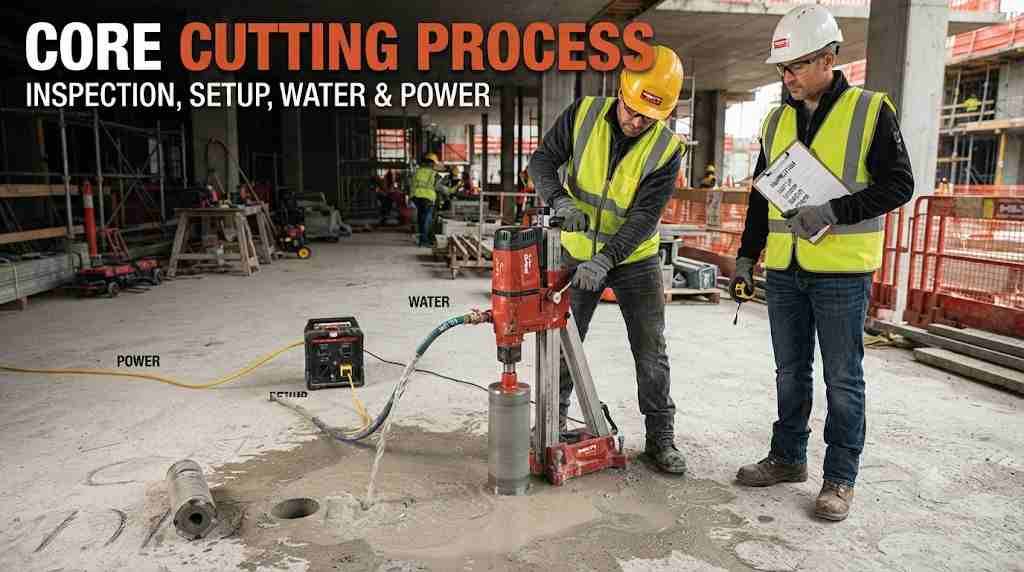
Most people only see two moments of a core cutting job: the crew arriving and the hole appearing. Everything in between happens quickly, noisily and with a lot of unseen care. Knowing what happens in that gap helps you prepare, ask the right questions and spot a careless crew.
This guide follows a typical core cutting visit in the order it happens, from the first look at your wall to the final cleanup. Along the way, it explains what the crew is doing at each stage, what they need from you, and why electricity and water matter so much. The timings and details vary by job, so treat this as a general picture, not a rulebook.
Curious what actually happens on cutting day? Or ready to book? 📞 Call: 7009679903 | 💬 WhatsApp: Ask about the process | ✉️ info@corecuttingindia.com
The Visit at a Glance
- Arrival and briefing
- Site inspection
- Marking and checking
- Setting up power and water
- Machine setup and anchoring
- Cutting
- Core removal
- Cleanup
- Inspection and handover
- Finishing the opening
Stage 1: Arrival and Briefing
The crew arrives with the equipment and meets whoever is on site. A good crew starts with a short conversation, not the machine.
What they usually confirm:
- The number, size and location of holes
- Who approves changes during the day
- Any special concerns, such as hidden pipes or structural elements
- Where power and water are available
What you can do: be ready with your hole list, photos and permissions. Keep one decision-maker available so questions get quick answers.
Stage 2: Site Inspection
Before anything is set up, a careful crew looks at the site. This is the stage that protects your building, your property and their own safety.
What the inspection covers
- The wall or slab: brick, RCC, thickness and condition
- Hidden services: steel bars, electrical conduits, water and gas pipes. Methods include checking drawings, looking at the other side of the wall and, where used, scanning equipment
- Structural elements: nearness to beams, columns, corners and openings. Structural elements need an engineer's approval before any cutting, as explained in our note on beam cutting
- Special risks: in some commercial or large-span slabs, tensioned cables may be present, and cutting one can be dangerous, so the crew should stop and ask if there's any doubt
- The surroundings: furniture, finishes, people and anything below the hole
If something looks wrong, the right move is to pause. For concrete-specific details, see what you need before concrete core cutting.
Stage 3: Marking and Checking the Position
The crew compares your chalk mark with the plan.
- The centre point and diameter are confirmed
- The hole is checked against nearby openings, edges and fixtures
- Slope is confirmed for AC pipes and drains
- The other side of the wall is checked for what the hole will meet and where the core will land
A professional will gladly re-check this stage, because a misplaced hole can't be undone.
Stage 4: Setting Up Power and Water
Now the two utilities that make the process work.
Electricity: why it matters
Core drilling machines use a motor to spin the bit at a steady speed through hard material. A weak or fluctuating supply makes the bit slow, stall or bind.
Setup steps:
- Locate a working power point near the cutting spot
- Run a properly rated extension cable along a dry, clear route
- Use earth-leakage protection, so a fault trips the circuit rather than shocking a person
- Keep cable joints and sockets away from wet areas
If power cuts are common where you live, tell the crew in advance and ask whether a generator is suitable. Machine ratings vary, so ask what your specific job needs.
Water: why it matters
Water cools the diamond bit, flushes out ground material and reduces dust. Without it, the bit overheats and wears quickly and the hole edge suffers.
Setup steps:
- Connect to a tap, tank or container
- Fit a hose or water feed to the cutting point
- Set up a collection tray or wet vacuum to catch slurry
- Lay plastic sheets around the area
For the reasoning behind each requirement, see core cutting requirements: electricity, water, space and safety.
Stage 5: Machine Setup and Anchoring
This is where the crew turns equipment into a stable cutting system.
The main parts
- The drill motor: powers the cutting
- The rig stand: a frame that holds the machine square to the surface
- The diamond core bit: a hollow barrel with diamond-set segments, chosen to match the hole diameter and material
- The water feed: delivers cooling water to the bit
What setup involves
- Choosing the bit for the diameter and material
- Positioning the stand squarely over the mark
- Anchoring the stand securely to the wall or floor, since movement during cutting can bend the bit or damage the hole
- Checking alignment and the angle, especially for sloping holes
- Attaching the machine and testing the water flow
Any movement of the rig is a safety and quality problem, so a good crew takes their time here.
Stage 6: The Cutting Itself
When everything is ready, cutting begins.
- The bit starts turning, with water flowing to the cutting edge
- The crew feeds the bit forward steadily and controls the pressure
- Slurry is collected as it comes out
- The crew watches the sound, the water and the progress, adjusting as needed
What can slow the job
- Reinforcement steel: cutting through bars takes longer and wears the bit faster
- Thick or hard material: takes more time
- Water or power interruptions: cause stops and restarts
- Awkward height or angle: requires extra care
When a crew should stop
- If the bit hits something unexpected
- If water stops or electricity trips unsafely
- If the rig moves or the surface cracks
- If a hidden service is suspected
Stopping and checking is a sign of professionalism, not weakness.
Stage 7: Core Removal
As the bit nears the far side, the crew prepares for the core to come free.
- The core is supported or caught where possible, so it doesn't fall unexpectedly
- Once free, the core is removed and set aside
- Anything on the far side is checked for damage or exposure
Core weight depends on diameter and depth, so handling is planned in advance. For larger openings that use different equipment, see wall cutting and slab cutting.
Stage 8: Cleanup
Cleanup should happen between holes and at the end, not just once.
- Slurry is vacuumed or mopped up before it dries
- The wall, floor and surroundings are wiped
- Plastic sheets are folded carefully, dirty side in
- Removed cores and debris are taken away or stacked as agreed
- Equipment is packed
For a deeper guide to protection and cleaning in finished spaces, see concrete cutting in finished buildings.
Stage 9: Inspection and Handover
Before the crew leaves, walk the site with them.
- Position: matches your mark and plan
- Diameter: correct for your pipe or duct
- Edge: smooth, with no cracks or chips
- Slope: right for AC or drainage lines
- Cleanliness: surfaces wiped, no leftover slurry
- Photographs: take pictures of every opening for your other trades
Raise any concern now, not a week later.
Stage 10: Finishing the Opening
A hole is not complete until it's sleeved and sealed.
- Fit sleeves for pipes and ducts
- Seal gaps against water, pests and air leaks
- Waterproof wet-area and outside openings
- Fire-stop where your building rules require it
- Repair any damaged finish
Ask your contractor what's included in their scope and what's left for your own trades.
What You Need to Arrange: Quick Summary
| Item | Your part | Contractor's part |
|---|---|---|
| Power | Working power point, stable supply | Cables, protection |
| Water | Tap or container within reach | Hoses, feed, collection tools |
| Space | Clear area and route | Rig positioning |
| Marking | Final positions and decisions | Verification |
| Permissions | Society, landlord, building | Site compliance |
| Equipment | Nothing | Machine, stand, bits, safety gear |
For a practical room-by-room walkthrough of your own preparation, see how to prepare your home for core cutting.
How Long Does It Take, and What Does It Cost?
Time and cost depend on the same things: hole diameter, thickness, material, reinforcement density, height, access and the number of holes. Small holes in plain walls can be quick, while thick reinforced concrete takes longer. Set-up and cleanup also take time, so batching holes into one visit is usually more efficient.
Use the Core Cutting Rate Calculator for a starting estimate. Our platform's general guide suggests roughly ₹150 to ₹800 per hole, though larger or harder jobs can exceed that. Confirm the final quote after the contractor has seen your photos, and ask what's included.
Signs of a Professional Crew
- They inspect before they set up
- They ask about wall type, steel, pipes and access
- They anchor the rig properly
- They control water and slurry
- They stop when something looks wrong
- They clean and let you inspect
Core Cutting India lists contractors with ratings and reviews on each profile. Start from the homepage and choose your city. For a hiring walkthrough, see what to arrange before hiring a core cutting service.
Local Note for Punjab Customers
On Punjab jobs, the inspection stage often shapes the day. Older houses may have thick, patched walls and wiring that doesn't match any drawing, while newer apartments bring society rules and working-hour limits. Summer demand can strain power in some areas, so mention backup plans, and in dense parts of Ludhiana, Amritsar and Jalandhar, narrow lanes and no-lift buildings affect how equipment is carried in. Share your locality, floor and building age when you call.
To compare contractors, ratings and reviews near you, see our Punjab core cutting service page. For Jalandhar kitchens and bathrooms, our guides on chimney hole cutting and exhaust fan hole cutting are useful starting points.
Frequently Asked Questions
What is the core cutting process?
It starts with site inspection and marking, then power and water setup, machine setup and anchoring, wet diamond cutting, core removal, cleanup, inspection and finally sealing the opening.
Why is site inspection important before core cutting?
It identifies hidden steel, pipes, wiring and structural elements, confirms the hole position and checks the surroundings, which protects your building and the crew.
Why does core cutting need water and electricity?
Electricity drives the motor that turns the bit, and water cools the bit, flushes out cuttings and reduces dust.
Who brings the machine for core cutting?
A professional crew normally brings the machine, rig stand, bits and accessories, but confirm this in your quote.
How long does core cutting take?
It depends on hole size, material, thickness, reinforcement and access, and set-up and cleanup add time. Ask your contractor for an estimate based on your photos.
How much does core cutting cost?
It depends on diameter, thickness, material, access and city. Our general range is about ₹150 to ₹800 per hole. Use the Rate Calculator and confirm with your contractor.
How do I book core cutting?
Call or WhatsApp 7009679903 with your city, hole sizes, wall type and photos for guidance and a quote.
Conclusion: A Good Process Makes a Good Hole
A clean, accurate core cut isn't luck. It comes from a sequence: inspect, mark, power, water, anchor, cut, clean and check. When the crew follows that sequence and you've prepared your part, the result is a smooth job and an opening that's ready for pipes, ducts or cables.
📞 Call or 💬 WhatsApp: 7009679903
✉️ Email: info@corecuttingindia.com 🌐 Website: corecuttingindia.com 🧮 Instant estimate: Rate Calculator