
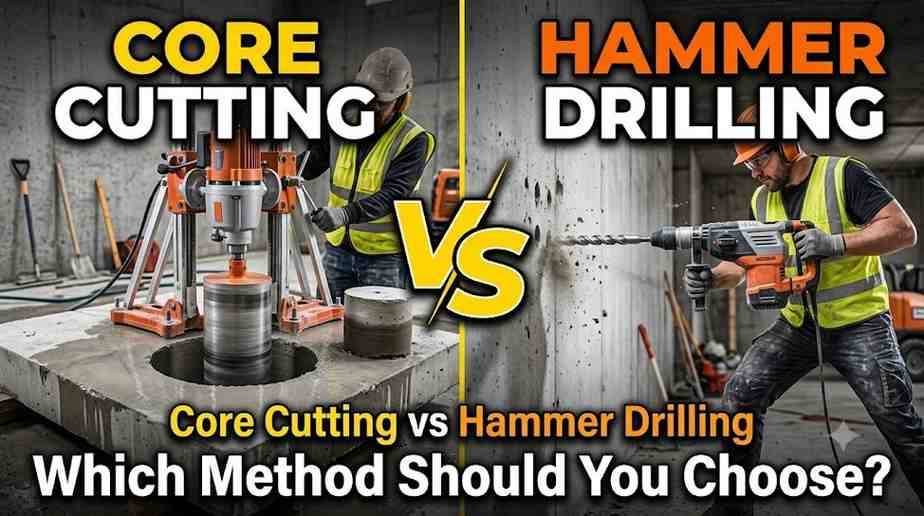
When it comes to making holes or openings in concrete, brick, or RCC walls, two methods dominate the construction and renovation industry: core cutting and hammer drilling. Both get the job done, but they work in completely different ways — and choosing the wrong one can mean cracked walls, structural damage, or a job that takes twice as long as it should.
In this guide, we compare core cutting vs hammer drilling across cost, speed, precision, safety, and best-use cases, so you know exactly which method to choose for your next project.
What Is Core Cutting?
Core cutting is a precision drilling technique that uses a hollow, diamond-tipped drill bit to cut clean, circular holes through concrete, RCC, brick, and stone. The bit rotates at high speed while water is fed continuously into the cut to cool the diamond segments and flush out debris — resulting in a smooth, accurate hole with almost no dust or vibration.
This method is widely used for AC pipe installation, plumbing lines, electrical conduits, CCTV cabling, and structural openings. You can learn more about the full process on our core cutting services page.
What Is Hammer Drilling?
Hammer drilling uses a rotary hammer or impact drill fitted with a standard masonry bit. The tool combines rotation with rapid hammering action to break through concrete or brick. It's a fast, low-cost method commonly used for smaller holes — like fixing screws, anchors, wall mounts, or shelving brackets.
Unlike core cutting, hammer drilling relies on impact force rather than a smooth cutting action, which means it can create more dust, vibration, and micro-cracks around the drilled area, especially in larger or deeper holes.
Core Cutting vs Hammer Drilling: Key Differences
| Factor | Core Cutting | Hammer Drilling |
|---|---|---|
| Hole Size | 50mm to 300mm+ diameter | Typically under 20mm |
| Precision | Very high — clean, exact circular cuts | Lower — rougher edges, possible chipping |
| Dust & Vibration | Minimal (wet drilling) | High (dry impact drilling) |
| Structural Safety | Safe for RCC, beams, slabs when planned correctly | Risk of micro-cracks on larger holes |
| Speed for Large Holes | Fast and efficient | Slow and labor-intensive |
| Best For | Pipes, conduits, cables, structural openings | Screws, anchors, small fixtures |
| Cost | Slightly higher per hole | Lower for small jobs |
| Equipment | Diamond core drilling rig | Rotary hammer/impact drill |
When Should You Use Core Cutting?
Core cutting is the right choice when you need:
- Larger diameter holes (50mm and above) for AC pipes, drainage, or plumbing
- Clean, structurally safe openings in RCC walls, slabs, or beams — see our guide on beam cutting service
- Minimal dust and noise, especially in occupied residential or commercial spaces
- Precision work where the hole size and shape must be exact, such as for slab cutting or utility installations
- Structural testing, such as concrete core sampling for strength analysis
Core cutting is also the preferred method in sensitive retrofitting projects — as explained in our articles on seismic retrofitting and fire safety system retrofitting, where minimizing structural stress on aging buildings is critical.
When Should You Use Hammer Drilling?
Hammer drilling makes more sense for:
- Small holes for wall mounts, curtain rods, shelves, or picture frames
- Anchor bolts and fasteners in brick or concrete
- Quick, low-budget jobs that don't require structural precision
- DIY home tasks where a handheld drill is sufficient
For anything beyond small fixtures — especially structural openings or larger utility holes — core cutting is the safer, cleaner, and more professional choice.
Cost Comparison: Core Cutting vs Hammer Drilling
Hammer drilling is generally cheaper for small holes since it requires basic equipment and less labor time. However, for medium-to-large holes, core cutting is actually more cost-effective and safer, because it avoids cracking, redo work, and structural damage that hammer drilling can cause at scale.
Core cutting costs in India typically range from ₹150 to ₹800 per hole depending on diameter, material, and location. Get an instant, accurate estimate using our free Rate Calculator.
Why Precision and Safety Matter
Choosing the wrong drilling method on a load-bearing wall, beam, or slab can lead to serious structural issues — including cracks that weaken the building over time. This is why professional contractors always assess:
- Location of rebar and embedded utilities
- Wall or slab thickness and material type
- Whether the surface is load-bearing
- The exact hole diameter and depth required
At Core Cutting India, every contractor listed on the platform is verified through business checks, portfolio review, and customer ratings — so you always get a professional who understands the difference between when to core cut and when hammer drilling is enough.
Explore related services in your city:
- Core Cutting Service
- Wall Cutting Service
- Slab Cutting Service
- Beam Cutting Service
- Door Cutting Service
- Roof Cutting Service
Or find verified local experts in top cities: Mumbai, Bengaluru, Hyderabad, Chennai, Gurugram, Noida, and Pune.
Need Expert Advice on Which Method to Use?
Not sure whether your project needs core cutting or hammer drilling? Our verified contractors across 500+ cities in India can assess your requirement and recommend the safest, most cost-effective method — with same-day service available in major metros.
📞 Call us now: 7009679903 💬 WhatsApp for a free quote: Chat on WhatsApp ✉️ Email: [email protected] 🌐 Visit: corecuttingindia.com
Get a free consultation and instant quote from verified contractors near you today.
Frequently Asked Questions (FAQ)
1. What is the main difference between core cutting and hammer drilling? Core cutting uses a diamond-tipped bit to cut clean, precise circular holes with water cooling, while hammer drilling uses impact force to break through concrete or brick, generally for smaller holes with less precision.
2. Which method is safer for RCC walls? Core cutting is generally safer for RCC walls, especially for larger holes, because it doesn't cause the micro-cracking or vibration stress associated with hammer drilling.
3. Is hammer drilling cheaper than core cutting? For small holes (like anchor points or wall mounts), hammer drilling is cheaper. For medium-to-large holes, core cutting is more cost-effective overall since it avoids cracking and redo costs.
4. Can hammer drilling be used for AC pipe holes? It's not recommended. AC pipe holes typically require 50mm+ diameter openings, which are best done with core cutting for a clean, structurally safe result.
5. Does core cutting create less dust than hammer drilling? Yes. Core cutting is a wet-drilling process that significantly reduces dust compared to the dry impact method used in hammer drilling.
6. How do I know which method my project needs? It depends on hole size, material, and whether the wall is load-bearing. For holes under 20mm for fixtures, hammer drilling works fine. For anything larger or structural, core cutting is recommended. A verified contractor can assess this for free.
7. How much does core cutting cost compared to hammer drilling? Core cutting costs ₹150–₹800 per hole depending on diameter and material, while hammer drilling for small anchor holes is usually a fraction of that cost but is limited to small-scale work.
8. Where can I find verified core cutting contractors near me? Search by city and service type on Core Cutting India to compare verified, rated contractors, or call 7009679903 for immediate assistance.
Not sure which method fits your project? Call 7009679903, WhatsApp us, or email [email protected] for a free expert recommendation from verified contractors in your city.