
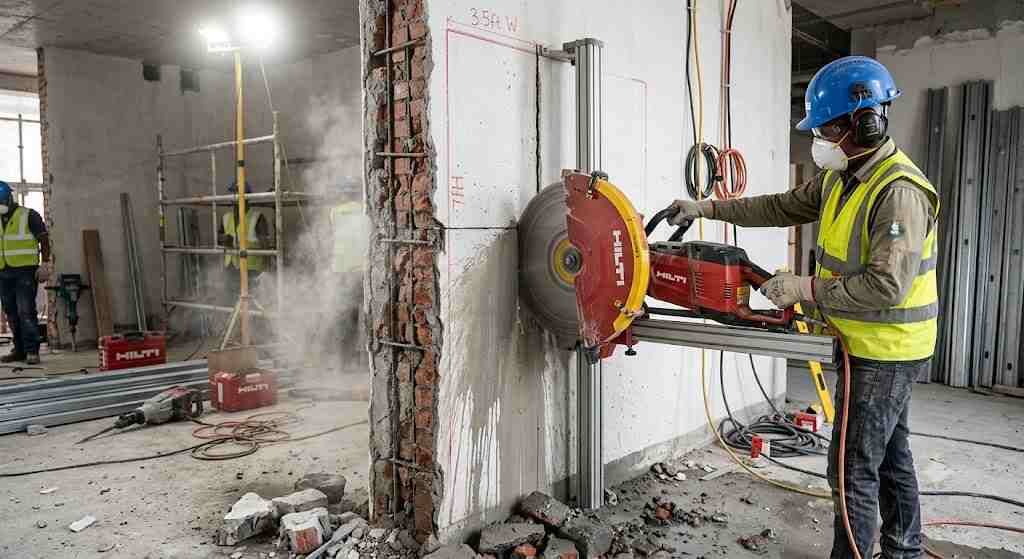
Wall cutting is a common requirement during construction, renovation, electrical work, plumbing installation, AC installation, exhaust fan installation, chimney installation, and structural modification. However, cutting a wall safely requires proper planning, the right equipment, trained workers, and careful inspection before cutting.
If you are wondering how to cut a wall safely, the most important rule is simple: never start cutting until you know what type of wall you are cutting and whether electrical wires, plumbing pipes, reinforcement bars, or other services are present inside it.
Depending on the wall material, thickness, required opening, and purpose, professionals may use diamond core cutting, wall cutting machines, concrete cutters, diamond blades, or other specialized equipment.
This guide explains everything you need to know about safe wall cutting, including RCC wall cutting, concrete wall cutting, brick wall cutting, wall core cutting, hole cutting, safety precautions, equipment, cost factors, and frequently asked questions.
Quick Answer: How Do You Cut a Wall Safely?
To cut a wall safely, follow these basic steps:
-
Identify the wall material — brick, block, concrete, RCC, or another material.
-
Check the wall thickness before selecting the cutting method.
-
Inspect for electrical wires, plumbing pipes, gas lines, and reinforcement steel.
-
Use a wall scanner or suitable detection equipment wherever applicable.
-
Mark the exact cutting location and dimensions.
-
Select the correct diamond blade, core bit, or wall-cutting equipment.
-
Wear appropriate PPE, including eye, hearing, respiratory, hand, and head protection.
-
Secure the work area and keep unauthorized people away.
-
Start cutting slowly and maintain control of the equipment.
-
Avoid cutting structural elements without professional assessment and approval.
-
Control dust and water safely according to the cutting method and site conditions.
-
Inspect the finished opening and clean the work area after cutting.
For structural walls, large openings, beams, columns, slabs, or heavily reinforced RCC, professional assessment is strongly recommended before cutting.
What Is Wall Cutting?
Wall cutting is the controlled process of creating a hole, groove, opening, or section in a wall using specialized cutting equipment.
Wall cutting may be required for:
-
AC pipe holes
-
AC outdoor unit connections
-
Exhaust fan holes
-
Kitchen chimney openings
-
Electrical conduits
-
Plumbing pipes
-
Drainage pipes
-
Ventilation openings
-
Door openings
-
Window openings
-
Cable routes
-
Ducting
-
HVAC installations
-
Construction modifications
-
Renovation work
-
RCC wall openings
-
Concrete wall openings
The cutting technique depends on the material, thickness, diameter, depth, location, and purpose of the opening.
For example, a small circular hole through a concrete wall may be created using diamond core cutting, while a large rectangular opening may require a different wall-cutting method.
Why Is Safe Wall Cutting Important?
Wall cutting may appear simple, but an incorrectly planned cut can create significant risks.
A wall can contain hidden:
-
Electrical cables
-
Water pipes
-
Drainage pipes
-
Gas lines
-
Steel reinforcement
-
Communication cables
-
Structural reinforcement
-
Embedded services
Cutting through an electrical cable can create an electrical hazard. Cutting a water pipe can cause leakage and property damage. Cutting reinforcement or structural elements without proper assessment can potentially compromise structural integrity.
Therefore, safe wall cutting is not just about using a powerful machine. It is about identifying the wall, understanding what is inside it, selecting the correct equipment, and controlling the entire cutting process.
Step 1: Identify the Type of Wall
Before cutting, determine what material the wall is made from.
Common wall types include:
1. Brick Wall
Brick walls are common in residential and commercial buildings. They are generally easier to cut than heavily reinforced concrete, but the wall should still be checked before cutting.
2. Block Wall
Concrete blocks, AAC blocks, and other masonry blocks may require different cutting techniques depending on their density and thickness.
3. Concrete Wall
Concrete walls can be significantly harder than brick or lightweight blocks. Diamond cutting tools are commonly used for controlled cutting.
4. RCC Wall
RCC, or reinforced cement concrete, contains steel reinforcement inside concrete.
RCC wall cutting requires additional care because the cutter may encounter reinforcement bars.
5. Structural Wall
If the wall may be carrying structural loads, do not treat it as an ordinary partition wall. A structural professional should assess the proposed opening before cutting.
Step 2: Measure Wall Thickness
Wall thickness is one of the most important factors when planning a cutting job.
For example, the requirement may be:
-
4-inch wall
-
6-inch wall
-
9-inch wall
-
10-inch wall
-
12-inch wall
-
18-inch wall
-
24-inch wall
The actual thickness should ideally be measured rather than estimated.
Wall thickness affects:
-
Machine selection
-
Diamond bit selection
-
Cutting depth
-
Cutting time
-
Labour requirements
-
Water requirements
-
Dust control
-
Risk assessment
-
Project cost
A 3-inch hole through a thin brick partition is a very different job from a 6-inch hole through a thick RCC wall.
Step 3: Check for Hidden Wires and Pipes
One of the most important wall-cutting safety precautions is checking for hidden services.
Before drilling or cutting, inspect the area for:
-
Electrical wiring
-
Water supply pipes
-
Drainage pipes
-
Gas lines
-
Internet cables
-
Telephone cables
-
HVAC lines
-
Reinforcement steel
A wall scanner or suitable detection device may help identify some embedded materials. However, detection devices are not infallible, so their readings should be interpreted carefully and combined with information from drawings, building plans, visible services, and site inspection.
If you are unsure about what is inside the wall, do not simply start cutting.
Step 4: Determine Whether the Wall Is Structural
This is especially important for RCC walls.
Not every RCC wall can be safely modified in the same way.
Before creating a large opening in a potentially structural wall, determine:
-
Whether the wall is load-bearing
-
Whether it forms part of the structural system
-
Where reinforcement is located
-
Whether the opening affects structural performance
-
Whether engineering approval is required
Small service penetrations may be very different from large openings.
For example:
A small AC pipe hole is not equivalent to creating a large door or window opening in an RCC structural wall.
If a proposed opening is large or potentially structural, consult a qualified structural engineer before cutting.
Step 5: Mark the Cutting Location
Once the wall has been inspected, accurately mark the cutting area.
For a circular hole, mark:
-
Required diameter
-
Centre point
-
Entry location
-
Exit location
For a rectangular opening, mark:
-
Width
-
Height
-
Corners
-
Required depth
Accurate marking helps prevent:
-
Oversized holes
-
Misaligned holes
-
Incorrect positioning
-
Damage to nearby finishes
-
Rework
For professional work, the measurement should be confirmed with the customer or site supervisor before cutting.
Step 6: Select the Correct Cutting Method
There is no single machine that is ideal for every wall-cutting job.
The method depends on the job.
Diamond Core Cutting
Diamond core cutting is commonly used to create precise circular holes in concrete, RCC, brick, and other masonry materials.
It can be useful for:
-
AC holes
-
Chimney holes
-
Exhaust fan holes
-
Plumbing penetrations
-
Electrical conduits
-
HVAC penetrations
-
Cable penetrations
The main advantage is that it can produce a relatively clean, accurate circular opening.
Wall Sawing
Wall sawing can be suitable for larger straight cuts or openings, depending on the wall and equipment.
It may be used for:
-
Door openings
-
Window openings
-
Large rectangular openings
-
Construction modifications
Because larger cuts can affect structural elements, professional assessment may be required before starting.
Diamond Blade Cutting
Diamond blades can be used for certain masonry and concrete cutting applications.
The correct blade should match:
-
Material
-
Thickness
-
Machine
-
Required cutting depth
-
Cutting method
Using an inappropriate blade can reduce cutting performance and increase wear.
What Is Core Cutting?
Core cutting is the process of creating a circular hole through a wall, slab, or other construction material using a cylindrical diamond core bit.
The core bit removes a cylindrical section of material.
For example, a professional may use core cutting to create:
-
2-inch holes
-
3-inch holes
-
4-inch holes
-
5-inch holes
-
6-inch holes
-
Larger diameter openings
The actual hole size should be confirmed based on the required installation and equipment specifications.
Core cutting is often preferred when a clean and accurately sized circular opening is required.
How Does Diamond Core Cutting Work?
A diamond core bit contains diamond segments designed to grind through hard construction materials.
During cutting:
-
The machine rotates the core bit.
-
Diamond segments contact the wall.
-
The diamond segments gradually grind through the material.
-
The cylindrical core is removed.
-
The resulting opening can be used for the intended service.
Depending on the machine and setup, cutting may be performed using water to cool the bit and control dust.
Why Is Diamond Cutting Used for Concrete and RCC?
Concrete and RCC are hard materials.
Traditional drilling methods may not provide the same level of precision or efficiency for larger penetrations.
Diamond cutting is widely used because diamond tooling is designed for hard construction materials.
Potential advantages include:
-
Accurate holes
-
Cleaner edges
-
Controlled cutting
-
Reduced vibration compared with some impact methods
-
Ability to cut hard concrete
-
Ability to work through reinforced concrete with appropriate equipment and tooling
However, the machine and tooling must be selected correctly for the actual material.
How to Cut a Brick Wall Safely
Brick wall cutting requires fewer considerations than some reinforced concrete applications, but safety remains important.
Recommended process:
-
Identify the brick wall.
-
Check the wall thickness.
-
Inspect for electrical and plumbing services.
-
Mark the required opening.
-
Select the appropriate cutting tool.
-
Secure the work area.
-
Wear PPE.
-
Cut carefully.
-
Avoid unnecessary damage to surrounding bricks.
-
Inspect and finish the opening.
For circular openings, a suitable diamond core bit can provide a cleaner result than uncontrolled breaking.
How to Cut an RCC Wall Safely
RCC wall cutting requires greater attention because reinforced concrete contains steel reinforcement.
Before cutting an RCC wall:
1. Identify reinforcement
Use available structural drawings or appropriate detection methods where possible.
2. Assess structural importance
Determine whether the wall is structural or contains important reinforcement.
3. Obtain professional approval when required
Large or structural openings should be reviewed by a qualified structural engineer.
4. Select suitable equipment
Use equipment and diamond tooling appropriate for reinforced concrete.
5. Control the work area
RCC cutting can generate noise, slurry, dust, and debris.
6. Protect surrounding areas
Cover sensitive surfaces and isolate the work zone.
7. Cut under controlled conditions
Do not force the machine through the material.
8. Inspect after cutting
Check the opening and surrounding wall for unwanted cracking or damage.
Can You Cut a Load-Bearing Wall?
A load-bearing wall should not be cut simply because the required hole or opening appears small.
The correct answer depends on:
-
Wall construction
-
Building design
-
Load path
-
Reinforcement
-
Opening size
-
Opening position
-
Structural system
A small service penetration may have a different structural impact from a large opening.
If you suspect a wall is load-bearing, consult a qualified structural engineer before making a significant opening.
Can You Cut Through Reinforcement Steel?
Diamond tools designed for reinforced concrete can encounter reinforcement steel.
However, reinforcement is not simply an obstacle that should automatically be cut.
Steel reinforcement may be an important part of the structural system.
Therefore:
Do not intentionally cut structural reinforcement unless the cutting plan has been reviewed and approved by an appropriately qualified professional.
For structural modifications, the objective should be to create the required opening while maintaining the safety and integrity of the structure.
Wall Cutting Safety Equipment
Proper PPE is essential during wall cutting.
Depending on the work environment and equipment, workers may require:
-
Safety helmet
-
Safety glasses
-
Face protection
-
Hearing protection
-
Suitable gloves
-
Safety footwear
-
Appropriate respiratory protection
-
High-visibility clothing
-
Fall protection when working at height
PPE should be selected based on the actual hazards and workplace requirements.
Why Eye Protection Is Important During Wall Cutting
Wall cutting can produce:
-
Dust
-
Small particles
-
Concrete fragments
-
Brick fragments
-
Water droplets
-
Slurry
Eye protection helps reduce the risk of particles entering the eyes.
For jobs involving significant debris or high-energy cutting, additional face protection may be appropriate.
Why Hearing Protection Is Important
Core cutting and concrete cutting equipment can generate high noise levels.
Long exposure to high noise can damage hearing.
Therefore, workers should use appropriate hearing protection where required by the equipment and site conditions.
Electrical Safety During Wall Cutting
Electrical safety is extremely important.
Before cutting:
-
Identify electrical circuits where possible.
-
Check for visible wiring routes.
-
Use appropriate detection equipment.
-
Isolate electrical circuits when necessary.
-
Keep electrical equipment and connections protected from water.
-
Follow applicable electrical safety procedures.
Never assume that because no wire is visible, there is no electrical cable inside the wall.
Water and Wet Cutting Safety
Some diamond cutting operations use water for cooling and dust control.
Water can create another hazard: electricity and water are a dangerous combination.
Therefore:
-
Keep electrical connections away from water.
-
Use suitable electrical protection.
-
Control water runoff.
-
Prevent slippery floors.
-
Protect nearby electrical equipment.
-
Clean slurry promptly.
Wet cutting should always be performed using equipment and procedures appropriate for the environment.
Dust Control During Wall Cutting
Concrete and masonry cutting can generate respirable dust.
Dust control is therefore an important part of safe cutting.
Possible controls include:
-
Wet cutting where appropriate
-
Local dust extraction
-
Suitable respiratory protection
-
Area isolation
-
Ventilation
-
Proper cleanup
Do not allow dust to spread unnecessarily through occupied buildings.
If cutting is being performed inside a home, office, hospital, commercial property, or other occupied building, additional containment may be necessary.
How to Cut a Wall for an AC Hole
One of the most common wall-cutting applications is an AC pipe hole.
A typical process is:
-
Confirm the AC installation position.
-
Determine the required hole diameter.
-
Check wall thickness.
-
Inspect for hidden services.
-
Mark the hole location.
-
Check the required slope and installation direction.
-
Select suitable core cutting equipment.
-
Secure the machine.
-
Perform the cut carefully.
-
Remove the core.
-
Clean the hole.
-
Install the AC sleeve or pipe according to the AC installation requirements.
The required diameter should be confirmed by the AC installer rather than assumed.
How to Cut a Wall for a Chimney
Kitchen chimney installations may require a larger circular opening than a typical AC pipe penetration.
Before cutting:
-
Confirm chimney duct diameter.
-
Confirm the installation height.
-
Confirm the centre point.
-
Check the wall material.
-
Inspect for hidden services.
-
Confirm wall thickness.
-
Select suitable cutting equipment.
A properly sized core-cut hole can provide a cleaner installation.
How to Cut a Wall for an Exhaust Fan
Exhaust fan holes are another common application.
The required hole diameter depends on the fan and duct design.
Before cutting:
-
Confirm the fan model.
-
Confirm the manufacturer's required opening size.
-
Mark the centre.
-
Inspect the wall.
-
Select the appropriate core bit.
-
Protect the surrounding area.
-
Cut the opening.
-
Remove the core.
-
Clean and finish the opening.
Do not determine the hole diameter only by looking at the fan face. Always verify the required installation opening.
How Long Does Wall Cutting Take?
There is no single answer because cutting time depends on:
-
Wall material
-
Wall thickness
-
Hole diameter
-
Number of holes
-
Reinforcement
-
Machine power
-
Diamond bit condition
-
Site accessibility
-
Working height
-
Water availability
-
Operator experience
For example, a small hole in a thin brick wall can be significantly faster than a large hole through thick reinforced concrete.
Multiple holes at one location can also take less time per hole than isolated jobs because machine setup and transportation are shared.
What Factors Affect Wall Cutting Cost?
Wall cutting prices vary by location and job requirements.
Common pricing factors include:
Hole Diameter
Larger holes generally require larger and more expensive tooling.
Wall Thickness
A thicker wall takes more cutting time and may require more powerful equipment.
Material
Brick, AAC block, concrete, and RCC can have different cutting requirements.
Number of Holes
A project with many holes may have a different per-hole price than a single hole.
Reinforcement
Reinforced concrete can require specialized tooling and additional cutting time.
Accessibility
Difficult locations can increase labour and setup requirements.
Height
Working at height may require additional access equipment and safety measures.
Location
Transportation and mobilization can affect the final price.
Cleanup
Some projects require extensive slurry and debris cleanup.
How to Choose a Professional Wall Cutting Service
When hiring a wall cutting contractor, do not choose only based on the lowest price.
Consider:
-
Experience
-
Equipment
-
Diamond tooling
-
Safety practices
-
Previous projects
-
Ability to handle RCC
-
Ability to work at required heights
-
Professional operators
-
Clear pricing
-
Site assessment
-
Customer reviews
-
Response time
-
Cleanup practices
A professional contractor should be able to understand the difference between a simple brick-wall hole and a potentially structural RCC modification.
Common Wall Cutting Mistakes to Avoid
Mistake 1: Cutting Without Checking the Wall
Never assume that every wall is safe to cut.
Mistake 2: Ignoring Hidden Services
Electrical cables and plumbing pipes can be concealed inside walls.
Mistake 3: Using the Wrong Bit
The tooling should match the wall material and required hole size.
Mistake 4: Forcing the Machine
Excessive force can increase wear and reduce cutting control.
Mistake 5: Ignoring Reinforcement
Reinforcement can indicate that the wall requires additional assessment.
Mistake 6: Cutting Structural Elements Without Approval
Large structural openings should be professionally assessed.
Mistake 7: Ignoring Dust and Slurry
Dust and water runoff can damage property and create health or slip hazards.
Mistake 8: Working Without PPE
Even small wall-cutting jobs can produce dangerous debris and noise.
Mistake 9: Poor Measurement
An incorrectly positioned or oversized hole can cause installation problems.
Mistake 10: Failing to Protect the Site
Furniture, flooring, electrical equipment, and finished surfaces should be protected where necessary.
DIY Wall Cutting vs Professional Wall Cutting
Many homeowners ask whether they can cut a wall themselves.
For very simple, non-structural work using appropriate equipment and after confirming the absence of hidden services, some minor cutting tasks may be possible.
However, professional wall cutting is preferable when:
-
The wall is RCC.
-
The wall is thick.
-
The wall may be structural.
-
Reinforcement is present.
-
The opening is large.
-
The work is at height.
-
The building is occupied.
-
Electrical or plumbing services are nearby.
-
Specialized diamond equipment is required.
-
Multiple holes are required.
-
Precision is important.
The biggest advantage of a professional service is not simply the machine. It is the combination of site assessment, equipment selection, operator experience, safety procedures, and controlled execution.
What Is the Difference Between Wall Drilling and Core Cutting?
Wall drilling and core cutting are not always the same.
Wall Drilling
Drilling usually refers to creating a relatively small hole using a drill and drill bit.
Core Cutting
Core cutting uses a cylindrical diamond core bit to create a larger, more precise circular opening.
Core cutting is commonly used for service penetrations where a clean, specific diameter is required.
What Is Diamond Core Cutting?
Diamond core cutting uses a core bit containing diamond segments to cut through hard construction materials.
It is commonly used in:
-
Concrete
-
RCC
-
Brick
-
Masonry
-
Stone
-
Other suitable construction materials
The exact capability depends on the equipment, bit, material, and site conditions.
Is Wall Cutting Dangerous?
Wall cutting can be hazardous if performed incorrectly.
Potential hazards include:
-
Electrical shock
-
Contact with hidden pipes
-
Falling debris
-
Dust exposure
-
Excessive noise
-
Tool kickback or loss of control
-
Slips caused by water
-
Structural damage
-
Working-at-height hazards
Most of these risks can be reduced through proper planning, equipment, PPE, trained operators, and appropriate site controls.
Wall Cutting Safety Checklist
Before starting a wall-cutting project, use this checklist:
Site Inspection
-
Identify wall material
-
Measure wall thickness
-
Determine whether wall is structural
-
Locate visible services
-
Check drawings if available
-
Scan/check for hidden services where appropriate
-
Confirm opening size
Equipment
-
Correct machine selected
-
Correct diamond bit/blade selected
-
Equipment inspected
-
Bit/blade in suitable condition
-
Water supply arranged if wet cutting
-
Dust control arranged
Safety
-
Helmet
-
Eye protection
-
Hearing protection
-
Appropriate gloves
-
Safety footwear
-
Respiratory protection where required
-
Work area isolated
-
Electrical safety confirmed
-
Working-at-height protection where applicable
Execution
-
Marking confirmed
-
Machine properly positioned
-
Cutting performed under control
-
No unauthorized people in work area
-
Dust/slurry controlled
-
Structural issues monitored
Completion
-
Core removed
-
Opening inspected
-
Debris removed
-
Slurry cleaned
-
Surrounding area checked
-
Opening handed over to customer/site team
Frequently Asked Questions About Wall Cutting
How do you cut a wall safely?
To cut a wall safely, first identify the wall material and thickness, inspect for hidden electrical wires and pipes, determine whether the wall is structural, mark the required opening, choose appropriate cutting equipment, use PPE, secure the work area, and perform the cut under controlled conditions.
What is the safest way to cut a concrete wall?
For circular penetrations, suitable diamond core cutting equipment is commonly used because it can create controlled, accurately sized openings. Structural concrete walls should be assessed before significant cutting.
Can you core cut an RCC wall?
Yes, appropriate diamond core cutting equipment can be used on reinforced concrete. However, reinforcement and structural considerations must be addressed before cutting.
Can I cut a load-bearing wall for an AC hole?
Do not assume that an AC hole is automatically safe simply because it is small. A qualified professional should determine whether the proposed location and size are acceptable when the wall is load-bearing or structurally important.
How do I know if there are wires inside a wall?
Visible installation information, building drawings, service routes, and suitable wall-scanning/detection equipment can help identify concealed services. No detection method should be treated as an absolute guarantee.
Can a wall scanner detect concrete?
Different wall scanners have different capabilities. Some can help identify materials or objects embedded in walls, but the device must be suitable for the specific application and used according to its manufacturer's instructions.
What PPE is required for wall cutting?
Depending on the task, PPE can include safety glasses or face protection, hearing protection, suitable gloves, safety footwear, a helmet, respiratory protection, and fall protection where required.
Is wet cutting safer than dry cutting?
Wet cutting can help control dust and cool certain diamond tools, but it introduces water and electrical hazards. The appropriate method depends on the equipment, material, environment, and site conditions.
How much does wall cutting cost?
Wall cutting cost depends on hole diameter, wall thickness, material, reinforcement, number of holes, accessibility, location, equipment requirements, and labour. A site-specific quotation is more reliable than a generic price.
How much does RCC wall cutting cost?
There is no universal RCC wall-cutting rate. Cost depends on thickness, hole size, reinforcement, number of cuts, access, equipment, and location.
How long does core cutting take?
The cutting time varies depending on material, thickness, diameter, reinforcement, equipment, bit condition, and accessibility. Setup and cleanup can also add significant time.
Can diamond core cutting damage a wall?
Any cutting operation can potentially cause damage if performed incorrectly. Proper positioning, suitable equipment, controlled cutting, and structural assessment help reduce unnecessary damage.
Can you cut through brick walls?
Yes. Brick walls can be cut using suitable masonry and diamond cutting equipment. The wall should still be checked for concealed electrical and plumbing services.
Can you cut a concrete wall without dust?
Dust can often be significantly reduced using appropriate wet-cutting or dust-extraction methods, but completely eliminating dust is not always possible.
What size hole can be core cut?
Core cutting equipment is available for a wide range of hole sizes. The maximum practical diameter depends on the machine, core bit, wall thickness, material, and site conditions.
Should I use a normal drill for a large wall hole?
A normal drill may not be appropriate for large-diameter holes through concrete or RCC. Specialized core cutting equipment is generally more suitable for larger circular penetrations.
Professional Wall Cutting Services in India
If you need wall cutting for an AC, chimney, exhaust fan, plumbing pipe, electrical conduit, ventilation system, or construction project, the correct method depends on the wall material, thickness, hole diameter, and site conditions.
Core Cutting India provides professional core cutting and wall cutting services for different construction requirements.
Services can include:
-
RCC wall core cutting
-
Concrete wall cutting
-
Brick wall cutting
-
AC hole cutting
-
Chimney hole cutting
-
Exhaust fan hole cutting
-
Wall core cutting
-
Slab core cutting
-
Beam cutting
-
Door opening cutting
-
Large wall openings
-
Construction cutting
-
Diamond core cutting
Before work starts, the required hole size, wall thickness, material, location, and site accessibility should be confirmed.
For projects involving potentially structural walls, beams, columns, or large openings, appropriate structural assessment should be obtained before cutting.
Wall Cutting in Delhi NCR and Other Indian Cities
Wall cutting requirements are common across residential, commercial, industrial, and construction projects in India.
Typical applications include:
Delhi: AC holes, chimney holes, RCC cutting, exhaust openings, renovation work and commercial construction.
Noida: Residential construction, commercial projects, HVAC openings and concrete cutting.
Gurugram: Office fit-outs, commercial buildings, HVAC installations and renovation projects.
Ghaziabad: Residential and commercial wall cutting, AC holes and plumbing penetrations.
Bengaluru: Construction, renovation, HVAC, plumbing and service penetrations.
Mumbai: Concrete and RCC cutting for residential, commercial and infrastructure projects.
The actual service availability, price, and response time depend on the project location and available cutting team.
Why Professional Core Cutting Is Better for Precision Work
Professional core cutting is particularly useful when the customer requires a specific hole diameter and a relatively clean opening.
Instead of repeatedly breaking the wall with a hammer or unsuitable drill, a properly selected diamond core bit can create a controlled circular opening.
This can be especially useful for:
-
AC installation
-
Chimney installation
-
Exhaust fan installation
-
Plumbing
-
Drainage
-
Electrical conduits
-
HVAC ducting
-
Cable routes
However, professional cutting should always begin with safety and site assessment rather than simply starting the machine.
Final Safety Advice
The most important thing to remember is that wall cutting is not simply a drilling job.
Every wall is different.
A thin brick partition and a reinforced RCC structural wall can have completely different risks and cutting requirements.
Before cutting any wall:
Identify the material → measure thickness → check hidden services → assess structural importance → mark the opening → select the right equipment → wear PPE → secure the site → cut carefully → inspect and clean.
If there is any doubt about the structural role of the wall or the presence of critical services, stop and get the appropriate professional assessment.
A properly planned wall-cutting job can provide a precise opening while minimizing unnecessary damage, dust, noise, and safety risks.
Quick Summary: Safe Wall Cutting in 10 Steps
-
Identify the wall material.
-
Measure the wall thickness.
-
Check for electrical wires and pipes.
-
Determine whether the wall is structural.
-
Confirm the required hole or opening size.
-
Choose the correct diamond cutting equipment.
-
Use appropriate PPE.
-
Protect the surrounding area.
-
Cut under controlled conditions.
-
Inspect and clean the finished opening.
When the wall is RCC, heavily reinforced, structural, unusually thick, or the opening is large, professional assessment and specialized equipment are strongly recommended.