
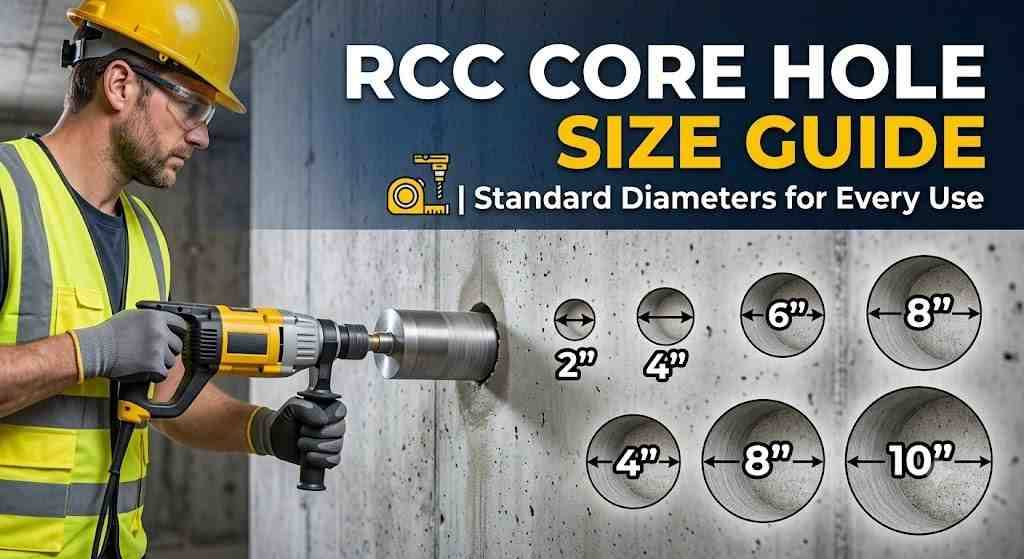
One of the most common questions we get on 7009679903 isn't "how much does core cutting cost" — it's "what size hole do I even need?" Get the diameter wrong and you end up with a pipe that won't fit, a duct that's too tight for insulation, or a hole so oversized it needs extra plastering to fix.
This guide breaks down standard RCC core hole sizes by use case — AC pipes, plumbing, electrical conduits, HVAC ducts, and structural sampling — so you can tell your contractor exactly what you need, or double-check the quote you've already received.
📞 Call / WhatsApp: 7009679903 | 📧 Email: [email protected] | 🌐 corecuttingindia.com
Not Sure Which Size You Need? Just Ask Us
Send us a photo of your pipe or fitting on WhatsApp — we'll tell you the correct core hole size, free of cost.
[📞 Call Now: 7009679903] [💬 WhatsApp Your Pipe/Fitting Details]
Quick Answer: Core Hole Sizes at a Glance
Core hole diameters in RCC construction typically range from 6mm to 600mm. Small holes (6mm–32mm) are for anchors, cables, and rebar dowels. Mid-size holes (40mm–110mm) cover electrical conduits, AC lines, and plumbing. Large holes (150mm–600mm) are for HVAC ducts, industrial extraction, and basement dewatering systems.
The golden rule: always drill 5–10mm larger than your pipe or conduit's outer diameter, to leave room for insulation, sealant, or thermal expansion — never drill an exact-fit hole.
Why Hole Size Matters More Than People Think
Getting the diameter wrong isn't just inconvenient — it's expensive to fix.
- Too small: The pipe or conduit won't pass through, forcing a second drilling visit and a bigger, uglier hole than if it had been sized correctly the first time.
- Too large: You'll need extra sealant, fire-rated foam, or masonry filler around the pipe — adding cost and creating a weak point for water seepage or fire-safety non-compliance.
- Wrong depth-to-diameter ratio: Very large holes drilled too deep in one pass can overheat the diamond bit and reduce cutting accuracy.
A professional core cutting service always confirms your fitting's exact outer diameter before selecting the bit — not just the "nominal" pipe size printed on the packaging, which is often smaller than the actual OD.
RCC Core Hole Size Chart by Application
1. Electrical & Data Cable Conduits — 20mm to 50mm
Standard PVC conduit pipes for house wiring need 25mm–32mm holes. Larger conduit bundles or CAT6/fibre trunking in commercial buildings typically need 40mm–50mm holes.
Common sizes: 20mm, 25mm, 32mm, 40mm, 50mm
2. Anchor Bolts & Rebar Dowels — 12mm to 32mm
Used for structural fixings, railing posts, and machine foundation bolts. These are precision holes, usually matched exactly to the anchor manufacturer's spec sheet.
Common sizes: 12mm, 16mm, 20mm, 25mm, 32mm
3. Split AC Copper Pipe & Drain Lines — 50mm to 75mm
A standard residential split AC needs a 2-inch (50mm) to 3-inch (75mm) hole for the copper refrigerant lines, drain pipe, and control wiring bundled together.
Common sizes: 50mm (2"), 65mm (2.5"), 75mm (3")
4. Plumbing & Water Supply Lines — 40mm to 110mm
Cold and hot water supply pipes generally need 40mm–50mm holes. Larger drainage or soil pipes need up to 110mm.
Common sizes: 40mm, 50mm, 65mm, 90mm, 110mm
5. Kitchen Chimney & Toilet Exhaust Vents — 150mm to 200mm
Kitchen chimney ducting almost always needs a 150mm (6-inch) hole. Toilet exhaust fans typically need 100mm–150mm depending on the fan model.
Common sizes: 100mm, 150mm, 200mm
6. HVAC Supply/Return Ducts & Fire Sprinkler Mains — 150mm to 300mm
Commercial HVAC penetrations and fire-fighting sprinkler mains generally start at 150mm and scale up depending on the building's mechanical design.
Common sizes: 150mm, 200mm, 250mm, 300mm
7. Industrial Dust Extraction & Large Ducting — 300mm to 600mm
Factory floors and MIDC/GIDC industrial units often need large-diameter holes for dust collection systems, cable trays, or basement dewatering pumps.
Common sizes: 300mm, 400mm, 500mm, 600mm
8. Structural Core Sampling for Lab Testing — 50mm to 100mm
NABL-accredited labs typically request 75mm or 100mm diameter core samples to test concrete compressive strength — this size is dictated by IS code requirements, not by your preference.
Common sizes: 75mm, 100mm
Depth Matters Just as Much as Diameter
A core hole is defined by two numbers: diameter and depth. As a general guide:
| Hole Diameter | Typical Depth Range | Common Use |
|---|---|---|
| 20mm–50mm | 100mm–230mm (wall thickness) | Electrical, AC lines |
| 65mm–110mm | 100mm–300mm | Plumbing, drainage |
| 150mm–250mm | 150mm–450mm (slab/beam depth) | HVAC, chimney, fire mains |
| 300mm–600mm | Custom, up to 1,500mm | Industrial, structural |
Professional diamond core rigs can drill depths of up to 1.5 meters in a single pass when needed for thick walls, basement slabs, or industrial floors — something a hand-held drill simply cannot achieve without multiple attempts and misalignment.
How to Correctly Measure the Size You Need
- Measure the outer diameter (OD) of the pipe or conduit — not the size printed on the box, which is often the inner diameter.
- Add a clearance allowance of 5mm for small conduits, up to 15–20mm for insulated AC or chilled-water pipes.
- Check for insulation thickness if the pipe will be lagged — the final wrapped diameter is what matters, not the bare pipe.
- Confirm with your plumber/electrician/HVAC contractor before finalising, since fitting specifications vary by brand.
- When in doubt, call a core cutting professional — we can confirm the exact size over a WhatsApp photo, before any drilling begins.
📞 Call 7009679903 if you're unsure — we'll tell you the right size for free, whether or not you book us.
Common Mistakes People Make With Hole Sizing
- Drilling an exact-fit hole with zero clearance — leaves no room for pipe insulation or future maintenance access.
- Using nominal pipe size instead of actual OD — a "4-inch" pipe is rarely exactly 4 inches (101.6mm) in outer diameter; always measure.
- Ignoring rebar location — a correctly-sized hole positioned on top of dense rebar can force a shift in location, which changes your plumbing/electrical layout.
- Guessing HVAC or chimney sizes — always check the manufacturer's duct collar specification rather than assuming a standard size.
- Forgetting fire-stopping requirements — commercial buildings often require slightly oversized holes to accommodate fire-rated sealant collars around the pipe.
Which Core Cutting Sizes Are Most In-Demand Across India?
Based on our project data across Indian cities, the most frequently requested core hole sizes are:
- 50mm–75mm — residential AC installations (highest volume nationwide)
- 100mm–150mm — plumbing stacks and kitchen chimney ducts
- 25mm–40mm — electrical and data cabling in new construction
- 200mm+ — commercial HVAC and industrial applications
If you're planning a project in a specific city, our detailed local guides cover pricing and process for your area — see our core cutting services in Mumbai, Navi Mumbai, Ahmedabad, and Bengaluru pages for city-specific rates.
Frequently Asked Questions
Q1. What is the standard core hole size for a split AC pipe? A: Most split ACs need a 50mm (2-inch) to 75mm (3-inch) hole to accommodate the copper refrigerant lines, drain pipe, and control cable together.
Q2. What size hole do I need for a single electrical wire conduit? A: A standard 20mm–25mm PVC conduit typically needs a 25mm–32mm core hole, allowing clearance for the conduit coupling.
Q3. Can core drilling machines cut holes larger than 300mm? A: Yes, professional hydraulic core rigs can drill holes up to 600mm in diameter and depths up to 1.5 meters, commonly used for industrial ducting and large HVAC penetrations.
Q4. Should I drill an exact-size hole to match my pipe diameter? A: No. Always add 5–20mm of clearance beyond the pipe's outer diameter, depending on whether it will be insulated, to allow for sealant, thermal expansion, and easier fitting.
Q5. What core hole size is required for concrete strength testing? A: Structural core sampling for lab testing is typically done using 75mm or 100mm diameter cores, as specified by IS code testing standards.
Q6. Does hole size affect core cutting cost? A: Yes, significantly. Larger diameters and greater depths require more drilling time and diamond bit wear, which increases the price per hole.
Q7. How do I know the correct hole size before booking a contractor? A: Measure your pipe or fitting's outer diameter and share a photo with us on WhatsApp — we'll confirm the exact core hole size you need, free of charge, before any work begins.
Get the Right Size, the First Time
Don't leave hole sizing to guesswork — an undersized or oversized core hole costs you time, money, and unnecessary repair work. Our team confirms the exact diameter and depth before we ever switch on a drill.
📞 Call or WhatsApp: 7009679903 📧 Email: [email protected] 🌐 Website: corecuttingindia.com
Related pages:
- Core Cutting Rate Calculator
- About Us
- Contact Us
- Our Blog
- Core Cutting Services in Mumbai
- Core Cutting Services in Ahmedabad
- Core Cutting Services in Bengaluru
👉 Not sure what size you need? Request a Free Site Assessment